


December 21, 2025, 6:31 am | Read time: 4 minutes
The waste from airplane toilets doesn’t just disappear into thin air. What happens to it? A few years ago, a Brit had an unpleasant experience: feces from a plane fell on his head. TRAVELBOOK asked an expert how likely such an event is and how airplane toilets actually work.
Airplane toilets work differently from those on the ground. After all, they are not connected to a sewage system. But simply opening a hatch and throwing out waste—that sounds not only a bit rustic, but it’s also not (any longer) common practice. However, it’s not impossible for feces or urine to escape from a plane into the environment. A Brit experienced this firsthand, or rather, on his head.
Man Hit by Feces from Airplane
In July 2021, feces fell from a plane into a man’s garden. Since he was there at the time, he got hit. This was reported by the “Manchester Evening News” among others. Unpleasant, but also very unusual, as noted a few weeks later at a city council meeting. If wastewater escapes from a plane, it usually reaches the ground in a frozen state. The odds of this happening are “one in a billion,” according to one of the meeting participants.
Aviation expert Heinrich Großbongardt would not agree with this probability calculation. However, he confirms the uniqueness of the incident in a conversation with TRAVELBOOK. Feces and urine have not been released from planes for decades. “That might have been the case in the early days of aviation,” the expert explains. “Unlike, for example, trains, which until a few years ago discharged waste directly into the environment through a chute.”
Why Are There So Many Airplane Accidents at the Moment?
What happens when the toilets on a plane suddenly malfunction?
What Happens to Waste from Airplane Toilets?
Instead, modern airplanes use special vacuum toilets. They work differently from regular (water) toilets. “A water flush like on the ground is not possible due to weight reasons. Planes would have to carry tons of water on long-haul flights.” This would mean additional fuel consumption, says Großbongardt, and consequently a high environmental impact.
Vacuum toilets are a closed system. They work like a vacuum cleaner: a valve opens, and the contents of the toilet bowl are “sucked” in by negative pressure—evident from the loud noise shortly after flushing. “This takes advantage of the fact that the air pressure outside the plane is much lower than in the cabin,” the expert notes. Only a small amount of water is needed to rinse the waste from the toilet bowl. The process takes two to three seconds.
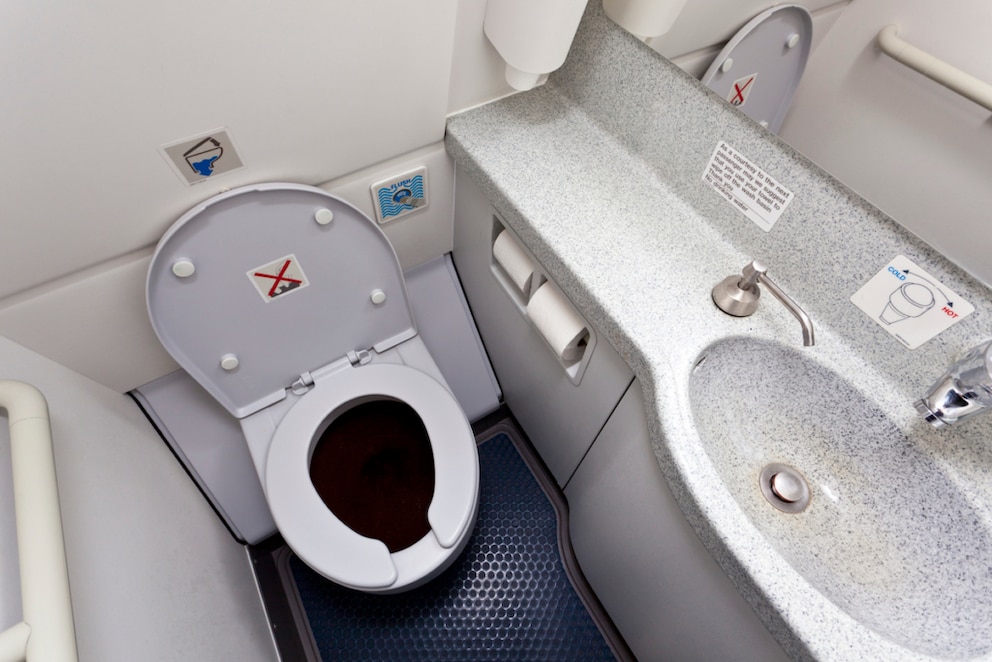
Out of sight, out of mind—at least for the toilet users. But of course, the waste doesn’t disappear after flushing. It goes from the onboard toilet into a holding tank in the aircraft’s fuselage. Once the plane lands, a special vehicle empties the waste tank. To prevent waste from sticking to the bowls, chemical additives are used, though their environmental compatibility is controversial. For onboard hygiene, these additives are essential, according to Großbongardt, to prevent the spread of dangerous diseases. “At least in Europe, North America, and many other countries, there are strict regulations for proper, environmentally friendly disposal,” he adds.
Also interesting: Why You Shouldn’t Sit in the Aisle on a Plane
How Frozen Urine Chunks Reach the Environment
We are not entirely safe from waste falling from the sky despite the described toilet system. Besides the incident in England, there have been other cases where entire chunks of urine fell to the ground. For example, in 2012, a two-kilogram ice chunk of urine landed in a family’s garden in Nuremberg. In the same year, a hand-sized ice block shattered the tiles of a house roof in Fellbach (Baden-Württemberg). In 2015 in India, a woman was even critically injured by a falling urine ice block, as reported by the British news portal “BBC“.
Where do these frozen urine chunks come from? “This happens when the valve used on the ground to empty the waste tanks is slightly leaky,” explains aviation expert Großbongardt. “Toilet fluid that leaks out freezes immediately due to the icy temperatures at cruising altitude. Over the many hours of a long-haul flight, an ice chunk forms under the tail, which sometimes falls off when the plane descends into warmer air layers.” However, this is very rare. The dump valves are regularly checked for leaks for safety reasons.