

November 17, 2022, 12:35 pm | Read time: 7 minutes
About 15 years ago, Hape Kerkeling made the Camino de Santiago popular in Germany. Since then, more and more Germans have been making the pilgrimage to Santiago de Compostela. They, along with pilgrims from other countries, have now set a record.
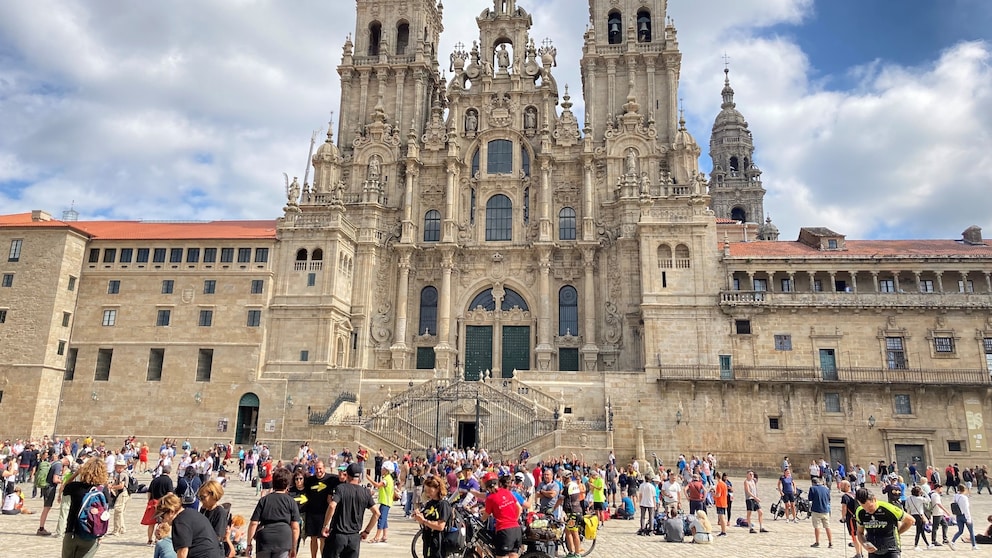
With a rush, five young pilgrims on bikes rattle down the steps to the Obradoiro Square in front of the Cathedral of Santiago de Compostela–giving a huge fright to two leisurely strolling clergymen. Just a few meters away, two dozen Mexicans celebrate their arrival with dances and songs. “Llegamos, llegamos!”–”We’re here, we’re here!” they shout.
This year, the destination of the Camino de Santiago is experiencing a boom–even now in the fall. More than 430,000 pilgrims have already received the arrival certificate in 2022, according to the Pilgrim Office Oficina del Peregrino. That’s about 20 percent more than in the previous record year of 2019. Many don’t even pick up the certificate–and aren’t counted.
Also interesting: Away from the party scene–Ibiza’s quiet corners
Popular through “I’m Off Then”
In the pilgrimage site in northwestern Spain, which became popular in Germany through Hape Kerkeling’s book “I’m Off Then,” the cash registers are ringing louder than ever. The operators of now very expensive hotels, private accommodations, souvenir shops, and restaurants are rubbing their hands. But not everyone is happy. Unlike in Lourdes or Fátima, religiosity and devotion are no longer the focus of visitor flows here. Littering, noise, and vandalism are on the rise. Many residents of the UNESCO-protected old town are angry or desperate, as you often hear when you even slightly broach the subject in the center of Santiago.
“It’s a trend that started a few years ago, but this year it was particularly bad; in the summer, it was sometimes simply unbearable,” resident Beatriz tells the German Press Agency. She had great difficulty concentrating while working from home due to the noise outside. “When you come into the city with 40 pilgrims at seven in the morning, you have to understand that people live, work, study, and sleep there. You can’t just shout loudly. It’s about respect,” she says.
In the center of Galicia’s capital, it’s already very loud during the day. In the evening, it’s even more so, especially on Rua de Franco. The bars and restaurants on the 400-meter-long party mile near the cathedral are still full at midnight on this autumn evening. Very long lines form in front of the establishments. “Another bottle, folks?” an Italian at a long table calls out, and the group responds in chorus: “Siiii, un’altra bottigliaaaa!”
Also interesting: The 16 most important tips for the Camino de Santiago
Like at Ballermann?
Locals are often recognized by their wrinkled noses, rolling eyes, or quickened pace. Hendrik, however, is different. “It’s almost as awesome here as at Ballermann!” shouts the 21-year-old from Hamburg. “Only the beach and the sea are missing.” He has to repeat this almost shouting three times from up close, it’s so loud. The lanky young man initially accompanied his parents reluctantly on the roughly 500 kilometers between Miranda de Ebro and Santiago–but now he’s “totally surprised and happy.”
Santiago de Compostela is not only a gem of religious architecture and a popular pilgrimage site because the cathedral is said to be built over the tomb of Saint James. It is also an old university town that has always hosted young people from home and abroad. But even the majority of students, some of whom are known not to mind partying, complain when asked about the behavior of many pilgrims–like Beatriz’s daughter Clara.
“I wasn’t here in the summer, but friends sent me videos of the huge and loud pilgrim crowds. It was frightening; we’ve never had anything like that here before.” “There’s more and more trash on the streets, more and more shoplifting,” is her assessment. Clara, like so many here, demands “more respect.” Some even speak of “war”: Pilgrims often come with megaphones, drums, or trumpets–and from balconies, they are doused with buckets of water.
More Crime
Meanwhile, the police say that crime has increased by about 30 percent in the entire region of Galicia and also in Santiago compared to the same period last year. Whether this is related to the rising number of pilgrims, they neither want to nor can say.
In various media and on social networks, the criticism is drastic. The renowned daily newspaper “El Mundo” reported in a feature about hordes of visitors who “shout obscene things” and “urinate everywhere.” Mass tourism “like in Venice or Mallorca” is bringing the small community of 96,000 residents and limited infrastructure “to the brink of collapse.” Indeed: Buses are often overcrowded, traditional commerce is being displaced by souvenir shops, trendy bars, and chains. Due to the Airbnb boom, there is a dramatic housing shortage. “We are being driven out of our city,” an outraged “Compostelano” told the digital newspaper “Galiciapress.”
Also interesting: Caravaca de la Cruz–Spain’s pilgrimage site that hardly anyone knows

‘This is how my hike on Spain’s unknown parts of the Camino de Santiago went’

The World’s Best Hiking Trails According to “Time Out”
No Exaggeration
On social networks, visitors are compared to “plundering Huns” and “British soccer hooligans.” No exaggeration, insists Monse Vilar, president of the citizens’ association “A Xuntanza.” On Facebook, she posts videos showing how huge groups of arriving pilgrims storm the roadway and bring car traffic to a standstill. Vilar: “These are uncivilized and irresponsible behaviors that go far beyond noise. This is not an amusement park, but a living space.”
Regional media warn that the Camino de Santiago could “fall victim to its own success.” Back in the 1970s, hardly anyone set out to walk the “Camino.” At that time, there were only a few dozen per year. Even during the visits of the popular Pope John Paul II, this number only climbed to around 2,000 (1982) and 5,000 (1989) for the entire year. The boom came with the spiritual books of Brazilian bestselling author Paulo Coelho. In 1993, the 100,000 visitor mark was broken for the first time, and in 1999, the 150,000 mark. After the Kerkeling book, Germans became one of the largest groups behind the Spaniards. According to official figures, there have been nearly 25,000 so far in 2022.
Those affected rely on the insight of the pilgrims and posted notes with “rules of conduct for the end of the Camino de Santiago” on poles and walls in the summer. However, most visitors ignore the notices. So they next complained to the authorities. In vain: At the meeting with Mayor Xosé Sánchez Bugallo, “he asked us to please make a small effort,” Vilar recounted. Several regional media also reported this statement from the mayor at the meeting with neighborhood representatives.
Overnight Tax as a Solution?
The city is considering introducing an overnight tax to further benefit from the visitor boom. Santiago’s Archbishop Julián Barrio advocated for more understanding for the pilgrims and their joy upon arrival: “Do we want to ask the seawater not to be salty?”
Even though tourism in Santiago, like elsewhere, is no longer limited to the summer months, the “Compostelanos” can slowly and probably until mid-March hope for quieter times. “But we are all already trembling, especially for next summer. It will be hell,” says architect Juan Carlos. “My parents are retirees and have money, so they can fortunately leave. They want to go to Ibiza for relaxation. It’s said to be even quieter there in the summer now than here.”