

May 17, 2023, 11:10 am | Read time: 5 minutes
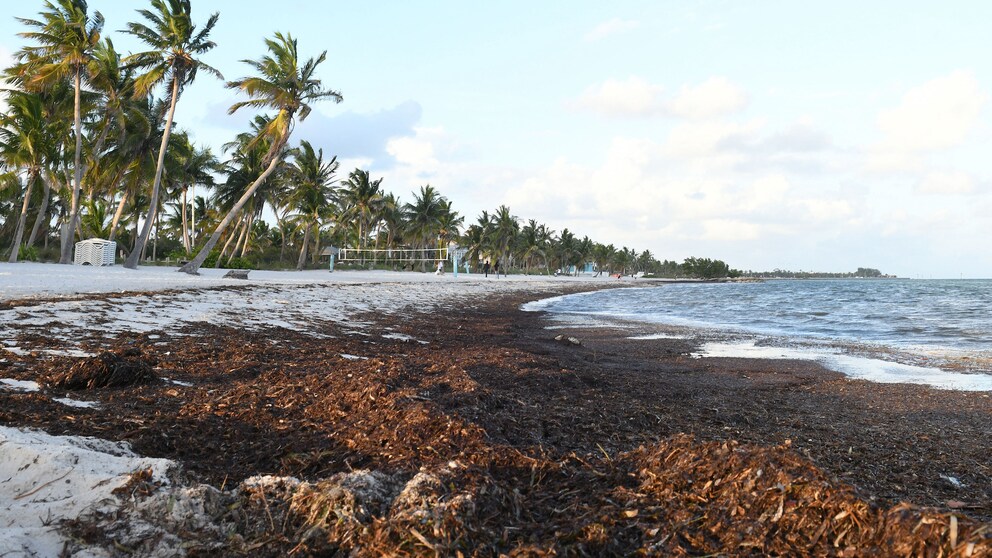
The increasing algae infestation is becoming a serious threat to the environment and tourism not only in Mexico. Experts say this year is expected to be particularly bad. In Florida, too, the stinking algae mass could have catastrophic effects on this year’s vacation season. Some popular vacation beaches in the U.S. state are already covered with algae.
Tons of algae have repeatedly buried the fine, golden sandy beaches of Mexico’s Yucatán Peninsula for years. As they rot, they emit a foul smell, specifically of sulfur and sewage, and release health-threatening hydrogen sulfide. Only the particularly hardy make their way through the stinking piles of algae and venture into the brownish-tinted water. The specific type of brown algae, called Sargassum or Gulfweed, is becoming increasingly difficult to control.
In 2022, according to “Euronews,” even Mexico’s navy had to intervene in the fight against it. While the algae infestation was already worse than ever last year, this year is expected to be much more dramatic–and not just in Mexico, but also in Florida, where the algae are already covering beaches such as those in Key West. According to the “New York Times,” this year’s Sargassum bloom is expected to be the largest ever. Why this is a serious threat: TRAVELBOOK provides an overview.
Algae Infestation in the Gulf of Mexico Has Long Been a Problem
Sargassum grows in warm, tropical waters. The Gulfweed provides an important habitat for fish, small crabs, eels, and turtles. “As a diverse habitat, they are of great importance. That’s why we sometimes refer to the Gulfweed as golden forests,” explains Chuamin Hu, a professor of optical oceanography at the University of South Florida in Tampa, to “National Geographic.” For birds, these “golden forests” are a true buffet.
However, given the past algae infestations in Mexico and Florida and the looming scale, it’s hard to focus on the good sides of Sargassum. Since 2011, the brown algae have been washing up on the Caribbean coast in unusually large masses, threatening tourism and health.
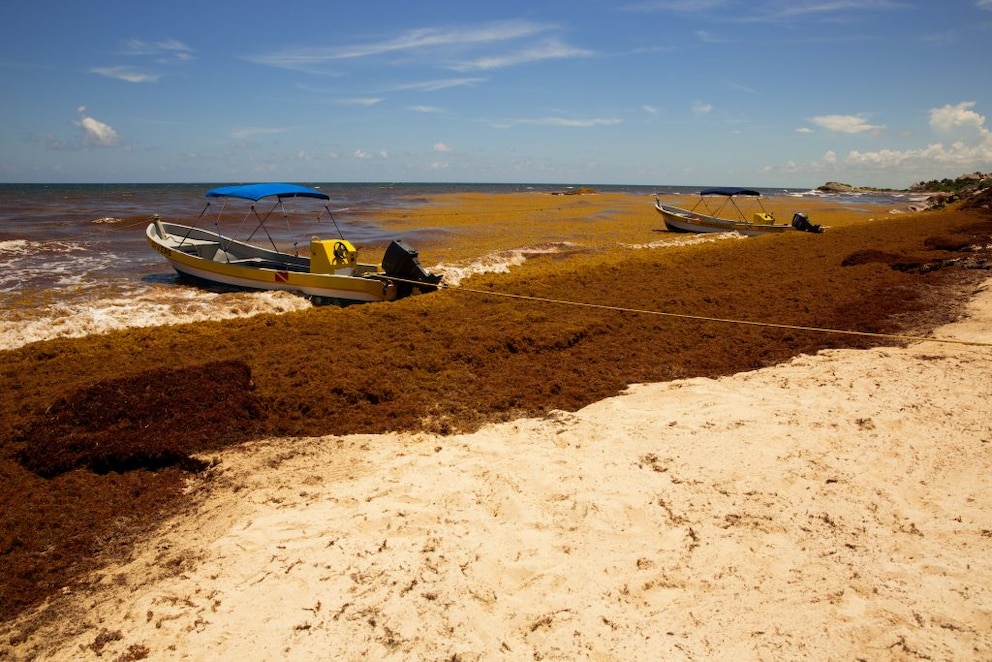
Instagram posts from this spring also show the dramatic extent. Tulum was already struggling with the brown algae at the beginning of the year–even though the main blooming season has so far extended from April to August. The U.S. city of Dania Beach, located between Fort Lauderdale and Hollywood, is known for its beautiful beaches, including Dania Beach Ocean Park, considered one of the best beaches in all of Florida. But here, too, the algae are becoming a plague.

Also interesting: How dangerous is a vacation in Mexico right now?
“Red Tide” Threatens the Coast of Florida! Danger for Beach Visitors
11 of the Most Beautiful Beaches on Bali
The Algae Are a Serious Threat
For several years, the largest brown algae field on Earth, the so-called Great Atlantic Sargassum Belt, has been floating in the Atlantic Ocean. According to “National Geographic,” scientists were able to identify a “Sargassum belt” in 2018 using data from NASA satellites, stretching from West Africa to the Gulf of Mexico over a length of 8,850 kilometers and consisting of more than 20 million tons of Gulfweed biomass. 8,850 kilometers: That’s roughly the distance from Berlin to Windhoek, Namibia.
Washed ashore–especially during the Sargassum bloom from April to August–these rot. This not only results in a disgusting egg smell, but the toxic sulfur gas produced by the decomposition process is extremely concerning for health. The fumes can “irritate eyes and airways at low concentrations. At high concentrations, H₂S can lead to collapse, unconsciousness, respiratory paralysis, and heart failure within seconds to minutes,” writes the Swiss news portal “Blick.” The microorganisms living in the algae can also cause skin rashes, and researchers warn against consuming the algae. Large amounts of heavy metals such as arsenic or cadmium could be present in the brown algae.
Additionally, the algae bury life beneath them and prevent turtles from coming ashore or returning to the sea after laying eggs. Often, the algae mats block sunlight from coral reefs, and the chemical compounds produced during decomposition are harmful to marine life.
Also interesting: Toxic blue-green algae in several German swimming lakes
Algae Infestation Is the “New Normal”
The problem seems unsolvable for now: “We are not dealing with episodes here, but with a new normal,” Hu explained to “National Geographic” back in 2021.
As Sargassum increasingly floods the beaches in Florida, Mexico remains the most affected by the algae infestation. In many tourist regions around Akumal on the Riviera Maya, Playa del Carmen, Tulum, and Cancún, the Caribbean dream beaches are often just a postcard motif. The Mexican government has already invested a lot of money in removal, but it is a Sisyphean task: You are never finished, as the photos published by Sargassum Monitoring on Instagram show:
The scientific community is discussing the causes of the strong growth and the consequences for the environment. According to “Euronews,” researchers attribute several factors, including climate change, human sewage, agricultural runoff, or fertilizer from the Amazon region entering the sea.