

July 27, 2026, 1:40 pm | Read time: 6 minutes
Sparkling diversity in Romanian Timișoara, music and wine in Hungarian Veszprém, and mysteries from the legendary Greek Eleusis—that’s what the European Capital of Culture year 2023 brings.
The European Capital of Culture year 2023 draws audiences to Romania, Hungary, and Greece. Three largely undiscovered gems aim to showcase their brilliance: the western Romanian city of Timișoara, the starting point of the 1989 revolution that toppled dictator Nicolae Ceaușescu; the charming Veszprém near Hungary’s Lake Balaton; and the Greek city of Eleusis, famous in antiquity for its mysteries. What the three 2023 Capitals of Culture have to offer—TRAVELBOOK provides an overview.
The Capitals of Culture 2023
Timișoara, Romania
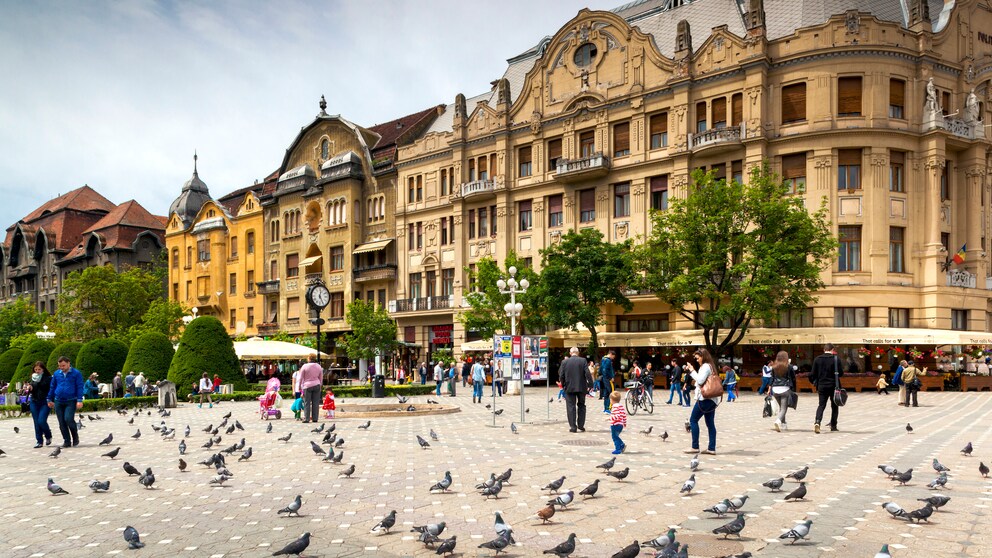
In Timișoara, an industrial hub with 300,000 residents at the tri-border area of Romania, Hungary, and Serbia, planners aim to highlight the city’s traditional diversity. Alongside Romanians, the city with Austro-Hungarian flair is home to ethnic Germans, Hungarians, Serbs, Roma, Czechs, Slovaks, and Bulgarians.
Before World War II, nearly every child in Timișoara spoke at least three languages, including Yiddish. This language nearly vanished here due to the Holocaust. Timișoara was the birthplace of stars: “Tarzan” Johnny Weissmuller (1904-1984) was born here, and two Nobel laureates graduated from high school here: writer Herta Müller and chemist and biophysicist Stefan Hell.
More than 50 Events for the Opening
For the opening alone, from February 17 to 19, more than 50 events are planned in Timișoara—including the opening of a “vertical” garden at the central Opera Square. There will also be a wide variety of music genres, featuring Ukrainian hip-hop artist Alyona Alyona and traditional Roma music.
Afterward, there will be an average of 30 events per week. Highlights include major exhibitions featuring works by Romanian sculptor Constantin Brâncuși (1876-1957) and Romanian-born surrealist Victor Brauner (1903-1966).
A German Mayor
A colorful figure and ambitious cultural promoter in Timișoara is Dominic Fritz, who has served as mayor since 2020. Born in the Black Forest, he is a political scientist, formerly active with the Alliance 90/The Greens, and a former speechwriter for former German President Horst Köhler.
The 38-year-old says he simply “fell in love with this city” during his work as a volunteer in a Timișoara children’s home in 2003. “Timișoara is much more European than the village I grew up in because it handles diversity, multilingualism, and the coexistence of ideas much better,” Fritz enthuses in an interview with journalists.
Fritz is passionate about the “Paths of the Revolution” project, which aims to commemorate the 1989 uprising, although it won’t be completed in 2023—like many other plans. The delays are due to domestic politics: Fritz belongs to the eco-liberal opposition party USR, while conservatives and social democrats govern in the capital, Bucharest. This has led to obstacles, such as funding blockades, Fritz laments. Nevertheless, he hopes the Capital of Culture year will bring “new momentum” that can be carried forward.
Exploring the 2023 European Capital of Culture: Veszprém and the Balaton Region

Surprise! This Is Europe’s Largest Christmas Market
Veszprém, Hungary
Gyula Porga, mayor of the western Hungarian city of Veszprém, also hopes for a boost in tourism. The opening of the Capital of Culture year is set for January 21, with a grand spectacle under the name “Veszprém-Balaton 2023”. Balaton is the Hungarian name for Lake Balaton, located just a few kilometers from Veszprém.
“Being a Capital of Culture means finding cultural answers to the challenges of the times,” Porga said in an interview with journalists. He cited issues such as the emigration of young people and the fluctuating economic output of the tourist magnet Lake Balaton, which is limited to a few summer months. However, with culture, the city can remain attractive year-round.
Castle Shines in New Splendor
The city, with its 60,000 residents, is attractive due to its location alone. It rises on five hills, with the small Sed River winding between them. The city center from the 18th and 19th centuries exudes coziness. The renovation of the imposing castle on a hill is expected to be completed at least on the exterior by early 2023.
Veszprém has already gained regional recognition with music festivals ranging from classical to jazz and choral music to street music. Music will also set the tone during the Capital of Culture year, along with gastronomy and wine: some top wines are produced on the hilly northern shore of Lake Balaton.
Eleusis, Greece
“Mysteries of Transition” is the motto of the Athens suburb Eleusis (also Elefsina). Cultural director Michail Marmarinos promises a “never-before-seen variant of the European Capital of Culture institution.” The opening ceremony is scheduled for February 4.
Eleusis, with its current population of around 30,000, has always been connected to the Greek capital, located about 20 kilometers to the east–and has always been in its shadow. Now, there is a push to break free from this peripheral status and become independent.
Brahms Production as a Highlight
The highlight of the celebrations is considered to be the scenic production of Johannes Brahms’ “German Requiem” as “Human Requiem” by director Jochen Sandig and the Berlin Radio Choir. It is set to be performed at the ancient site in late September 2023. Austrian director David Haneke is expected to create a film based on recordings of the concert.
The production reflects what Eleusis stood for in antiquity and what the “Mysteries of Transition” motto of the 2023 Capital of Culture is all about, said the organization’s cultural director, Michail Marmarinos, to dpa. In antiquity, the “Mysteries of Eleusis” took place there, a kind of secret cult celebrating the annual rebirth of nature. The rites attracted thousands of Athenians who made pilgrimages to the city. Now, there is hope for another influx of visitors.
Eleusis experienced its last heyday in the 19th and early 20th centuries. As the region’s granary and due to its port, it was one of Greece’s most important industrial centers. Shipbuilding, cement factories, manufacturing, and the food industry were booming.
But then came the decline: Piraeus and Athens absorbed almost all economic sectors. The port of Eleusis became a graveyard for ships. Dozens of wrecks are still present today. The city aims to overcome all this as the European Capital of Culture. Will it succeed?
The German original of this article was published in December 2022.
With material from dpa