

June 5, 2022, 7:30 am | Read time: 5 minutes
Since Wednesday, you can travel nationwide in Germany for just 9 euros on regional transport. This not only relieves commuters but also benefits vacationers–provided they are somewhat resilient. Comfort is often not a priority in public transport. TRAVELBOOK took the test and traveled on the regional express that runs the longest stretch without a transfer, from Berlin to the Baltic Sea. A report on the experience.
The sea breeze blows my hair into my face, the ropes of the sailboats clatter, the sun sparkles on the water, and I inevitably feel like I’m on vacation. It’s Thursday, just before 1 p.m., and I’m exploring Rostock, a city I’ve never visited before. But today, I was finally able to have this experience for less than 10 euros–thanks to the long-awaited 9-euro ticket.
I admit, I am among the many people in Germany who have used the ticket not for its intended purpose of relieving commuters. It has been repeatedly criticized that many of the millions of ticket buyers do not commute but simply want to travel cheaply. The criticism is justified or at least understandable. There is concern that popular routes will soon be completely overcrowded. To get a sense of the situation myself, I embarked on a journey to northern Germany, from Berlin to the beach and then on to one of Germany’s most popular city destinations, Hamburg.
Also interesting: Top offers for a short vacation in Germany
My Experience Traveling with the 9-Euro Ticket on Germany’s Longest Regional Train
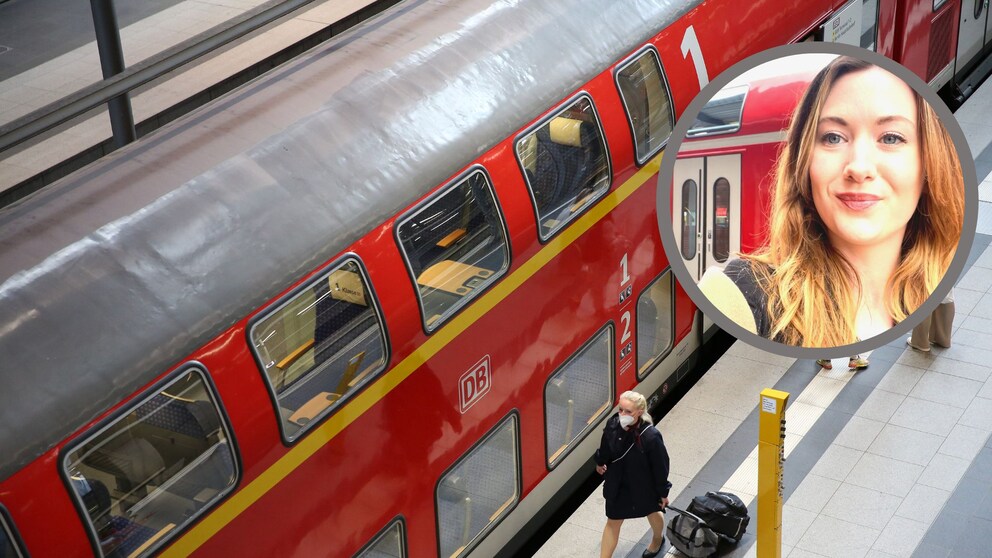
My journey begins directly on a record-breaking train. I board the RE5 bound for Rostock. The train starts in Elsterwerda in Brandenburg, and with a length of 390 kilometers to its destination, it is the regional train that covers the longest distance without a transfer. It is supposed to take me, along with numerous retirees and several school classes, past the Müritz to the sea. The train is crowded, especially in Berlin, where some people have to stand in the aisle. But after about an hour and a half, it clears out. On this Thursday just before Pentecost, it seems the rush is still manageable. My seatmate Maik agrees.
Also interesting: 5 tips on how to avoid overcrowded regional trains
Maik is on vacation and is also using the 9-euro ticket to explore Rostock. Where he will go next, he doesn’t know yet, “you can be spontaneous.” We started talking because the distractions on the regional train are significantly less than on an ICE–cell phone reception is scarce. Our conversation is eventually interrupted, to our surprise, by a conductor. After the railway had already announced that it would deploy fewer conductors during the ticket’s validity period, I hardly expected it. The ticket check, however, is very routine, and even subscription cards from regional transport companies are checked as a matter of course.
After more than four hours of travel from its starting point, the regional train finally arrives in Rostock on time. It’s half past 11, and I have the whole day to explore the city. Motivated, I set off, only to remember shortly after that I could also ride the tram for free! Since my time is limited, I switch and am soon in the middle of the city. In the afternoon, I want to take the S-Bahn to the Warnemünde district–but that initially proves difficult.
Also interesting: The best travel tips for Rostock

What Frustrates Me Most About the Train Delay Madness

New “Dresdner Bahn” Halves Travel Time to BER Airport
Broken Signals and Low Battery
Because the connection is disrupted, sometimes it’s said a signal is broken, sometimes the control center is to blame. Several S-Bahn trains are canceled until I can finally board one. This remains the only delay on this trip, but as a frequent traveler, I know that cancellations and delays are more the rule than the exception with the railway. All those who are now tempted by the low price of the ticket to take the train instead of the car will have to experience this painful reality.
After a full day in Rostock, I continue to Hamburg in the evening. I board at the starting station and travel straight through to Hamburg, spending more than two hours again on the regional train. Here, I painfully notice that, unlike ICEs and ICs, there are, of course, no power outlets. So part of the journey becomes unexpectedly meditative for me, as I look outside, enjoy the view of sunny fields and lakes, and am glad I had no additional expenses for this trip.
My Conclusion: Is the 9-Euro Ticket Good for Vacation Travel?
Based on my experience of traveling with the 9-euro ticket on this one, non-representative day, I have the following conclusion. If you don’t need luxury on train journeys and can travel outside peak times, the 9-euro ticket is excellent for day trips. However, I don’t see a permanent shift in transportation. There are two reasons for this: the lack of reliability and the expected high occupancy of the trains.
A longer journey is particularly challenging due to the unavoidable various transfers–if just one train is delayed, you might miss all subsequent connections. And: If you want to travel on the weekend, you must prepare for crowds. I, for one, was glad to have traveled on Thursday and not today, Friday, before the long Pentecost weekend. Because if the ICEs are already fully booked (which is the case on many routes today), I don’t want to imagine what it’s like in the almost free regional trains…