

June 22, 2026, 11:14 am | Read time: 8 minutes
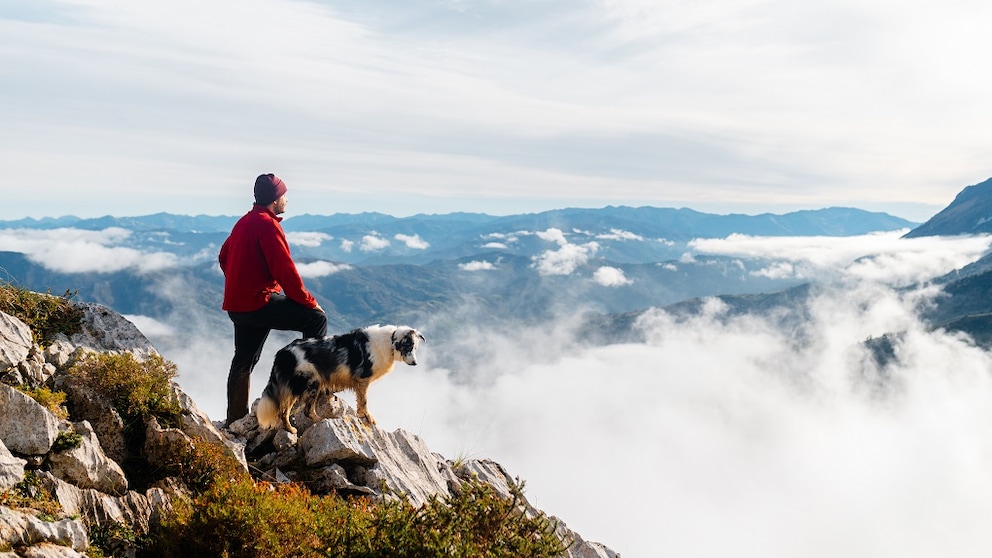
TRAVELBOOK author Robin Hartmann has spent years enjoying his free time in nature on long, challenging hikes. His latest expedition was a particularly special adventure, as it was the first time his new best friend, a Border Collie mix named Misiek, joined him. Here, he reveals how hiking with a dog can change such an adventure, but also wonderfully enrich it.
I’ll be honest: When my girlfriend showed me pictures of an admittedly charming dog, which she had already adopted in her heart, in December 2025, I was initially quite skeptical. We live in a spacious but not overly large apartment. As a village kid, I had always believed that a dog absolutely needed a garden. I often feel trapped within four walls myself. I seek out stays in the great outdoors, sometimes lasting several weeks, as a balance. How would a four-legged friend feel? But then my beloved, a skilled diplomat in her own right, planted a dream in my heart. I could simply take the dog along on my hiking adventures in the future.
Immediately, my imagination took off: I envisioned myself roaming the wilderness with my new best friend like Paul Bunyan. Or, in my case, perhaps more like Rübezahl. I dreamed of us embarking on adventures together. Maybe even, a long-held wish, one day hiking across all of Germany together. I think it’s needless to say that adopting Misiek, the name of our dog, became more of a formality after that. We drove to the Polish border to meet the previous owners, took a first walk with the “little bear” (Polish = Misiek, pronounced Mischek), and were hopelessly in love. Just a week later, he moved in with us. And I wasted no time starting the “training.”
Learning Limits
Now, I’m someone for whom the weather might have a different meaning than for others. My need for nature is so great, sometimes overwhelmingly so, that I just always go out unless the world is truly ending. And so, by February 2026, we were already taking our first 10-mile hikes. Our testing ground was my hometown of Berlin-Spandau, where, fortunately, despite being close to the city center, there’s still quite a bit of nature. Of course, we had gradually increased our distances by then. Misiek had previously belonged to an old man and initially trotted so leisurely behind me on regular walks that I kept turning around to see if he was still there. But inside, I was sure he still had some wolf blood, to borrow a phrase from Jack London.
My first recommendation to you, dear hiking enthusiast with a dog: Take enough time before your first big tour to get to know your pet, its willingness to perform, and especially its capabilities. A dog will generally do anything to “please” its owner. And that’s where the wolf blood comes into play again. Showing weakness means falling behind in the pack. Therefore, your dog might not show that it’s already beyond its limit. Where humans might complain or simply stop, your loyal four-legged friend might just keep trotting alongside you. Especially a multi-day hike should be planned in sensible sections that are challenging but not overwhelming for both you and your pet.
Breaks and Food as Motivation
Additionally, you must now always consider that you are no longer traveling alone. A dog inevitably has shorter legs than you, which means that walking in open terrain will generally require more effort. Therefore, longer, even multi-hour breaks for regeneration should be planned throughout the day. I wasn’t aware of this myself beforehand, but a fully grown dog typically sleeps up to 18 hours a day or even longer. So, you should definitely give him the opportunity to take “power naps” along the way. It may initially be hard to reconcile with your ego (at least it was for me), but plan shorter daily distances from the start so that everyone is happy in the end.
Fortunately, this worked very well for Misiek and me on our first joint tour. The weather was so terrible that I repeatedly sought refuge in inns for longer breaks. So we sat out the rain and even a snowstorm (mind you, in mid-May 2026) dry and cozy, and then continued on warmed and strengthened. Use such small or longer breaks to offer your dog a little food and water. Distribute smaller portions cleverly as “motivation” throughout the day, and at the end of the stage, there’s a big feast for your furry friend.
Don’t Pack Too Much
The keyword “food” brings us to the next topic, namely your packing list. In my opinion, a hiking backpack, especially for a multi-day tour, should not weigh more than 26 pounds, and that’s already hard to maintain under normal circumstances. Just a tent, sleeping bag, and sleeping pad, along with the weight of a good backpack, often weigh 11 pounds (or more). Then there’s cooking equipment, actual provisions, clothing, and small items. Now you also have to consider food for your dog.
Additionally, you should have a blanket and a towel for cleaning your pet. He will also appreciate being as comfortable as possible after a long tour and might get quite dirty. For you, this can be an opportunity, as in my experience, especially at the beginning of outdoor adventures, there’s a tendency to pack way too much. A simple rule of thumb: What is still there or clean at the end of your tour doesn’t need to be packed next time. For me personally, it’s a very liberating feeling to discover how much I can actually do without when it comes down to it. Your dog, on the other hand, should not have to do without anything, so you should carefully consider all his potential needs in advance. You are not only a friend to the animal but also a guardian.

6 expert tips for a safe vacation with your dog

My Adventurous Moped Tour Through Vietnam
Recognize Signs, Replan if Necessary
In this respect, you must also be ready to recognize signs and take action if necessary. For me, this ultimately meant a complete overhaul of the originally planned tour with Misiek. I had intended to spend five nights outdoors with him. But while I usually find very restful sleep in nature, Misiek couldn’t enjoy the “adventure” at all. For hours, he sat in front of the shelter where I had settled, often barking into the darkness at night. His sense of smell made him perceive supposed dangers, and sleep was out of the question for him. At around 6 a.m., he lay there whining and whimpering, and I knew: I wouldn’t subject him to another night like that.
In this sense, it was excellent that we had traveled on our tour in our own car. It then served as a shelter from bad weather and as an unusual sleeping place. A car also has the advantage that you can plan or easily replan tours differently. Instead of long distances, Misiek and I simply did circular hikes that each led back to the car. And we did several of these in a row, which more than once added up to 10 miles. I reluctantly admitted it, but in the end, I almost preferred this new way of hiking to those 15-mile-per-day “punitive expeditions” I had sometimes undertaken in the past.
The Shared Pace
A topic for you and your dog might be finding a mutually agreeable pace on the trail. Your four-legged friend perceives his world primarily through his sense of smell. This means he will likely stop frequently to sniff around. Allow him these breaks and use them yourself to catch your breath or take in the scenery more consciously. For the joint tour, I recommend putting a longer leash on the dog. This way, he can move relatively freely from you. Sometimes, Misiek was drawn off the main path by the scent of wildlife, and in such cases, it’s good to be able to pull the dog back. Otherwise, he’s gone before you know it. And shouting for him in the absolute wilderness of the forest and praying that he reappears is not a pleasant feeling.
Perhaps you recently read my article on TRAVELBOOK about why I prefer to go on long hikes alone. I wrote it before my first tour with Misiek, and I would take him on such an adventure again anytime. Even before, as a full-time home office worker, I was always there for him, but this hike brought us even closer together. Simply seeing him happily trotting and sniffing through the landscape made me happy. The trust between us grew even more during those days. And even without me always holding his leash tightly, he stayed close to me. I sincerely hope that hikes with your dog will be just as wonderful for you.