

March 14, 2023, 12:54 pm | Read time: 14 minutes
It is Jordan’s most famous landmark: Petra, the legendary rock city, a UNESCO World Heritage site, and the setting for films such as “Indiana Jones and the Last Crusade” and “Transformers: Revenge of the Fallen.” Yet, this world-renowned tourist attraction still holds secrets in the desert sands. What travelers can and should expect.
The first impression is simply overwhelming. Visitors first walk through a narrow, winding gorge over a kilometer long, the “Siq,” Arabic for “shaft.” Nearly 100-meter-high rock walls rise on both sides. At its narrowest point, the gorge is only two meters wide. And then, suddenly, you stand before it: the massive facade of the “Treasury,” Khazne al-Firaun. It is, like Petra itself, world-famous and the largest tourist attraction in Jordan. Yet, the UNESCO World Heritage site holds many mysteries.
TRAVELBOOK reveals some lesser-known facts, highlights unsolved mysteries, and offers tips for a visit.
11 Facts About Petra in Jordan
1. Petra Was the “Wall Street” of Ancient Arabia
The Nabataeans, an Arab people from pre-Islamic times, carved the capital of their empire from the red sandstone cliffs over 2,000 years ago. The deceased were buried in the elaborately decorated caves. Petra was a necropolis, a city of the dead, whose tombs are preserved to this day–but also a thriving trade metropolis.
“The ‘Wall Street’ of Ancient Arabia”: Petra also has this nickname. For nearly three centuries, until about 100 A.D., the Nabataeans ruled the city, strategically located at the crossroads of important trade routes, including the legendary “Incense Route.” Through a sophisticated water management system with channels that brought water from surrounding springs to Petra, the rock city became an oasis in the desert. It gained its wealth through the trade of precious spices, incense, and other goods, which were also taxed.
Since the Nabataeans left almost no written records that provide insights into their daily life or Petra’s history, it can only be pieced together indirectly from biblical, Greek, and Roman sources–and much will always remain in the dark.
Also interesting: Vacation in Jordan? What You Should Know Before a Trip
2. Petra Was Discovered by a Pseudo-Sheikh
As a tourist attraction, Petra is surprisingly young. It wasn’t until the 1920s that archaeological excavations began, followed by its development as a tourist site. The background: Petra was considered lost for 1,200 years. It was rediscovered for Europe in 1812 by a Swiss man who disguised himself as an Arab and claimed to be a sheikh.
The Basel native Jean Louis Burckhardt accidentally discovered Petra while searching for the “Land of Gold beyond Timbuktu,” according to an article by “ABC News.” His guide at the time found him suspicious, “like a magician on a treasure hunt.” Apparently, he did not convincingly portray “Sheikh Ibrahim,” as he called himself, despite having learned Arabic, converted to Islam, and wearing a turban.
3. Jordan’s Most Famous Highlight Is Actually Outside the City of Petra
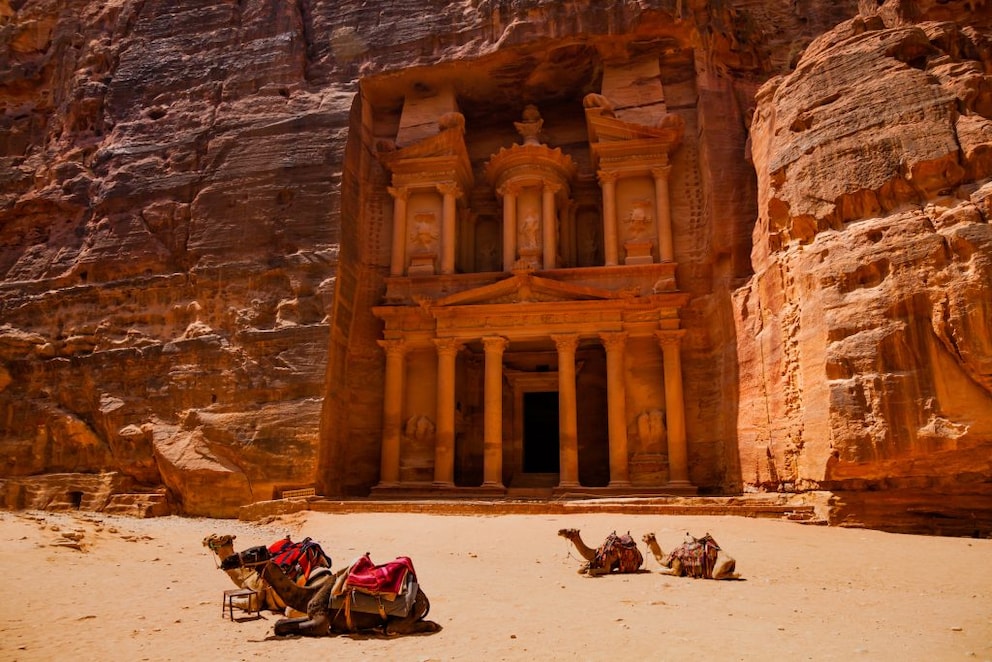
The towering, column-adorned wonder rises about 40 meters: the “Treasury” Khazne al-Firaun, also known as “Al-Khazneh.” Almost everyone has seen the world-famous building, which also impresses in the film “Indiana Jones and the Last Crusade,” in pictures. Visitors to Petra don’t have to wait long for this highlight. As mentioned, it is located right at the end of the Siq, which leads to Petra. And technically, Khazne al-Firaun isn’t even really in Petra. It is actually a mausoleum–and the dead were always buried outside the actual city.
Specifically, Al-Khazneh likely once housed the royal family members of the Nabataeans. Excavations have uncovered a burial chamber with human skeletons and pottery. It was the Bedouins who later settled in Petra that gave the burial site the nickname “Treasury.” This also explains the next fact…
4. The Pockmarked Facade of the “Treasury” in Petra
The magnificent facade of the famous “Treasury” still shows several bullet holes today. This is likely due to a rumor that gave the building its glamorous name. Allegedly, pure gold was hidden behind the rock–a tempting notion. The supposedly fabulous treasures also attracted fortune seekers who likely tried to gain access with firearms. The bullet holes remain as evidence of this raid.
5. The Best Photo Spots Are Actually Forbidden
Despite its holes, Khazne al-Firaun is undeniably the highlight for many travelers to Petra, and many want a souvenir photo with the world-famous building. But this is often not so easy–firstly, because the 40-meter-high gate is hard to capture in a photo when standing directly in front of it, and secondly, because hundreds of tourists are usually present at the same time. Nevertheless, Instagram features various photos showing influencers and tourists on an elevated platform with a breathtaking view of Petra. How do travelers get these photos?
The answer becomes clear when standing in front of the “Treasury.” Besides the various tourists, there are also dozens of Bedouins offering not only camel rides but also selling the way to the best photo spot. You can’t get there alone; you need a local to show the way–for a fee, of course. Typically, it’s about five Jordanian dinars per person (equivalent to 6.56 euros, as of March 14, 2023). Once the fee is paid, photo enthusiasts are led away from the main square in front of Khazne al-Firaun to a restricted area that can be crossed at one point. Then, you climb a path about 20 meters high. The climb takes about five minutes. At the top, you’ll find laid-out carpets and a truly breathtaking view of the world-famous “Treasury.”
However, it’s important to know that these photo spots are actually illegal, as TRAVELBOOK learned on-site. There’s a risk that tourists could injure themselves while climbing up or down. Although there have been no such reports so far, caution is still advised.

6. The Mystery of the Name of the City of the Dead
“Petra” comes from Greek and means “rock” or “stone”–as stated in travel guides. However, it is still not definitively clear what the Nabataeans actually called the capital of their empire. According to the writings of Flavius Josephus, its name was “Reqem” or “Rekem,” meaning “the Red” or “the Colorful” in German, perhaps a reference to the color of the sandstone. In Aramaic sources, the name refers to the place Kadesh, and there are speculations that Flavius Josephus may have confused two places here. A stone inscription with the name “Rekem,” which was said to be located opposite the gorge, was covered with tons of cement during the construction of a modern bridge and can no longer be examined.
The Old Testament mentions a place called “Sela” (meaning “rock” or “stone”), which could be identical to the Nabataean metropolis. However, this is disputed. Even in other often-cited sources where the Greek word “Petra” appears, the reference is not always clear.
Also interesting: 6 Israeli Specialties You Must Try
7. Did Moses’ Miracle Spring Originate Here?
In Petra, travelers encounter cheerful pilgrims, nuns, and Bible tourists from various countries. They love to share the legends surrounding the entire area: The “Moses Valley,” the translation of Wadi Musa, is named because Moses and the Israelites are said to have come here during their exodus from Egypt. The “Moses Spring” outside Petra’s gates is considered the place where Moses struck a rock, causing water to gush forth (Numbers 20:10). Moses’ brother and prophet Aaron is said to be buried in Petra, specifically on the mountain now known as “Jabal Harun” (“Mount Aaron”). A Byzantine church and later an Islamic shrine were built on the summit in his honor, attracting pilgrims from around the world today.
Additionally, according to tradition, Petra is an important resting place for the Three Wise Men, who traveled to Bethlehem with incense, gold, and myrrh for Jesus’ birth. The king mentioned in the Bible, Aretas (2 Corinthians 11:32), is considered a former ruler of Petra.
8. Why Did Petra Decline?
The Romans finally conquered the wealthy trading city in 106 and ruled it until around 330 A.D. After them came the Byzantines. To this day, the remains of Roman temples and Byzantine churches testify to the changing rulers.
But why did the once-thriving trading city eventually decline? Experts have several explanations. First, Petra may have lost significance as ancient trade routes shifted over time, while Basra and Palmyra developed into new trade centers. Second, Petra was hit by a particularly severe earthquake in the eighth century. The destruction that accompanied it may have forced the inhabitants to leave Petra for good. The Muslim conquest of the region in the mid-seventh century could also have played a role.
9. Do People Still Live in the Caves Today?

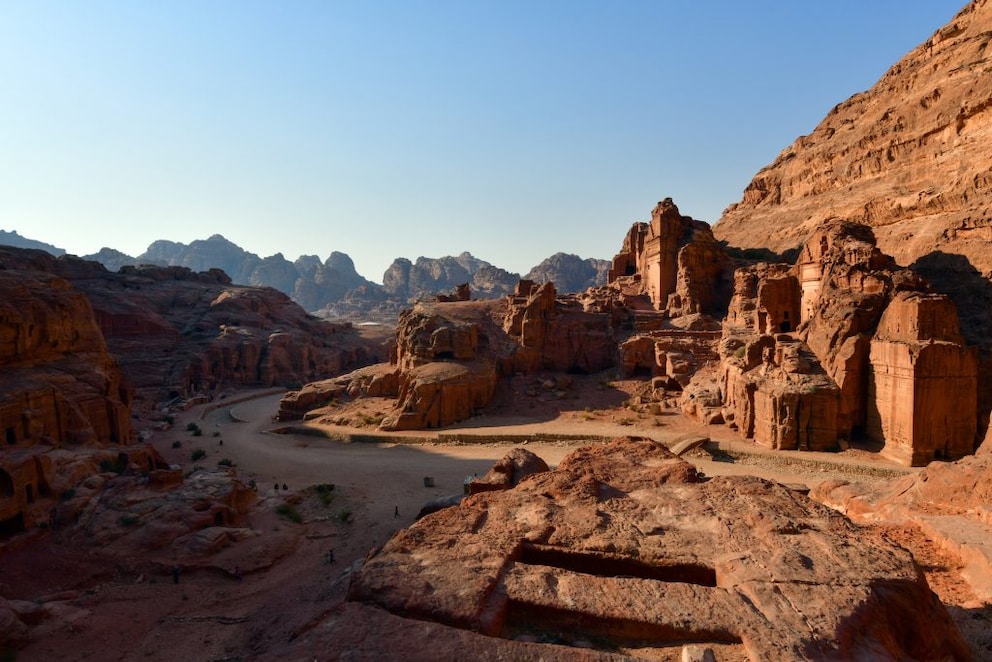
During Petra’s heyday, residents lived in stone houses with multiple floors and even a type of bath–today, only individual ruins of the dwellings remain, while the rock-carved tombs of the Nabataeans are well-preserved. However, Bedouins lived in the caves of Petra for a long time: Until the 1980s, they served as winter quarters for the so-called “Bedoul,” who lived in tents in Jordan during the summer.
When Petra was discovered as an archaeological treasure and declared a UNESCO World Heritage site in 1985, the Bedouins were relocated to a village built for them to protect the valuable ruins. Whether the relocation was forced or at the Bedouins’ request is still debated, writes the news portal “Al-Monitor”, among others. The persistent rumor that some families have returned to the caves because the village built for them is now overcrowded was contradicted by TRAVELBOOK on-site. Although Bedouins who guide tourists through Petra occasionally stay there overnight, it is only in exceptional cases. Caves that appear to be inhabited are more of a “tourist highlight” and not a regular residence.
10. Most of Petra Is Still Buried Today
Petra still holds many more secrets. “The so-called Columbarium, for example, a box-like structure, still puzzles historians, as do the snake images on the way to Mount Aaron,” said Osama Otoum, a German-speaking tour guide in Jordan, to TRAVELBOOK. To this day, only a small part of the legendary rock city is visible: Experts estimate that only 20 percent of ancient Petra has been excavated. More sites still need to be uncovered. Although archaeologists believe that all the major rock facades have now been found–who knows what the desert sand still conceals?
11. Petra Has a Little Sister
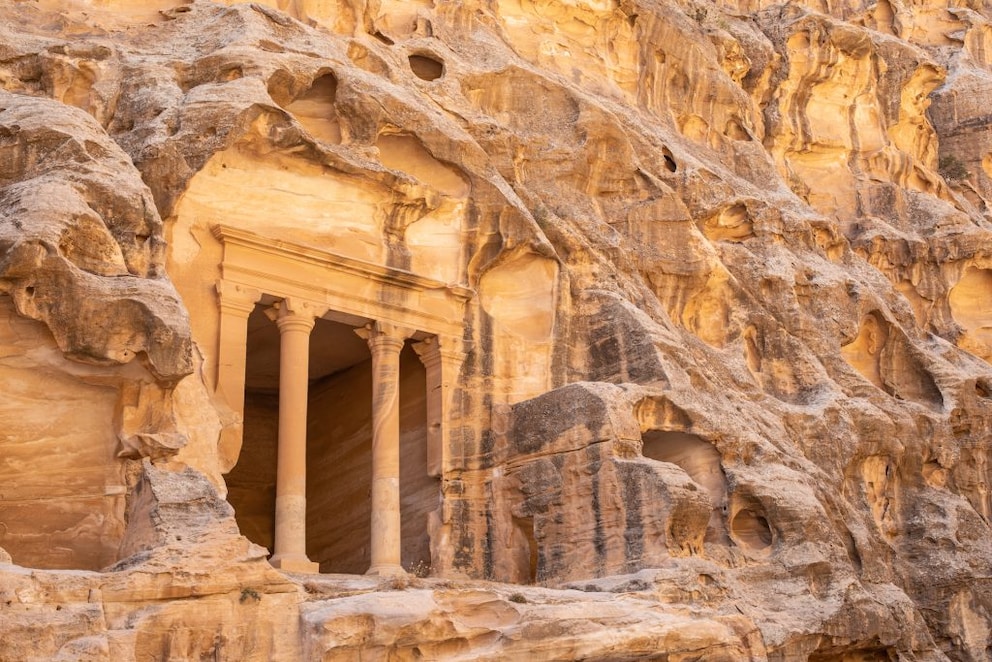
About eight kilometers from Wadi Musa lies El-Barida, also known as “Little Petra” or “Klein-Petra,” the “little sister” of the world-famous rock city. As a caravan stop, it was once a kind of suburb of Petra. Little Petra, also featuring a type of “Siq” and numerous rock reliefs, resembles its famous “big sister” and is definitely worth seeing. What few know: Little Petra has a rare feature–a preserved ceiling fresco from the 1st century with flowers, birds, and vines.
Information for Visiting Petra, Jordan’s World Wonder
How to Get There?
Petra is located roughly midway between the Dead Sea and the port city of Aqaba, which is in the far south of Jordan. The fastest way to reach Petra is via the Desert Highway; alternatively, you can take the Dead Sea Highway. If you’re not comfortable driving the sometimes quite winding roads to Petra yourself, you can book one of the various tours available from Amman, the Dead Sea, and Aqaba to Petra. A one-day tour from Amman, including transportation, costs about 100 euros.
Here you can find an overview of all entrance fees.
How Much Is the Entrance Fee?
The entrance fee for Petra is anything but cheap–for one day, Jordanian tourists pay 50 Jordanian dinars, which is approximately 65 euros. However, if you don’t stay overnight in Jordan, such as those on a day trip from Israel or cruise tourists, the fee is 90 JD, or 118 euros. Admission is free for children under 12 years old.
TRAVELBOOK Tip: You can purchase a ticket for multiple days in Petra directly, with only an additional five Jordanian dinars charged per extra day. If you’re very interested, you should plan to stay in Petra for several days.
What Should You Definitely See in Petra?
In addition to the already mentioned Siq and Al-Khazneh, Petra offers several other highlights. These include the Roman theater, also built by the Nabataeans, which still boasts excellent acoustics today. The nearby colonnaded street, the Temple of the Winged Lions, which features intricate reliefs, as well as the Palace Tomb and the Royal Tombs, also carved into the rock, are worth a visit.
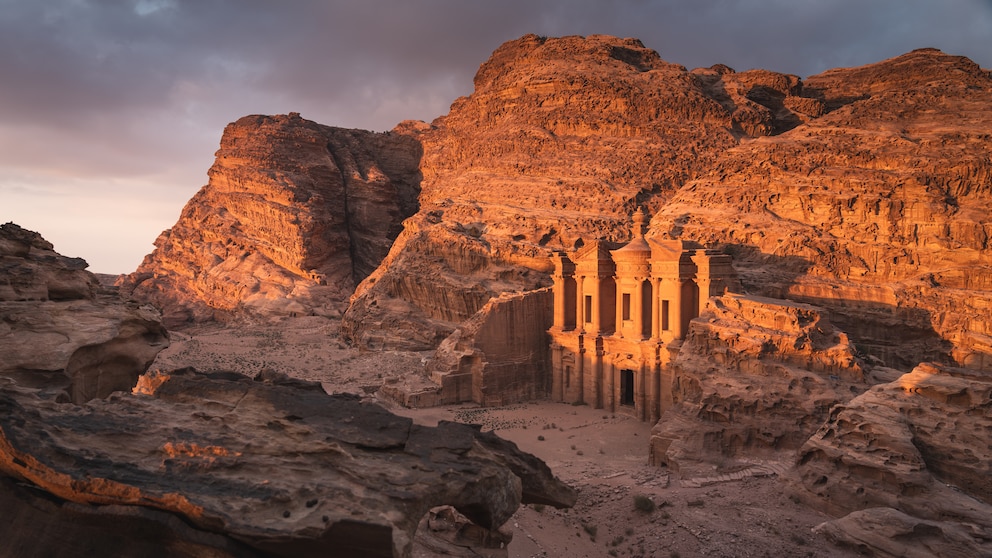
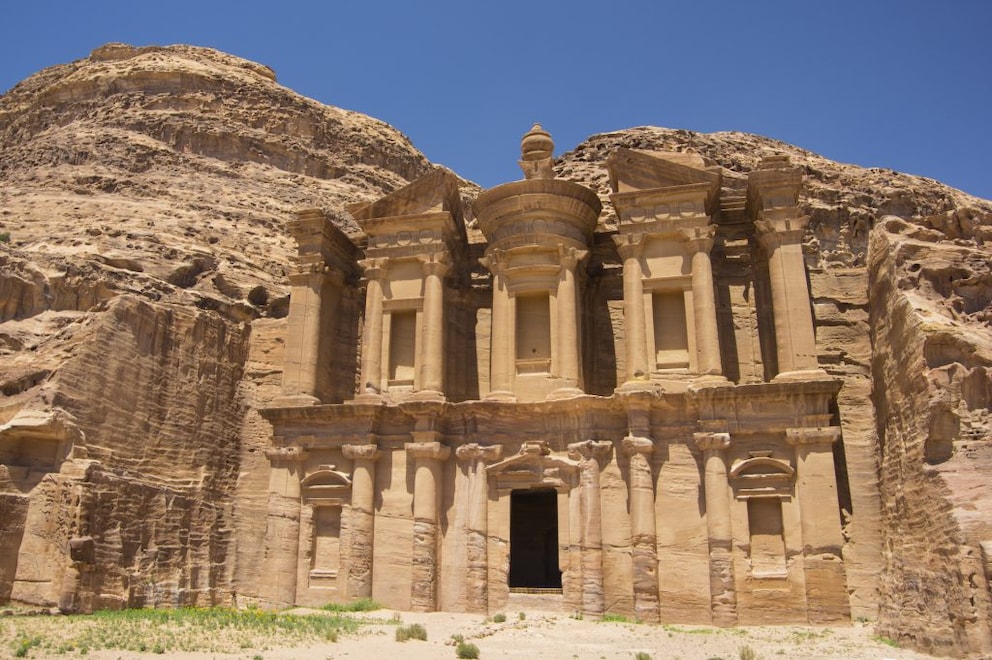
An extraordinary attraction is the “Ad-Deir” monastery, dating from the 2nd century A.D. Like the “Treasury,” after which it was modeled, it was carved into a rock. With a width of 47 meters and a height of 48.3 meters, it is one of the largest monuments in Petra, yet less known and crowded. This is partly because it is quite far from the Siq and located on a hill. If you want to visit it, you should plan at least an hour for the ascent and be in good physical condition.
What Should You Pay Attention to On-Site?
First, you should note that the area where Petra is located is very large. It takes about half an hour to walk from the parking lot at the tourist information center through the Siq to the “Treasury”–and you’re only at the beginning of the site. Good footwear is essential. Additionally, you should equip yourself with enough drinking water and, depending on the weather, a sun hat and sunscreen. Petra is in the desert, and the sun is relentless, especially in the warmer summer months. However, even those visiting in winter should be cautious! Petra is prone to dramatic floods, which can sometimes be life-threatening. At the end of 2022, 1,700 tourists had to be rescued from the floodwaters, as reported by the “Guardian.” If you plan to explore Petra on your own, you should definitely check the weather forecast carefully and postpone your visit if necessary.
How Much Time Should You Plan for a Visit?
Given the many attractions in Petra, the long distances, which should not be underestimated, and the fact that many tourists come to Jordan primarily for the ancient city, you should plan more than just a day trip. If you want to explore the rock city in detail and at your leisure, a two-day stay is advisable–especially since the entrance fee for the second day, as mentioned, is significantly lower. Wadi Musa offers various hotels and guesthouses suitable for an overnight stay.
Is “Petra by Night” Worth It?
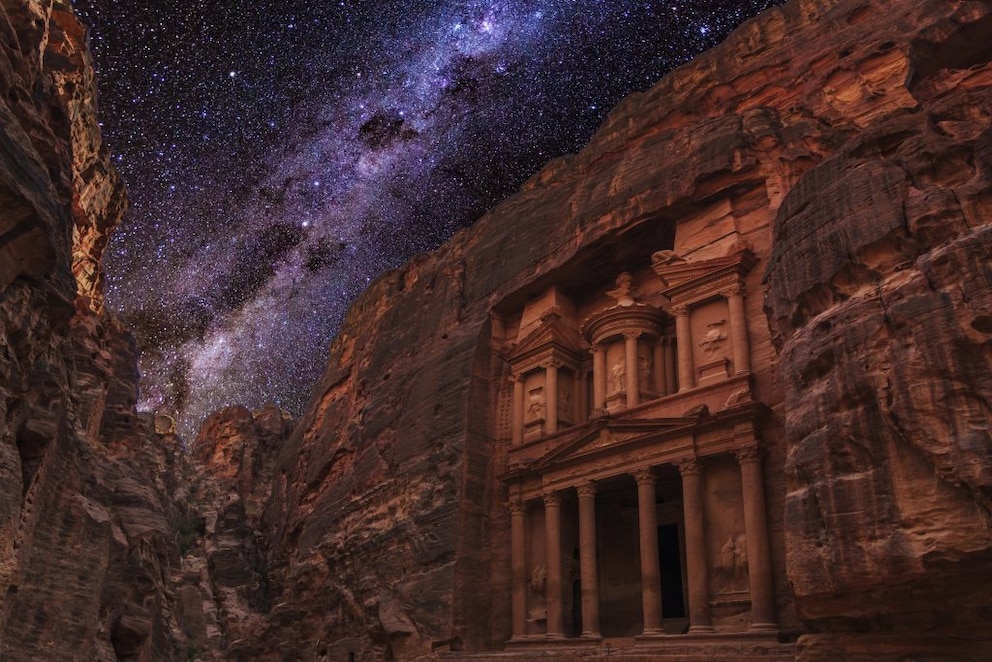
Additionally, those staying in Petra for more than a day can participate in a special experience: “Petra by Night” or “Petra by Night.” Three times a week, on Mondays, Wednesdays, and Thursdays, tourists are allowed to enter the rock city after dark. The Siq is illuminated only by tea lights along the path. At the end of the path, there is tea and a musically accompanied light show at the “Treasury.” The latter is, admittedly, a matter of taste. The additional fee of about 22 euros, on top of the regular entrance price, leaves a bit of a sour taste. Nevertheless, the fascinating view of the Treasury at night and the spectacular desert starry sky make it worth a visit for those who can afford this luxury.