


April 12, 2023, 9:58 am | Read time: 10 minutes
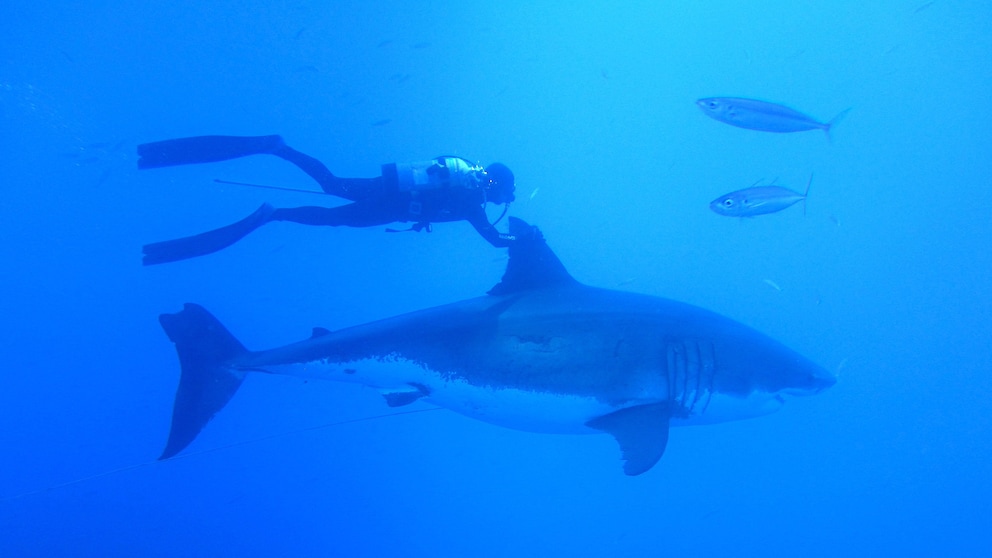
The type of leisure activity that German journalist and video reporter Christian Kemper* engages in during his travels is anything but ordinary–and also life-threatening. The 49-year-old dives with great white sharks, without a cage or other protective measures. In an interview with TRAVELBOOK, he reveals what fascinates him about these predators and how one shark encounter nearly ended fatally for him.
TRAVELBOOK: How did you come to have the unusual hobby of diving with great white sharks?
Christian Kemper: “When I was a little boy, my parents were among the first in their circle of friends to have a VCR at home. One day, they brought home the movie ‘Jaws,’ and I was eight or nine years old. I watched it and was, of course, terrified. But at the same time, I was fascinated and asked my parents if such bloodthirsty animals really existed, because back then, movies like ‘King Kong’ and ‘Godzilla’ were also coming out, which were pure fantasy monster films. My parents didn’t really know if the animals were as terrifying as in the movie. So I wanted to know more, collected newspaper clippings, and pasted them into a folder, and for my birthday, I asked for books about sharks. It stayed with me even as a teenager. I’ve always loved being in the water and swimming, and one day I thought: Man, you just have to get into the water with these animals.”
When was the first time you did it?
“At 18, I got a diving license because I wanted to see sharks. In Dortmund, where I grew up, there were none, of course. I quickly realized I had to fly around the world to see sharks. So I flew to Jamaica, the Maldives, the Great Barrier Reef in Australia, the Red Sea–but I only saw small reef sharks or nurse sharks, which was too boring for me. I wanted to see the shark that had sent me on this journey, the great white shark.”
And when did that dream come true for you?
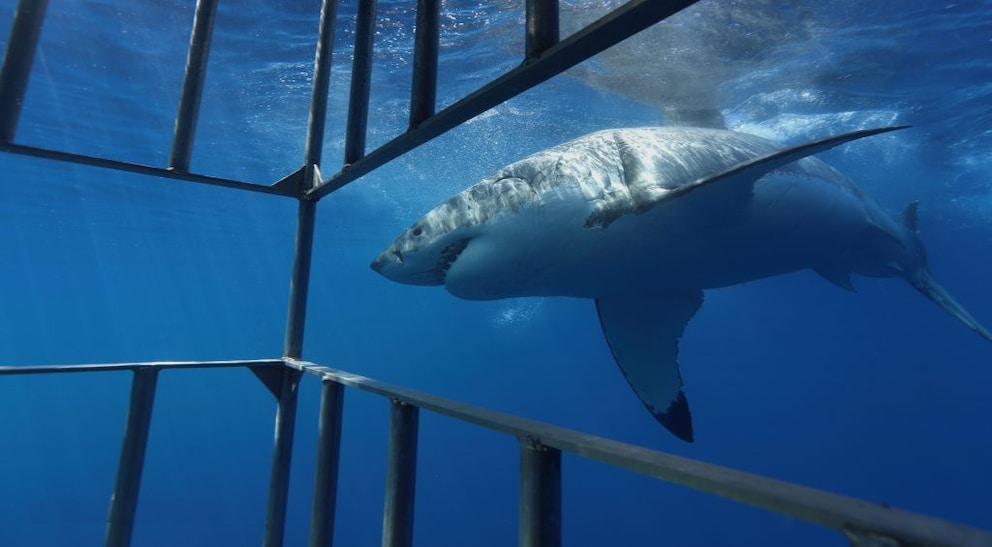
“It actually took a few more years. I later found out that there is the White Shark Research Institute in South Africa, a research institute for great white sharks. I applied there and worked for three months as a student assistant. I helped tag sharks from the boat, take photos, and analyze behavior. That was also the first time I dived with great white sharks, but in a cage.”
How did you come to want to dive with great white sharks without a cage?
“Through my work at the research institute, I became completely captivated by the animals and traveled back to South Africa several times over the years. I showed the photos of the sharks to my friends and acquaintances at home, and everyone said it was still far too dangerous. No one wanted to believe me that the sharks never attacked us in the cage, but were always only interested in the bait. I could even touch the sharks through the cage! But everyone still had this ‘Jaws-Hollywood-myth’ in their heads. And then I thought, okay, you have to take it a step further, you have to get out of the cage so everyone can see that great white sharks are not killers or beasts.”
There is still some danger, isn’t there?
“Of course, they are dangerous predators, and attacks do happen from time to time. But humans are not typically on the menu for sharks. If they were, we wouldn’t be able to go into the sea anymore, because there wouldn’t be ten deaths a year, but ten deaths a day.”
How was your first encounter with great white sharks without a protective cage?
“That was in 2013, exactly 10 years ago, on the Mexican island of Guadalupe. It’s practically the only place in the world where you can dive with great white sharks without a cage, albeit not entirely legally. At times, there were four great white sharks around me at once, which was a bit unsettling. But I was also totally fascinated, and–this shouldn’t sound clichéd–it’s also a spiritual experience when you’re not facing a wild boar, for example, like in Germany, but a five-meter-long great white shark, and then four of them at once.”
Was there ever a situation that was particularly dangerous for you?
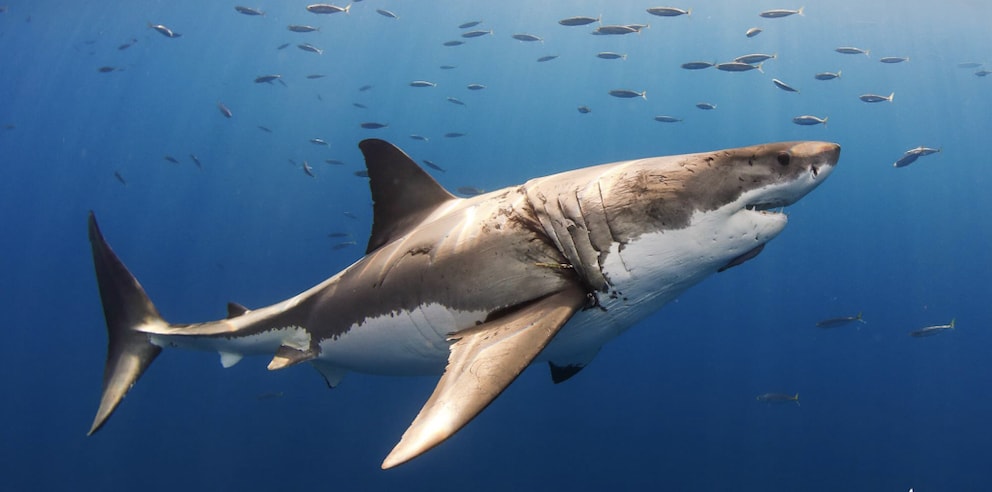
“Yes, the most dangerous was indeed in Guadalupe, where these four great white sharks were around me, and suddenly a fifth came swimming up from below. I knew that this was actually an attack behavior because sharks like to attack from below. The shark was about 20 meters below me, and I knew I had three or four seconds to act before it reached me. A thousand thoughts run through your head, of course. I knew swimming away was bad, then it would definitely attack. It wouldn’t have made sense anyway because the shark is faster. I was standing vertically in the water at that moment, briefly considered lying horizontally because sharks don’t know that. But then I thought it might grab me from below. In the end, I did nothing and just waited. About a meter before the shark’s jaws would have touched my fins, it suddenly turned away. I think it just wanted to test me. It wanted to see what I was, how I reacted, whether I was food or not. This happened twice in quick succession, and the second time I thought, okay, that’s it. Maybe it won’t end so well the third time. It tested me twice, and the third time it might be bolder. So I swam back into the safety of the cage. That was the most dangerous situation I’ve been through, I really had a pounding heart.”
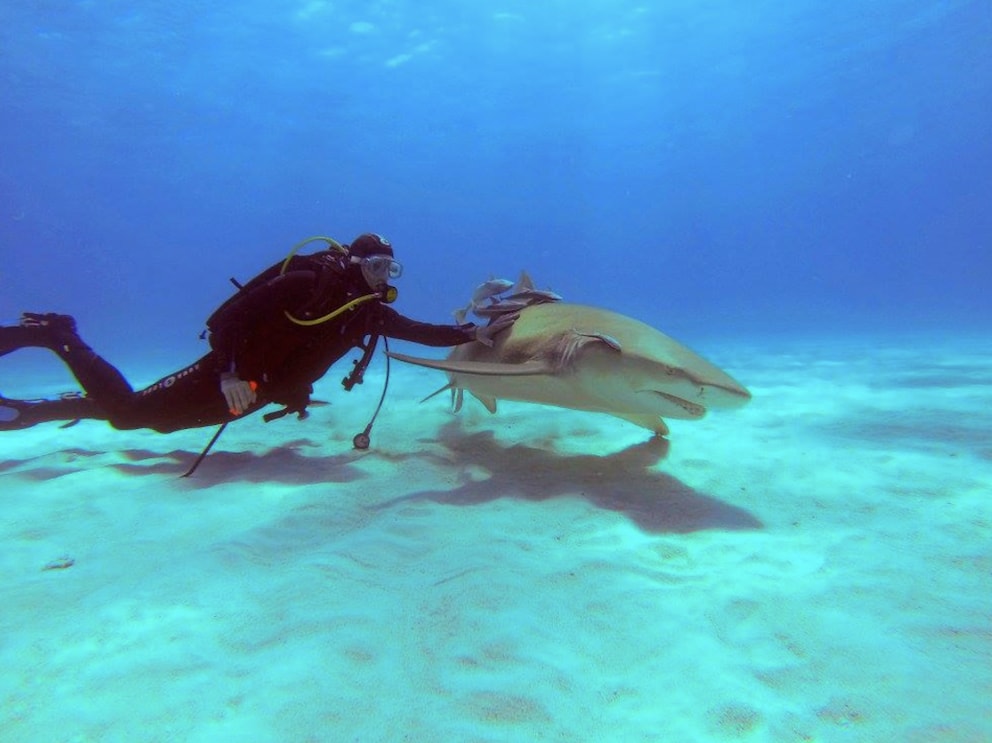
Also interesting: The best tips to protect yourself from a shark attack
So you’ve checked off the wish to dive with great white sharks from your bucket list. What came next?
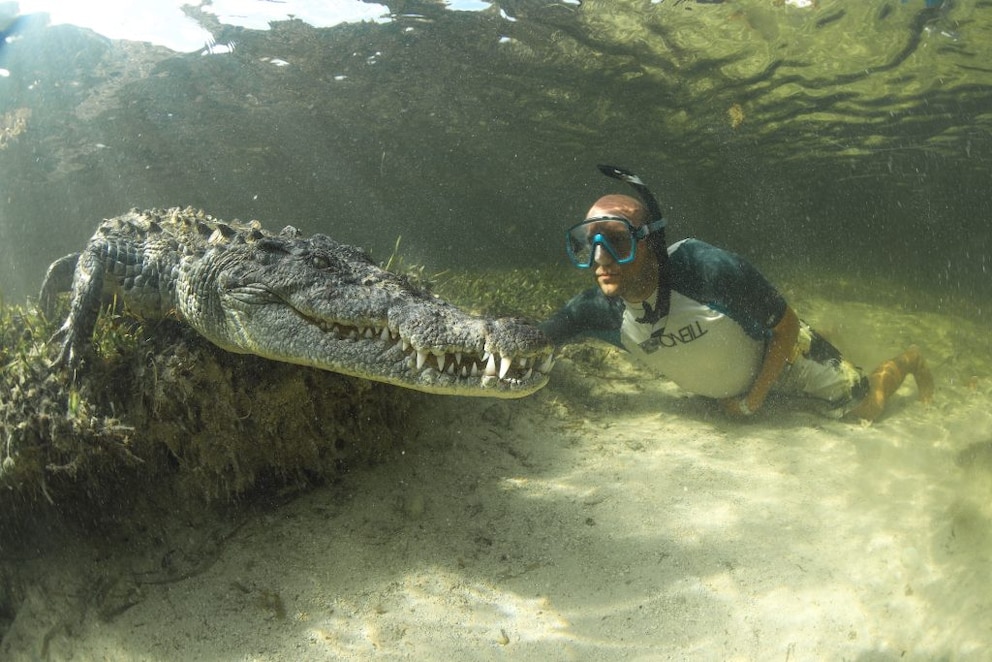
“When sharks attack humans, it’s usually a case of mistaken identity. So I wondered if there are animals that attack and eat humans simply because they can. And I quickly landed on crocodiles. A crocodile doesn’t care if it eats a kangaroo, a zebra, or a nine-year-old girl–they eat anything that comes in front of their mouths. The most dangerous crocodiles are the Australian saltwater crocodiles. Then come the African Nile crocodiles, and then the American crocodiles. The latter also live in saltwater and are responsible for many attacks and some fatalities. In a nature reserve in Mexico, I was in the water in an atoll where about 300 American crocodiles live.”
And how was that?
“It’s a whole different experience than diving with sharks, but just as gripping and fascinating. At times, there were seven crocodiles around us, stirring up the water so much that everything was full of sand, and we couldn’t see anything anymore. We only knew that somewhere around us were these seven crocodiles. Then we all froze like salt pillars because we were afraid of stepping on one, which could have provoked an attack.”
Weren’t you afraid at all?
“I wouldn’t say afraid. It’s more like just before a parachute jump from a plane when the door opens. You catch your breath a bit. It’s the same when diving with crocodiles. You have this inner tension and an adrenaline rush. But I can honestly say, without exaggerating, I haven’t had a situation where I was truly afraid. And I think it has to be that way because animals can sense fear, panic, and anxiety very well. Just like when a growling dog stands in front of you, you should never panic and run away because that triggers the hunting instinct in them, and then they’ll definitely bite you. It’s the same with large predators like sharks or crocodiles. You must never panic. If I had panicked while swimming with the crocodiles and fled wildly splashing to the boat, I might only have one leg today.”
In this video, you can see Christian Kemper’s expedition to the crocodiles in Mexico:
You have a wife and children, and thus a certain responsibility. Why do you still expose yourself to this risk?
“Yes, it’s a discussion with my wife every time I travel. But I always think: With stuntmen, race car drivers, or skydivers, their wives know that this is their passion. And if you love someone, you don’t stop them. My wife always says, ‘Take care of yourself, you know you have a family.’ I’m well aware that it’s a risk. But I always tell myself it’s a calculable risk. Of course, that’s a bit of sugarcoating because you can’t really calculate the behavior of wild animals. That’s why they’re wild. It’s a mix of fear and fascination for me, which is why I take the risk and will continue to do so. By now, my sons are also at an age where they’re proud of their dad. But sure, I can’t deny that there’s always a residual risk.”
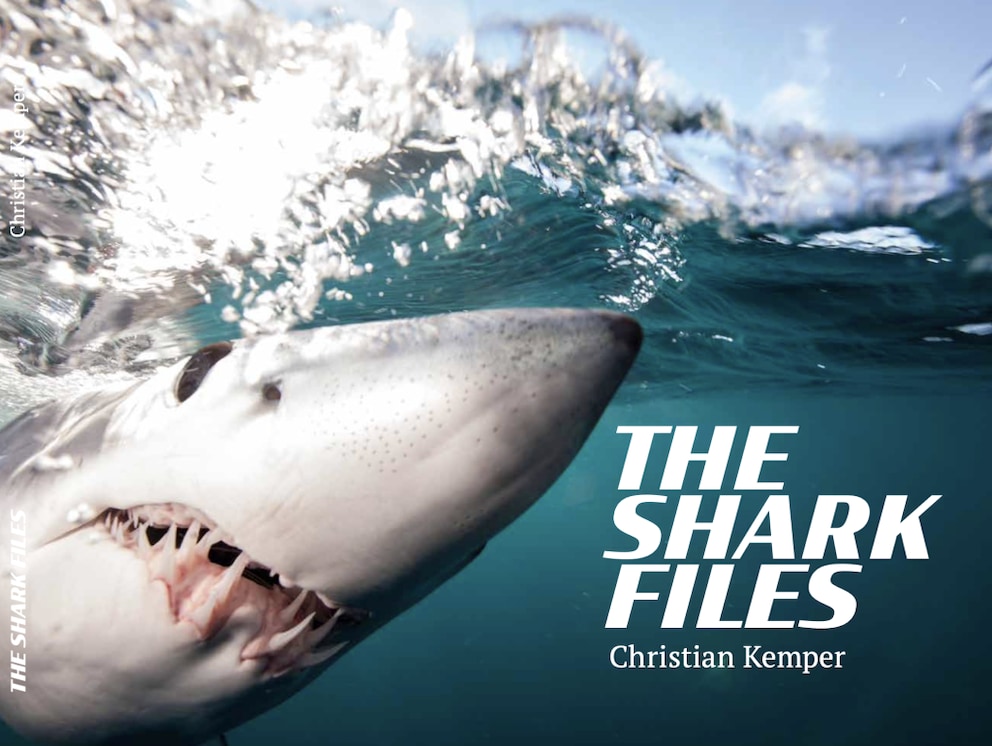
You’ve written several books about sharks, most recently ‘The Shark Files,’ and it’s important to you to educate people about sharks and dispel the prejudices about these animals. What do you think needs to happen for people to stop labeling sharks as ‘beasts’?
“What many don’t know: Sharks play an enormously important role in the ocean’s food pyramid. Studies have shown that a reef would die within a year if sharks were removed by hunting or whatever. Sharks ensure a certain food balance in a reef, preventing any species from multiplying explosively. Sharks are very important in the sea; they’re like the ocean’s food police. Similar to wolves in the forest, which eat sick and weak animals and thus prevent diseases from spreading. The sad thing is: 100 million sharks are caught and slaughtered every year, mainly for shark fin soup, or they end up as bycatch in nets. And if we’re not careful, there will be no sharks left someday. A well-known marine researcher once said: ‘If the shark dies, the sea dies, and if the sea dies, then humans die too.’ That’s why it’s so important to me to raise awareness that sharks are worth protecting.”
One last question: You’ve dived with great white sharks several times, you’ve swum with American crocodiles. Do you have another animal on your wish list that you’d like to get close to?
“Yes, two actually. I’d like to dive with sperm whales. They’re not necessarily dangerous to humans, but they’re over 20 meters long and are considered the largest toothed whales in the world. Who can say they’ve dived with ‘Moby Dick’? And then I’d also like to dive with orcas. They’re even bigger than great white sharks, super intelligent, and there’s never been an attack on humans in the wild. So I think diving with sperm whales or orcas is a bit less dangerous than diving with sharks or crocodiles, but just as fascinating.”
*Christian Kemper currently works at BILD (which includes TRAVELBOOK) as a video reporter.