

September 2, 2024, 8:32 am | Read time: 5 minutes
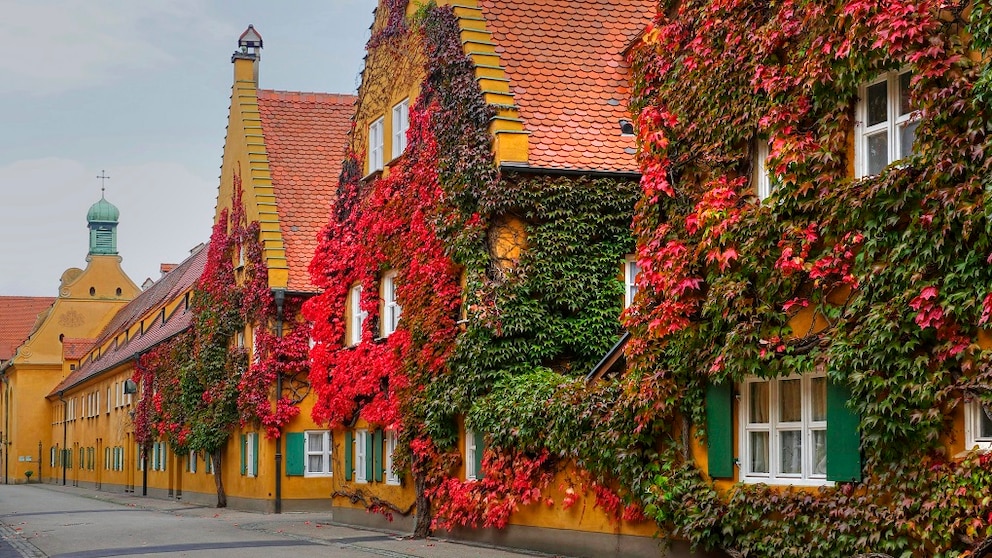
More than 500 years ago, the wealthy merchant Jakob Fugger founded the Fuggerei in his Bavarian hometown of Augsburg, named after him. Today, the complex is the world’s oldest social housing settlement, where needy residents can live for a nominal fee. This has made the location one of Augsburg’s biggest tourist attractions. However, there are conditions to be met to live here–and some are quite peculiar.
Honestly, would you be willing to pray three times a day to be allowed to live in your apartment? Well, if you live in Berlin or a similarly sought-after metropolis, the answer is probably: “Sure, if necessary, even more often.” But for the people living in the Fuggerei in the Bavarian city of Augsburg, daily conversations with God are indeed a condition for moving in. This refers to a complex founded by the wealthy merchant Jakob Fugger, which is now considered the world’s oldest social housing settlement.
To obtain an apartment in the Fuggerei, one must first meet three conditions, regardless of other factors: They must be officially recognized as needy, live in Augsburg, and belong to the Catholic faith. Then there’s a waiting list, of course, because housing in this unique settlement is extremely popular. No wonder, as the rent here is only 88 cents–per year. According to “Welt,” there are also monthly utility costs of about 90 euros for a 60-square-meter apartment.
The Fuggerei Is Over 500 Years Old

Since its founding over 500 years ago, the Fuggerei has grown to a total of 67 houses with 142 apartments. To live here, one must fulfill another condition besides the aforementioned ones: They must pray three times a day for the soul of Jakob Fugger. The man who initiated this extraordinary and visionary project back in 1521. Having become more than wealthy as a merchant and then the richest man in the entire Holy Roman Empire, he founded what is now the world’s oldest social housing settlement.
Also interesting: Renting a Vacation Home – 9 Tips You Should Know
This likely had various reasons: First of all, Jakob Fugger probably wanted to cement his family’s status in Augsburg. They had only moved here at the end of the 14th century and had not gained access to the innermost circles of the city’s elites until the founding of the Fuggerei. As someone who had made money-making his business model and was sometimes called a “nasty usurer” by contemporaries, he might have simply been concerned about his soul’s salvation in the afterlife. Finally, Jakob Fugger probably also had a genuine, humane, and charitable side.
Waldsiedlung Wandlitz: The Secret Residence of East Germany’s Elite!

Inhabited for 1,000 Years! The likely Oldest Settlement in the United States
88 Cent Annual Rent
He acted entirely in the spirit of his namesake, the Apostle James, who advises in the Bible to help widows and orphans in need. Fugger applied this recommendation to generally needy people with the construction of his Fuggerei. And there were many of them in Augsburg in the mid-16th century. Attracted by the earning opportunities in the city, countless day laborers flocked here during Fugger’s time, and living conditions were correspondingly cramped. Many people were probably even completely homeless.
On August 23, 1521, the merchant wrote in his foundation charter for the Fuggerei: “I, Jakob Fugger, citizen of Augsburg, acknowledge with this letter to complete the houses for poor people at Kappenzipfel as a foundation and to commit the descendants to its execution forever.” Seven years earlier, he had acquired the first houses and gardens from the widow of a former mayor in Jakobervorstadt-Süd for 900 Rhenish gold guilders. By 1523, the settlement with a total of 52 houses for 102 residents was completed. Fugger set the annual rent per resident at one Rhenish guilder, which at the time corresponded to a day laborer’s weekly wage, as “Deutschlandfunk Kultur” writes. Currently, that amounts to just 88 cents.
More Than 200,000 Visitors Per Year

And indeed, the approximately 150 needy Augsburg residents today still pay no more than this symbolic fee for their apartments. This unusual housing model has made the Fuggerei one of Augsburg’s largest tourist attractions today. More than approximately 200,000 people now come annually to see the world’s oldest social housing settlement. Whether its residents actually pray three times a day for the soul of founder Jakob Fugger as suggested is not monitored. However, there is a night watchman at the gate in front of the settlement who closely observes comings and goings.
Also interesting: Why Augsburg Has So Many Water Channels
If a resident arrives after 10 p.m., they must pay a 50-cent fee to the quirky porter. After midnight, it’s even one euro. The Fuggerei opens its gates at 6 a.m. and officially closes at 10 p.m. The continued existence of this unique housing project is thanks to the still-existing Fugger Foundation. Its wealth today primarily comes from owning 3,000 hectares of forest. But gravel mining, operating Christmas markets, wind energy, and income from other properties also contribute to the upkeep of the Fuggerei.
In addition to the total of 67 apartments, there is also a beer garden, a medical station, and the St. Markus Church belonging to the complex for the residents today. Visitors can now learn about the history of the Fuggerei and life here in two museums. According to the official foundation website, adult visitors currently pay an entrance fee of 8 euros. The reduced ticket is available for 7 euros, and visitors aged 8-17 pay only 4 euros. Incidentally, figures of protective house saints stand in front of every door, and somewhere, of course, there’s also a bust of Jakob Fugger himself. The man who had a vision more than 500 years ago. And thus enabled perhaps Germany’s most unusual housing project.