

November 16, 2025, 5:53 am | Read time: 4 minutes
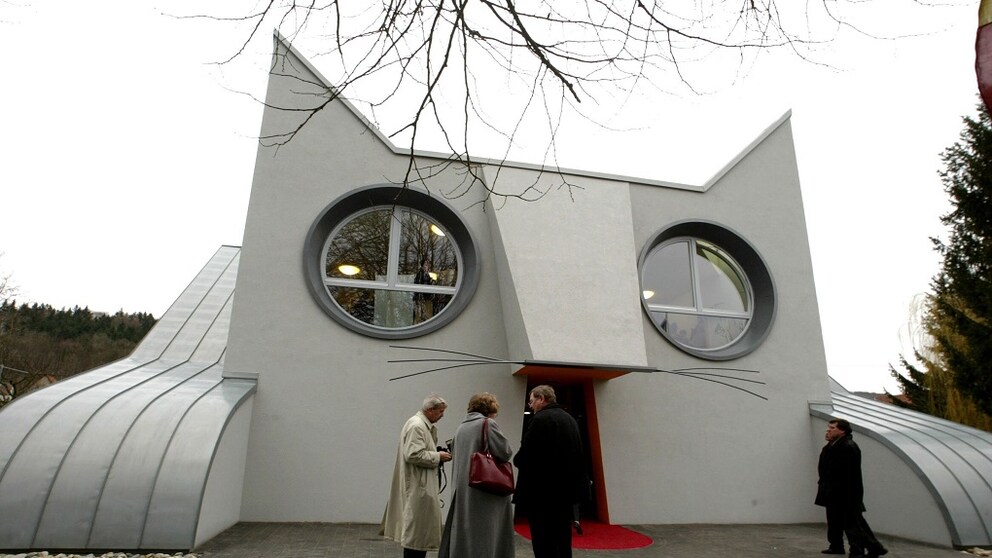
In the Karlsruhe district of Wolfartsweier stands what is likely Germany’s most unusual kindergarten. The building actually looks like a giant version of a cat. More than 20 years after its opening, it continues to delight its young visitors and tourists alike. TRAVELBOOK spoke with a member of the team that designed the cat kindergarten about its unique design, challenging construction conditions, and the adults who still get wide-eyed at the sight of the building.
Whether the kindergarten children in the Karlsruhe district of Wolfartsweier are happier than those in the rest of the country is unknown. However, it is certain that they probably enjoy going to their daycare, as it is housed in a rather unusual building. This building is shaped like a giant cat. Built more than 20 years ago, it has always fascinated the kids of Karlsruhe, some of whom stay there until they enter elementary school. But how did this quirky design come about? TRAVELBOOK discussed this with a member of the planning team that designed and built the cat kindergarten.
The unique kindergarten is the work of the Karlsruhe architecture firm Yöndel Zimmerlin, which was known simply as Yöndel at the time of construction. “The idea for the cat building came from the now-deceased, internationally renowned artist Tomi Ungerer,” recalls the staff member. “He wrote several children’s books and also a book about cats.” Known primarily as a graphic artist, writer, and illustrator, Ungerer eventually wanted to design a building. “And he thought it should be in the shape of a cat.” The connection to the architecture firm was made through the then-head of the Karlsruhe building authority, Lars Dragmanli.
Challenges and Slides
“The construction of the kindergarten itself took about a year. Fortunately, there were no major complications, but there were some challenges.” The site where the giant cat now stands was once a clay pit. “Because of the ground, we couldn’t just place a building on it. So we had to drill supporting piles into the ground to anchor the house properly.” Implementing the idea of the kindergarten as a gigantic cat was not easy, but very interesting.
Also interesting: Nitt Witt Ridge: The quirky U.S. estate made of trash
The unusual building appears “real” in its own way, a successful imitation of a cat, just several sizes larger. The animal’s eyes are the windows, and its mouth is the entrance to the kindergarten. “There’s also a red doormat meant to represent the cat’s tongue.” The highlight for the kids at KiTa Wolfartsweier: The cat’s tail is a slide–a unique solution by the architect team for an emergency escape route. “You can slide from the first floor to the ground floor and climb back up via a staircase.” This also serves as an escape route in case of danger, with both the staircase and slide accessible from a small balcony.
“People Fondly Remember It”

Laughing, the staff member recalls the opening of the special kindergarten in 2002. “The children and parents loved it from the start, but the reactions in the architecture world were highly controversial.” Even today, there are multiple inquiries each year from media around the world about the cat kindergarten. In the past, these have included magazines from the U.S., Japan, and France. “We think we did a good job; it’s a one-of-a-kind.” However, she wouldn’t describe the building as a major tourist attraction. “There aren’t any tour buses with tourists parked in front of it.”
Also interesting: The crazy sphere house settlement in the Netherlands
Still, she wasn’t 100 percent satisfied with her version of the kindergarten back then. “For cost reasons, the building was simply bricked and plastered. We would have liked to use materials like wood or steel and make the cat look even more like a giant toy. As it is, it’s too much building and not enough object.” A consolation, however, is that even today, people still thank her for the quirky KiTa. “They say their children or grandchildren go there, or that they even went there themselves. Almost everyone who has been there remembers it fondly.”