

April 14, 2026, 8:32 am | Read time: 5 minutes
In 1888, Bertha Benz, the wife of an industrialist, undertook the first long-distance journey in history in a three-wheeled precursor to the automobile. This event put the small Black Forest town of Wiesloch on the map, as something historic happened here. In the local pharmacy, the brave pioneer had to refuel, making the Wiesloch pharmacy the world’s first “gas station.” TRAVELBOOK knows the full story of the adventure.
“Behind every successful man stands a strong woman.” Anyone looking for proof of the truth of this old saying would find it in the Black Forest town of Wiesloch. Nearly 140 years ago, a story unfolded here that made history and is closely linked to a German pioneer. Her name was Bertha Benz, wife of Carl Benz, the inventor of the automobile. In 1888, she became a trailblazer with a daring act for the time, as the first woman to drive a car. Her maiden voyage led her, albeit somewhat involuntarily, to the aforementioned small town. Since then, Wiesloch has been known as the place where the world’s first gas station is located.
In 1886, Carl Benz invented the precursor to today’s car. A three-wheeled vehicle that initially seemed destined for little success. Even Kaiser Wilhelm I, according to the science magazine “P.M.,” preferred to use horses for transportation. This was also due to the fact that there were no roads in Germany at the time in the modern sense. Traffic signs, navigation systems, all nonexistent. It is all the more astonishing that in 1888, Bertha Benz, along with her sons, decided on an adventurous long-distance journey with her husband’s vehicle. The journey was to cover over 66 miles from Mannheim to Pforzheim. It is likely that Mrs. Benz had never heard of Wiesloch at that time, let alone a gas station.
The World’s First Long-Distance Driver
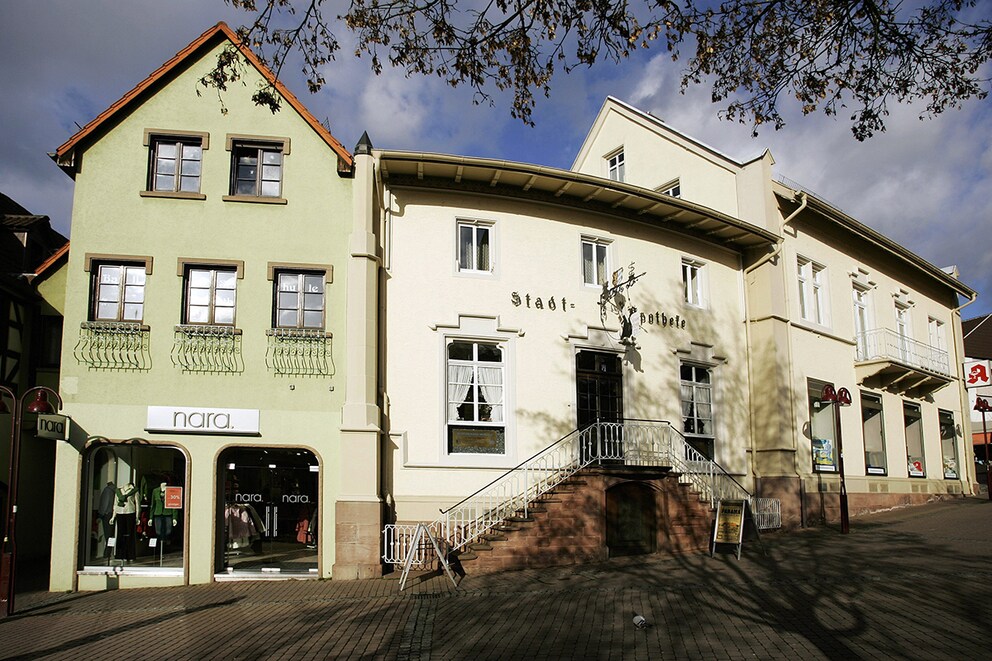
However, fate led the automotive pioneer through the Black Forest on her route. And it was there that they ran out of fuel, as the car’s small tank was empty. But where to find a solution? Well, the resourceful Bertha knew how to help herself and headed straight for the Wiesloch pharmacy. This pharmacy has existed since 1735 and thus became the world’s first gas station. Here, she purchased three liters of ligroin, also known as petroleum ether. People of her time primarily used this to clean clothes or wounds. The fuel was enough to get Mrs. Benz and her sons to their destination, making her the first long-distance driver ever. It is certainly this remarkable achievement that helped promote the rapid rise of her husband’s invention.
During Bertha Benz’s time, there were no fuel pumps. So she filled her car with ligroin using a glass container. Soon, gasoline could also be purchased in drugstores, general stores, or inns. In later years, barrel pumps were used to fill thirsty tanks with fuel. By 1917, the U.S. company Standard Oil of Indiana developed the gas station as we know it today. The pharmacy in Wiesloch, now considered the world’s first gas station, still exists and can be visited upon request. “For 40 years now, guests and the media have been flocking here,” says Dr. Adolf Suchy, who runs the local pharmacy museum with his wife and daughter, in response to a TRAVELBOOK inquiry.
Busloads of Visitors
“The actual pharmacy has not existed for two years, but as the world’s first gas station, it is still very much in the public eye. The room is largely preserved in its original state from around 1900, and the furniture even dates back to 1860.” The pharmacy gas station is definitely a flagship of Wiesloch, a landmark. “Sometimes busloads of visitors come here, but more often smaller private groups.” They receive an approximately one-hour lecture on the history of the place and a subsequent tour. “Recently, a U.S. camera team was even here, wanting to make a film about Bertha Benz. And in January 2026, Mercedes passed by on a world rally to promote the new S-Class.”
Suchy, a trained chemist himself, has been happily providing information about “his” gas station to guests for 40 years. He does not want to be immortalized as a museum director in TRAVELBOOK but jokingly refers to himself as a “gas station attendant.” It is also worth knowing that Johann Philipp Bronner, one of the fathers of German quality winegrowing, also worked in the Wiesloch pharmacy. He ran the establishment until 1860. According to the site “Geschichte des Weines,” he also opened a vine school in his hometown, a model operation with about 400 varieties. Those interested in booking a tour with Suchy can find his contact information on the “Rhein-Neckar Industriekultur e.V.” website. The total price for a small group is 75 euros, according to the operator.