

April 16, 2026, 8:12 am | Read time: 6 minutes
When the Ohio State Reformatory opened in the 1880s, it was one of the most advanced and humane prisons in the entire U.S. Over time, however, it transformed from a model institution into an absolute horror prison, where violence and murder were commonplace. Conditions eventually became so dire that inmates successfully sued the prison. Today, the site is a tourist attraction, reputedly haunted, and is also used frequently by Hollywood for filming.
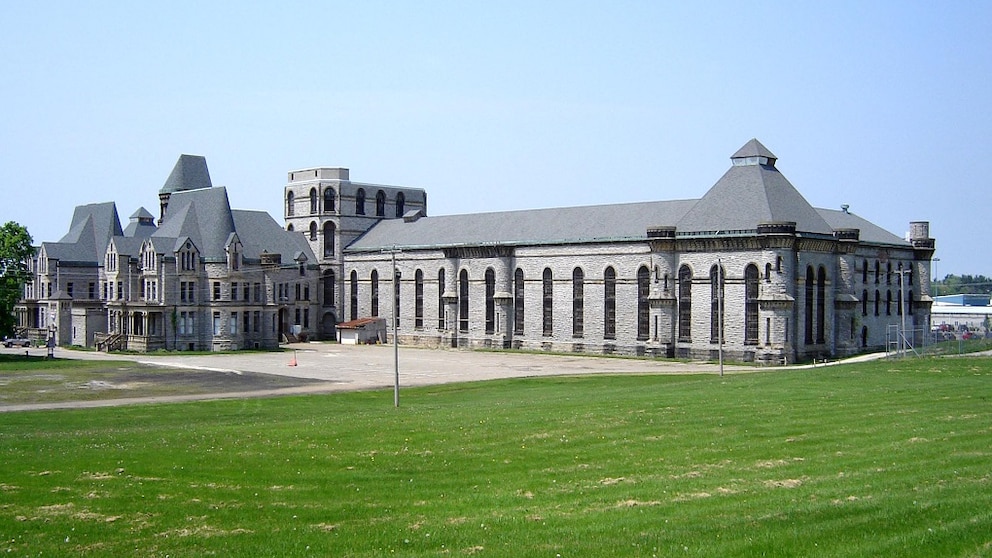
The small town of Mansfield in the U.S. state of Ohio would likely be completely unknown to most U.S. tourists. Yet it is home to one of the most famous, or rather infamous, buildings in the entire country. We’re talking about the Ohio State Reformatory, which opened in 1886 as a model prison, only to develop over the decades into an absolute horror prison where violence, mistreatment, and murder were everyday occurrences. Unsurprisingly, the restless souls of many unfortunate individuals who perished here are said to haunt the old building. It’s also a true visitor magnet because one of the best prison films of all time—if not the best—was shot here.
It was the year 1886 when the Ohio State Reformatory opened its doors, according to the Mansfield Reformatory Preservation Society, which manages it today. Ten years of construction had passed, consuming the then staggering sum of $1.3 million. The work had repeatedly stalled due to funding shortages, but now the first 150 inmates have moved into the massive building. Architect Levi Scofield aimed to create an awe-inspiring prison, and he succeeded. The prison almost resembles a castle. Across six floors, there are 100 cells for the inmates. Initially, they are comparatively well off.
Deadly Tragedy
Those incarcerated here have committed minor offenses and are given a realistic chance at rehabilitation. The stay at the Ohio State Reformatory is characterized by three pillars: education, religion, and learning a trade, such as woodworking or agriculture. Regardless of the offense, each inmate receives the same sentence of 18 months. If they improve during this time, they are released to a free life. If not, their stay is automatically extended by another 18 months. A humane system that soon yields remarkable success, with a relatively low recidivism rate among inmates.
It was not uncommon for former convicts to voluntarily return to the Ohio State Reformatory to lead tours for guests. Life here was also comparatively luxurious, with inmates generally having single cells equipped with a sink and their own toilet. The east wing set a world record at the time as the largest self-sustaining prison block in the world. But then, in 1930, a tragedy occurred that would forever change the fate of the model prison and its inmates. A devastating fire broke out, killing 320 people. The survivors were temporarily placed in other prisons, and the drama unfolded.
Also interesting: Gorgona: Europe’s Last Penal Colony
Murder, Torture, Diseases
Suddenly, the relatively harmless offenders from the Ohio State Reformatory were exposed to the truly tough guys in places where violence and murder were everyday occurrences. This shaped the returnees, and soon, shocking acts of violence occurred in the once elite prison. Prison guards were murdered, and those responsible ended their lives in the electric chair. In 1948, two inmates on parole kidnapped and murdered a senior official and his entire family. But the real death blow to efforts for more humanity in a prison came for the Ohio State Reformatory in 1960.
At that time, the state converted it into a maximum-security prison. It became notorious for its sadistic guards. They tormented inmates with hoses and electric shocks. Days-long solitary confinement in sweltering cells was also common. These cells soon became completely overcrowded. Where previously one man had a cell to himself, soon two or three convicts were sharing one. As a result of the catastrophic deterioration in hygiene, rat infestations spread. The result was diseases, and inmates often died from these due to neglect. Many who could no longer endure the horrors of the prison took their own lives.

Alcatraz: The History of the Infamous Prison Island Near San Francisco

Which of these places is the spookiest in Germany?
The Ghost Prison
Eventually, conditions became so dramatic that in 1978, the inmates resorted to a truly extraordinary and desperate measure. They sued the Ohio State Reformatory with the help of the Council for Human Dignity. And successfully, as an order was issued stating that no more than 500 people could be incarcerated here at the same time. Previously, the number of inmates had been as high as 2,200. In 1990, the prison closed for good. To save it from decay, the Mansfield Reformatory Preservation Society subsequently bought it from the state of Ohio for $1 million. And turned it into a true visitor magnet.
Today, about 120,000 people visit the Ohio State Reformatory annually. Many of them are likely fans of the paranormal, as several ghosts are said to haunt the former horror prison. Tours are offered by sites such as “US Ghost Adventures.” According to this site, even when the prison was still operational, inmates frequently reported unusual phenomena. At night, a ghostly woman was said to roam the halls, pulling the sheets off inmates’ beds. She is believed to be a nurse who was murdered here. Screams and whispers, or even snoring, are often heard in the corridors. The ghost of a woman who died here in an accident sometimes even speaks to visitors.
The Prison as a Hollywood Film Set

Sometimes, a piano can be heard from the empty guard room, and there is even said to be a ghost cat at the Ohio State Reformatory. On a tour, guests are guaranteed to see the chapel, solitary confinement cells, the basement, and the cemetery where over 200 former convicts are buried. But there’s another reason why the former prison is so popular with visitors. Hollywood has regularly filmed here in the past, including the classic “The Shawshank Redemption” with Morgan Freeman and Tim Robbins. It is considered by many fans of the genre to be the best prison film of all time. The action film “Tango & Cash” with Kurt Russell was even shot while the institution was still in full operation. If you now want to visit the Ohio State Reformatory, you have the opportunity to do so year-round. There are several guided tours, including “Hollywood meets History” and an escape game. These vary in length depending on the content and can last up to three hours. Participation in the “Hollywood meets History” tour, for example, costs $40 per adult. Of course, there are also numerous ghost tours available, which can cost up to $135 per person. You can find the corresponding offer here.