

April 19, 2026, 5:10 am | Read time: 5 minutes
In the cemetery of the original church in the Bavarian town of Chammünster, there is a special memorial site about 800 years old. In the ossuary there, the bones of countless deceased from long past eras still rest today. The fact that the site can shine again in its old glory is thanks to a coincidence. And perhaps the most unusual school project of all time.
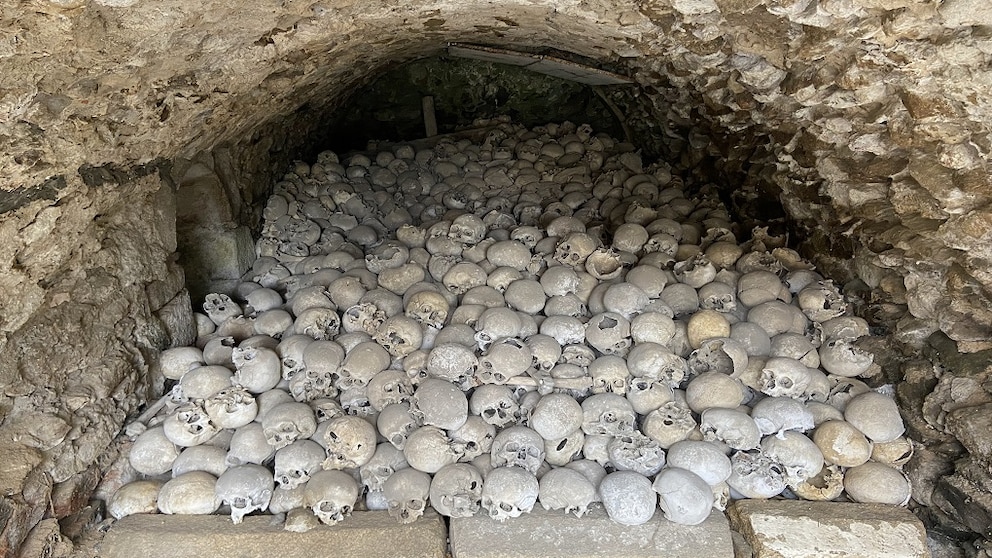
Cemeteries are places where the living can remember the deceased in peace and dignity. Sometimes, however, death and the transience of one’s own existence are openly confronted, as is the case in the ossuary in the Bavarian town of Chammünster, a district of the city of Cham. Also known as a charnel house, the bones of countless deceased from several centuries of history rest openly and visibly in the local ossuary in the churchyard of the original church. Only separated by a grille, they can be viewed, stacked in a catacomb. This is mainly due to a coincidence.
Hans Wrba is a retiree and volunteer local historian in Cham. He knows the history of the ossuary of Chammünster well. Even as a teenager, he was interested in the history of his region, as he tells TRAVELBOOK. He credits his teachers for providing him with so much literature on the subject back then, and today he is a great art lover and classical music fan. Regarding the unusual burial site in the cemetery of the original church, he says: “The ossuary probably originated around the year 1200. The construction method suggests this. This way of laying the dead to rest originated in France and dates back to the 11th century.”
Rediscovery by Chance
As early as 739, a church was founded in what is now Chammünster, which had a huge catchment area in the following centuries. The problem on site, as well as in other communities in Bavaria and Austria that still have ossuaries today: Due to the high number of believers, there was eventually no more space in the cemeteries to honorably bury them all in the spirit of faith. “And so, at some point, the bones of the dead were exhumed and laid to rest in the ossuaries, as in Chammünster.” But due to the confusions and upheavals in history and several partly forced religious changes in the region, the ossuary eventually fell into oblivion.
More precisely, it was literally buried. In 1556, the rulers at the time ordered the demolition of the St. Catherine’s Chapel, which was then located above the ossuary of Chammünster. “The rubble was then used to fill in the entrances to the catacomb.” It was not until 1820 that the vault was rediscovered by chance when the local sexton wanted to have a cellar dug in the same place. “It was immediately thought to be a mass grave of plague victims. The Black Death had raged terribly in our region. So the pit with the bones was immediately filled in again.” It took several more decades before the remains were finally rescued.
Students Stole Skulls

In 1880, the Bavarian State Office for Monument Preservation in Munich finally had the ossuary excavated again. The fact that it is visible to everyone today is due to perhaps the most bizarre school project in German history. In 1902, the local school teacher, who was also the pastor, set out with his class to recover the bones. “There were several wagonloads. They were then neatly stacked on site. In one room rest the bones, in another the skulls. You also have to know that the schoolhouse was still located at the cemetery back then.”
Since 1965, the local mortuary has been located above the bone catacomb. There, the dead are laid out until their burial. Today, no more remains are interred in the ossuary. “In the 1950s and 60s, there were repeated break-ins here,” Wrba recalls with a laugh. “Medical students broke open the door and stole skulls, which they probably needed for their studies. Once, one of them rang the pastor’s doorbell and returned a skull neatly wrapped. Perhaps remorse got the better of him–or fear.”
Anyone who wishes can view the ossuary of Chammünster from the outside at any time. The door is barred with a grille and is only occasionally opened for tours. However, with a light switch, the skull site can still be viewed in the right light even at a later time of day. “Many guests come,” says Wrba. “In the past, it was also a burial site for the local nobility, so we still have some impressive gravestones here.” Access to the cemetery grounds is free.