

August 23, 2025, 4:45 am | Read time: 5 minutes
The Hungarian capital, Budapest, is famous for its thermal springs—more than 120 bubble up from the ground, earning the city the nickname “City of Baths.” This makes it unique worldwide: No other capital has such a high density of hot springs. Less known, however, is that numerous cave systems lie beneath the city. TRAVELBOOK introduces some of the caves beneath Budapest.
Budapest is appreciated by many tourists for its impressive architecture, numerous thermal springs, and culinary diversity. Lesser-known, but equally fascinating, are the underground caves beneath the city. Those who want to experience Budapest “from below” now have the opportunity—some caves are easily accessible, while others can only be explored with a diving certificate.
The Caves of Budapest
In addition to its thermal springs, Budapest has a variety of underground caves. Most of them are located on the Buda side of the Danube, in the western part of the city. A large amount of limestone and karst rock is found beneath Buda. Over the years, this has been washed out by thermal water, creating a dense network of caves.
On the eastern side (Pest), however, there are hardly any caves, as the region is comparatively flat. According to the website “Budapest Besuchen,” there are now over 200 different caves beneath the streets and buildings on the Buda side of the city. However, only a small part of these is accessible to visitors, while the rest remains for research. Most (walkable) caves are located under the Rose Hill (Rózsadomb), the Buda Castle Hill (Várhegy), and in the thermal karst area of Buda, which mainly includes districts II and XI.
Pál-völgyi Caves
The longest cave system under Budapest is the Pál-völgyi Caves. They are located in the Buda Hills, near Rose Hill (Rózsadomb). Visitors can explore about 500 meters of the total 32-kilometer tunnel system, while the rest of the cave remains closed. According to the website “Budapestinfo,” the walkable part includes more than 400 steps and is accessible from the age of 5 and a height of 115 cm. Even though the cave is relatively “spacious,” visitors should still be in good physical condition. Once inside, stalactites and shiny calcite crystals can be discovered among winding passages and various levels. The adjacent visitor center also offers insights into the world of bats that live in the cave.

Szemlő-hegyi Cave
Another easily accessible cave beneath Rose Hill (Rózsadomb) is the Szemlő-hegyi Cave. It has been open to visitors since 1986 and was discovered in 1930. It is nicknamed the “underground flower garden of Budapest” on its website, inspired by the white crystal formations on the walls that resemble flowers. The cave is also known for its special air quality: Inside, the temperature is consistently around 12 degrees Celsius with high humidity. For this reason, it has been used for respiratory therapies for several years and is considered a healing cave.
About 250 meters are accessible to visitors. Wide corridors and paved paths make the Szemlő-hegyi Cave suitable for families or people without caving experience.
Molnár-János Cave
Another spectacular cave system lies beneath Rose Hill: the Molnár-János Cave. It is located right next to the Lukács Thermal Bath on the western bank of the Danube, in an area formerly known as “Felhévíz.” In this part of Budapest, numerous thermal karst caves were discovered—often by chance during construction work. According to the website “mjcave,” they were formed by hot, mineral-rich water rising from the depths and hollowing out the limestone over millennia.
Its location is particularly unique: The cave extends directly under a residential area, and its inconspicuous entrance is next to the Lukács Thermal Bath. It was once used for flour and gunpowder mills, and later served as a source for the nearby thermal bath.
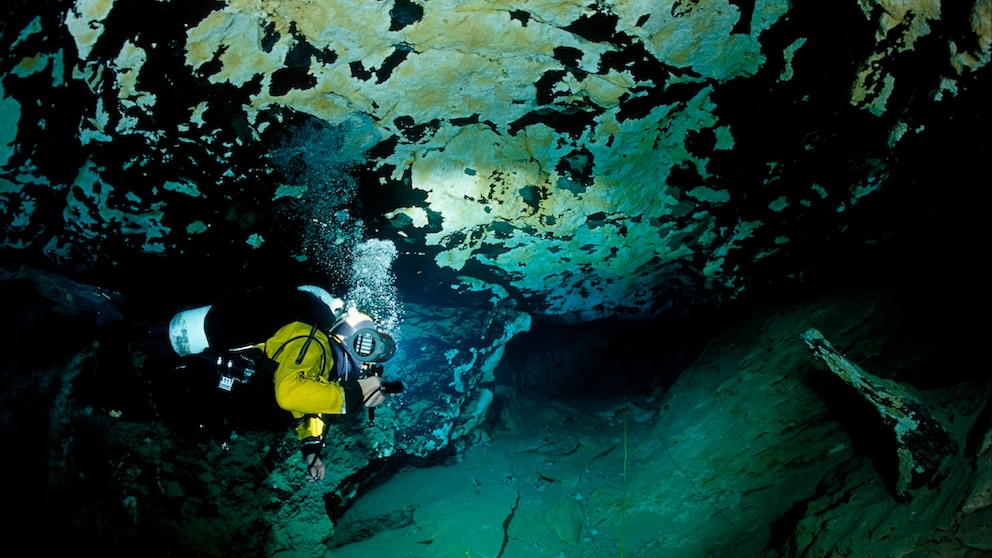
While the other two are dry karst caves, the Molnár-János Cave is a flooded thermal water cave, completely submerged. For this reason, it can only be explored with appropriate diving equipment and experience. Experienced divers can dive through underground halls at water temperatures of up to 27 degrees Celsius.
Travel to Budapest
The most convenient way to reach Budapest from the United States is by plane. The destination airport is Budapest Liszt Ferenc International Airport, which is the largest airport in Hungary. From there, you can easily reach the city center by taxi or car in about 30 minutes. Alternatively, regular shuttle buses connect the airport directly to the city center. For those who prefer train travel, you can reach Budapest from the U.S. by flying to a European hub such as Vienna and then taking a train.