


October 26, 2025, 6:23 am | Read time: 13 minutes
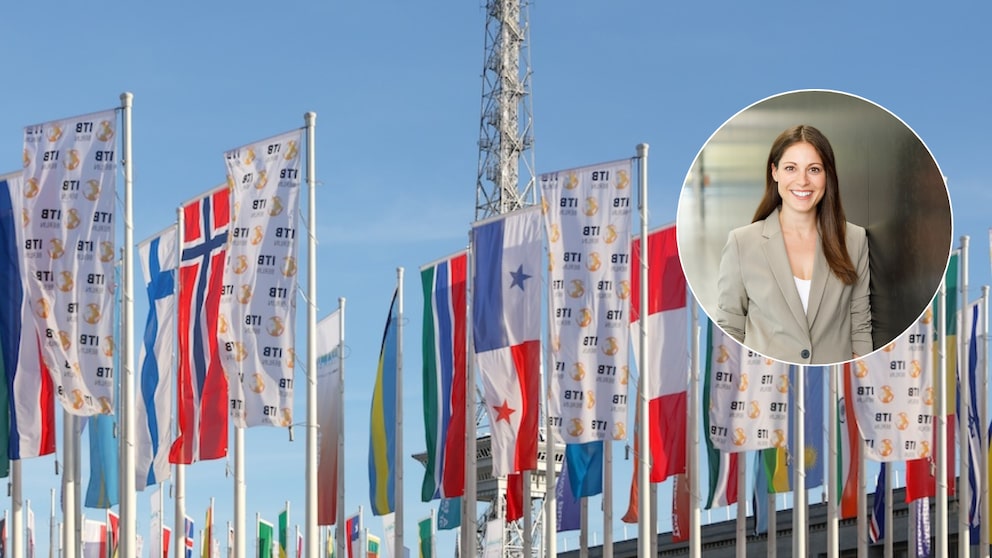
The fact that 2024 was a record year for many travel destinations in Europe is also reflected at the world’s largest tourism fair: Over 170 countries presented their offerings, trends, and ideas for the future of travel at ITB 2025 in Berlin. TRAVELBOOK spoke with ITB Director Deborah Rothe about the fair’s success formula, new international offshoots like ITB Americas–and why, despite AI and crises, personal exchange in the industry is more important than ever.
TRAVELBOOK: Ms. Rothe, ITB started in 1966 with five countries–today we are talking about more than 170 countries and about 5,800 exhibitors last year; before the pandemic, there were even more. If you had to break down ITB’s success formula over six decades into a few key points, what would they be, and what has changed the most?
Deborah Rothe: “The DNA of ITB Berlin was and still is to bring cultures and countries together, to build bridges and inspire. And that is exactly what we continue to take as our greatest mission for the future: to offer this platform–regardless of geopolitical and economic crises, of wars we experience–and still form a meeting point and bring together the world’s tourism offerings. I would say that people’s mindset has changed somewhat, in that we have very clearly understood how important it is to see each other, meet, and talk in person. And that despite digitalization, the personal handshake is important. It’s simply the magic, not only of the tourism industry but also of the trade fair industry.”
ITB in Berlin is the largest tourism fair in the world. How does the “experience factor” of ITB Berlin differ from other major fairs like WTM London, beyond just the size?
“The difference lies precisely in this DNA I just described. Namely, that it is a very personal and emotional event. ITB Berlin is often referred to as the ‘family reunion of the industry.’ And we know that this combination of the B2B factor, which we bring as a pure trade fair, now combined with the experience that tourism professionals also like to enjoy–such as cultural performances on-site or music–must be there. Emirates always likes to present their new business class, we have the railway with their new seats. And the fair also lives from the feeling, from the after-work parties at the stands. I think what sets us apart is the emotional connection and ITB as a place you simply come to every year.”
ITB not only attracts the industry to Berlin–with ITB Asia, ITB China, and ITB India, three successful offshoots have already been established abroad. In November 2026, ITB Americas will follow. How did this come about?
“We have not only been around the longest, but we are also the platform for the entire tourism industry–globally speaking. That means we are the meeting point for the world. And in 2008, we decided for the first time to go abroad with ITB Asia in Singapore. That was our first step abroad for the Southeast Asian market. And we then realized that it fits very well to build individual market events around the world, and we then decided to go into more markets. We always look at these markets very specifically. We also consciously take the time; we don’t launch a new event every year because ITB Berlin is, of course, a great platform, but it is also an event that must represent a market in terms of demand. That’s why after ITB Asia, we went to Shanghai with ITB China because China was already a very emerging market in the tourism environment at that time. And then we also decided on ITB India in 2021. We know India has not yet reached its peak, and there is still incredible potential for the future. And after the pandemic, we decided last year to take the step to America–the demand is there, and America is an incredibly exciting, comprehensive market. And that’s why ITB Americas is now in Mexico.”
Why was Guadalajara in Mexico chosen for this, and what sets ITB Americas apart from other fairs on the American continents?
“When we go abroad, we look at at least three major factors. The first is the partner structure: What partners are there on-site that we want and can work with? We also look at the infrastructure: How is the connection to the market? To be able to represent America comprehensively, it is important that everyone can travel there. And it was pretty clear to us early on that we were looking for a central location. Mexico represents that very well–and also a visa-free or visa-simple entry as much as possible. There are actually numerous flights from Europe every day, mostly from Madrid. But we also have many flights from America. Guadalajara is actually Mexico’s second-largest airport. And: Guadalajara has had the international book fair on-site for over 20 years. That means they are very familiar with the trade fair business. And that was a clear goal for us, along with the hospitality there.”
Speaking of the attractiveness and hospitality of your locations: Berlin is sometimes considered a bit rough–do you feel the city has an image problem?
“I love Berlin. I believe Berlin has incredible potential and has always tried very hard to exploit it for many, many years–and is still facing various challenges. It must be said that the competition worldwide is greater than ever–especially when it comes to location costs. Berlin is currently very expensive for many airlines, which is why we urgently need to work on becoming Germany’s global hub again. Nevertheless, ITB Berlin and Messe Berlin are our heart. And we are still convinced that ITB Berlin is best placed in Berlin–as a global hub. We see this in the general value creation of ITB Berlin. The people who travel–the tourism professionals–stay. They definitely want to spend the weekend here, go shopping, and enjoy the restaurants. And Berlin can simply do that.”
On the ITB website, looking back at its 60-year history, it is noted that “environmental and human rights issues have played an important role since the early 1990s.” How does ITB deal with countries criticized for their human rights/LGBTQ policies–such as Malaysia, one of the host countries in recent years–without losing dialogue spaces?
“You mentioned an important keyword: dialogue. And that is exactly what we want to promote. We clearly stand for our values. And we represent them as Messe Berlin, also as the state of Berlin. At the same time, we respect the sovereignty of countries. And I am convinced that you can only create a global platform for tourism if you open the door for everyone to exchange, communicate, and learn from each other. And the open dialogue–as critical as it may sometimes be–should be clearly promoted. We simply create space for countries to exchange with each other. I would like to ensure this in the future and think that we can promote development through it. Countries are at different stages of development, and I believe every country should be given the opportunity to develop further–and basically also to advance certain laws and projects into the future.”
Many cities popular with tourists are tightening regulations–Venice’s day ticket, Barcelona’s stance against vacation rentals. Tourism boards are increasingly focusing on regions not yet affected by overtourism. How does the omnipresent overtourism affect the presence and focus of smaller, regional exhibitors and representatives at ITB?
“So, basically, it is always very important to me that when we talk about overtourism, we look very specifically at what the individual problem is in the countries. Overtourism is such a buzzword that is often used to perhaps explain other problems to some extent. And in general, we see that sustainability is a huge buzzword–but there is a lot behind it. There are many different companies thinking about how to live the topic, how to fill it with life. This trend is also noticeable among the exhibitors who register. One of the biggest trends is actually the topic of ecotourism. People are always looking for something that no one has communicated yet, trying to find a new hidden gem. And that is exactly what leads to smaller, rural areas being visited much more in the future than the purely large metropolitan areas.”
The travel market has long returned to pre-pandemic volumes, and consumers are more willing than ever to invest money in travel and related experiences. Since 2023, however, ITB has been strictly B2B and condensed to three days. Is the setup set–or could consumer days or hybrid formats tap into further potential in the future?
“I clearly see the potential in the B2B fair. ITB is now a very strong, the world’s leading trade fair and leading congress for the tourism industry. That is also our core business. We want to focus on that because I believe it needs different stages for B2C and B2B. We used to combine that, and it worked wonderfully. But we have seen that the trend is increasingly towards smaller festival formats. That is the B2C. We have an incredible offer, especially in Berlin–it feels like there is an event every day. And in most cases, it is somewhat tourism-related or travel-related. And that’s why we said our stage is the B2B area.”
Looking back at ITB 2025 and already with an eye on the upcoming 2026 edition: What are the most exciting trends and developments in the travel market–both from the perspective of industry players and for consumers?
“In fact, travel spending, also due to inflation, is higher than ever. People are spending more money on travel. However, there is sometimes a cutback on additional offers. So maybe a little less money is spent on entertainment or additional travel products–but more on hotels and airlines. We have business class rates that are now incredibly in demand. What we also see as a clear trend: more diverse travel–much more towards adventure, experiencing new things, individual travel. It’s nice because people feel safe traveling again. When you look out into the world, a lot is happening that might be off-putting–but we hardly see that in travel behavior because travelers have simply become more resilient. And if I can’t travel to a particular country right now, then I’ll travel to another–the flows are simply redirected. Another trend is the big topic of Coolcation. I always find the term beautiful. People travel to cooler destinations, especially in the summer months–for example, to Tromsø in Norway, which has now become a huge topic. Another big buzzword is Longevity–everything around wellness and health. Here we see an exciting combination of luxury and well-being. How can I get more out of myself? How can I optimize my lifestyle? That is the new luxury–no longer gold faucets and milk baths.”
AI is a big, current topic–also in the travel industry. What are your most exciting developments in this regard?
“So, I will come back to the hotel industry here. We know: resource scarcity is a big issue–just like the staff shortage, which became even more noticeable due to the pandemic. Through AI or new technologies, you now learn where staff is really essential and where bottlenecks can be reduced through artificial intelligence. In the hotel industry, for example, it has been very clearly recognized that there is incredible potential in the back office. You can manage inquiries, organize the allocation of beds and rooms, or even answer queries automatically. Many hotels now use WhatsApp chats controlled by AI bots–you can ask anything there around the clock. But: I personally would like to be greeted by a person. I want to arrive at the hotel and feel that there is someone there to welcome me–someone who greets me with a smile. Exactly at this point, personal contact can be used much more specifically and efficiently in the future. When we look at the airline industry, a similar principle applies. If a flight is canceled, I no longer have to pick up the phone. I can enter directly via WhatsApp or AI chat: ‘Help me, how do I get on the next flight?’ At the same time, there are still manned counters. I think we can learn a lot from this. Nevertheless, we still see that control through a personal component–that is, through a person–remains important. We need this monitoring. And I believe that is our big key for the future: that we understand how to use AI sensibly, but also how to control it well.”
The registration deadline for ITB 2026 was September 1. Can you already give us an outlook on whether the next edition will be even bigger than this year’s? And what innovations and highlights can visitors expect in light of the anniversary?
“Well, it must be said that ITB Berlin is already the size of 23 soccer fields. We are still in the process of screening the registrations again. So, it’s still a bit too early to make a concrete statement. But I can already see that the demand is very high. It increases annually in terms of diversity. As ITB Berlin, we are not only exclusively countries and regions, but we also have a very vertical value chain on-site across companies. And we see that much more variance is coming here. We are getting bigger–in that we are becoming even more diverse. We had over 170 countries in recent years. I am cautiously optimistic to say that we will have the countries represented again. But of course, we are always directly affected by any crises and wars that happen. And we all hope that the world will become more peaceful. As for trends in the exhibition sector: We see very clear growth among cruise lines. But we also still see a sustainable trend in the area of travel technology. The various payment options are a big topic. And we still see a great demand from the health sector when it comes to the combination of luxury and health. Additionally, we have a large waiting list from the African region.”
Cruises are currently booming again and are a controversial topic in times of resource scarcity. To what extent does the topic of environmentally friendly cruises play a role at ITB?
“We deal with the topic of ecotourism or nature conservation and the environment holistically. That means we address the entire value chain of the tourism industry. We do this on the exhibition floor, where each company can decide what it represents. But we also do it in the congress. And sustainability is one of the biggest and most important topics we work on. In recent years, we have also had cruise panels where we have clearly promoted exchanging ideas about what possibilities there are in the future: How can sustainable fuels be promoted? How can you manage to move this small village on the water as environmentally friendly as possible? There are great approaches, and I am a fan of not prohibiting but rather looking at how it can be shaped in the future.”