

May 5, 2026, 3:08 pm | Read time: 9 minutes
How do I behave correctly in other countries–or at least not inappropriately? TRAVELBOOK provides an overview of the special customs and etiquette rules in popular vacation destinations and what you should avoid doing.
Adolph Freiherr Knigge addressed interpersonal behavior as early as 1788 in his work “On Human Relations.” What is sometimes considered outdated, dusty, and even frowned upon today (and which this author currently finds highly relevant) remains a part of not only German culture. Similar etiquette and behavior rules can sometimes be found in other countries, while in some cases, entirely different or even opposite rules apply. In this overview, we compile important etiquette rules from various vacation countries. Given the multitude of countries and customs, this overview should be seen as a starting point and is not exhaustive.
Etiquette Rules in Popular Travel Destinations
Overview
Japan
“There are other countries, other customs. And then there is Japan”–as the “Süddeutsche Zeitung” wrote in its “Travel Etiquette for Japan,” hinting at what many European travelers to Japan report: Japan has so many etiquette rules that it seems almost impossible not to misstep in the Land of the Rising Sun. To help you succeed, we summarize important behaviors in Japan here:
- Do not be loud–neither in public nor in your own home. This means speaking quietly and refraining from other emotional outbursts. Gesturing is also frowned upon.
- Take-out is available everywhere, but eating on the go is not done.
- When entering houses (of any kind), remove your shoes and place them with the toes pointing toward the door. Slippers are usually provided. But beware: There are special toilet slippers for the bathroom, often recognizable by their red soles. They remain in place after using the toilet.
- Do not take photos or videos of people without asking–no matter how fascinating they may be to look at.
- No tipping in Japan–it could even be considered an insult.
- Do not haggle.
- Do not leave trash lying around and separate it properly.
- Do not push and stand in line properly.
- Do not stick chopsticks upright in food or pass food from chopstick to chopstick–both are part of funeral rites and are otherwise frowned upon. Do not point with chopsticks at something or someone.
- Men may slurp soup, which is a compliment to the chef. Women may not.
- This would have pleased Mr. Knigge: Punctuality is not only a German but also an important Japanese virtue.
- No physical contact for greetings, instead a slight bow with a straight back. The rule is: The lower-ranking person must bow lower. Beware: Guests rank above hotel staff, hosts, and others. If you bow as low as they do, you force your counterpart to bow even lower.
- Point at people with the whole hand, point at yourself by touching your nose. When beckoning someone, palms face down.
- A “no” is subtly packaged.
- Do not count change in front of the waiter, seller, etc.
- No nose blowing or sneezing in public.
Also interesting: 15 things you should not do in Japan
France
Few places in the world are as strict as Japan, but many other countries also demand manners that may seem unfamiliar to Germans at first. Our neighboring country France is one of them.
- Instead of immediately speaking English, start with a polite “Excusez-moi, parlez-vous anglais?”
- Do not just sit at a free table in a restaurant; wait for the waiter.
- Do not form a circle with your thumb and index finger.
- Bills in restaurants are paid by one person and later divided equally among everyone.
- If you want to leave a small tip, leave it on the plate.
- Food is always eaten with utensils.
- Baguette is not cut but broken.
- Cheese is cut from the side.
Also interesting: 12 things to avoid in France
Great Britain
The stereotype of the somewhat stiff, extremely polite Brit is not unfounded, as this small selection of typical etiquette rules in Great Britain shows:
- In the United Kingdom, greetings include “How do you do?”, “How are you?” or “Nice to meet you!” Honest answers about one’s emotional state are avoided; instead, responses like “Fine, thank you” suffice. In Great Britain, physical contact is generally avoided during greetings.
- Always remain polite, thank and apologize often, and downplay problems.
- Keep emotions in check and do not show too much feeling (except for football or royal events).
- No mocking the royal family, the English national team, or criticizing Brexit.
- Do not cut in line.
- Never make the victory sign with the back of the hand facing forward–in England, it has the same meaning as a middle finger in Germany.
- Whoever invites to a restaurant pays. Otherwise, all guests split the bill evenly afterward.
- On British sidewalks, do not slide on ice, fly kites, or engage in other disruptive games.
- In the United Kingdom, a tip of ten to 15 percent is given unless it is already included in the bill (then it can be less). Exception: In pubs, there is no tipping, but “one for yourself,” meaning a beer for the bartender if you wish.
Also interesting: How much to tip on vacation–with country overview
Bali/Indonesia
In recent years, so many tourists have misbehaved in Bali that there are now numerous restrictions and laws. Here are some of the required behaviors on the Indonesian dream island:
- No public displays of affection.
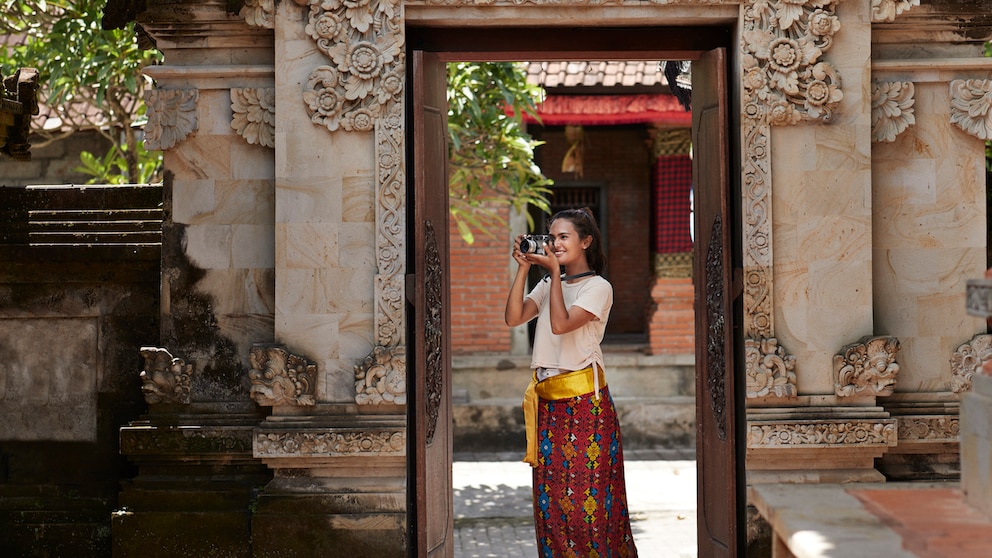
- Temples are only entered with covered shoulders, upper arms, and knees, for example, with a sarong.
- Banyan trees must not be touched.
- Do not sunbathe topless; in some places, even bikinis and similar attire are inappropriate.
India
India is also popular with travelers–and holds many pitfalls for unaware Europeans:
- Never use the left hand to reach for food or anything else or to shake hands. This hand is reserved solely for cleaning after using the toilet.
- In India, people greet each other with hands folded in front of the chest and a slight bow; handshakes are uncommon.
- Both women and men should wear loose clothing that covers the legs. At least one scarf for temple visits should always be handy.
- Shoes are removed before entering indoor spaces.
- In India, people often eat with the (right!) hand, preferably with the thumb, index, and middle fingers. For creamy or liquid foods, use chapati or rice. At the end, there is often rice–of which you should eat only a little so that the host does not think you are still hungry.
- If an Indian slowly shakes their head sideways, it means “yes.” “No” looks similar to Europe, with the head moving faster from left to right and back. There is also a wobbly nod that means an answer somewhere in between.
Also interesting: 8 things you should never do in India
Thailand
As in Bali and India, visitors may only enter temples in appropriate clothing in Thailand. This means with covered arms, shoulders, and legs. Shoes are also removed. There are also clear guidelines at the beach: No topless (women) or nude sunbathing is allowed. Additionally, it is strongly advised to avoid insulting the royal family in Thailand. Unlike in Great Britain, where you might get a wrinkled nose, you could face up to 15 years in prison here.
Also interesting: Here, a wrong word can end your trip in jail
Singapore
As in Japan, you must not litter in Singapore and should not walk around eating. If you do, you risk a fine of 300 euros. Chewing gum is even more severely punished: You must pay around 500 euros for violating the gum ban. For littering, you pay around 1,000 euros. Spitting and smoking are also prohibited. Here, too, much value is placed on calm and generally unemotional behavior; people treat each other with respect, speak at an appropriate volume, and do not push.
As in Bali, lovers should not show their affection too openly and exuberantly in Singapore. Even in your own home, you should be cautious, as you are not allowed to be naked if a neighbor could see you.
Also interesting: Do’s and Don’ts in Singapore–13 official bans and unspoken rules
Brazil
Nudity is also not well-received in Brazil, at least not on the beach. Topless is also prohibited, as is changing clothes. Additionally, discussions about soccer, religion, and politics are frowned upon.
Also interesting: 14 things tourists should avoid in Rio de Janeiro
Luxembourg
A custom in Luxembourg that may seem unfamiliar to Germans is this: Cakes are eaten with a knife and fork.
New Zealand
Even the Gap Year favorite New Zealand has some etiquette rules, partly derived from Maori and partly from British and Irish culture. Here are some examples:
- Do not sit on tables or pillows.
- No shoes indoors.
- Do not expect a “no”; New Zealanders are more likely to respond with a reserved “yeah nah,” “not sure,” or “not really,” meaning “no.”
- While you should maintain eye contact with non-Maoris during conversations, it can appear aggressive to Maoris.
- Casual but not naked: In New Zealand, shorts, sweatpants, and similar are normal everyday wear, but topless or nude is not well-received on the beach.
China
As in Japan, punctuality is valued in China. However, dining in China is much more relaxed: slurping, burping, and chewing with an open mouth are all okay. What you should not do is finish your meal completely, so the cook does not think you are still hungry. You should also not blow your nose at the table.
USA
Due to movies and TV shows, the USA often feels very familiar, but there are many small and larger behavioral differences that you may notice when traveling:
- Wishing each other the classic German “Guten Appetit” is uncommon in the USA, and “good appetite” might be met with an amused grin. If anything, it’s “Enjoy (your meal),” but you can also just start eating.
- A waiter assigns you a seat in the restaurant.
- Once you finish eating, the plate is quickly removed, and the bill is placed on the table.
- Americans are often talkative, extremely friendly, and may shower you with compliments. However, you should not feel too flattered, as this is usually part of successful small talk.
Also interesting: Tourists beware! These 11 things are prohibited in Italy
Italy
Italy also has some peculiarities that can lead to misunderstandings or even overly full stomachs:
- If you are full, leave something on your plate. Otherwise, more will keep coming. And even then, you may be asked five more times to eat more.
- Pasta is not a main course, but an appetizer.
- Spaghetti is rolled on the fork, not cut or bitten off.
- After a meal, there is a caffè, meaning espresso. Italians only drink cappuccino for breakfast.
- Tipping is uncommon, but if desired, it is left on the table afterward.