

March 2, 2026, 4:00 pm | Read time: 9 minutes
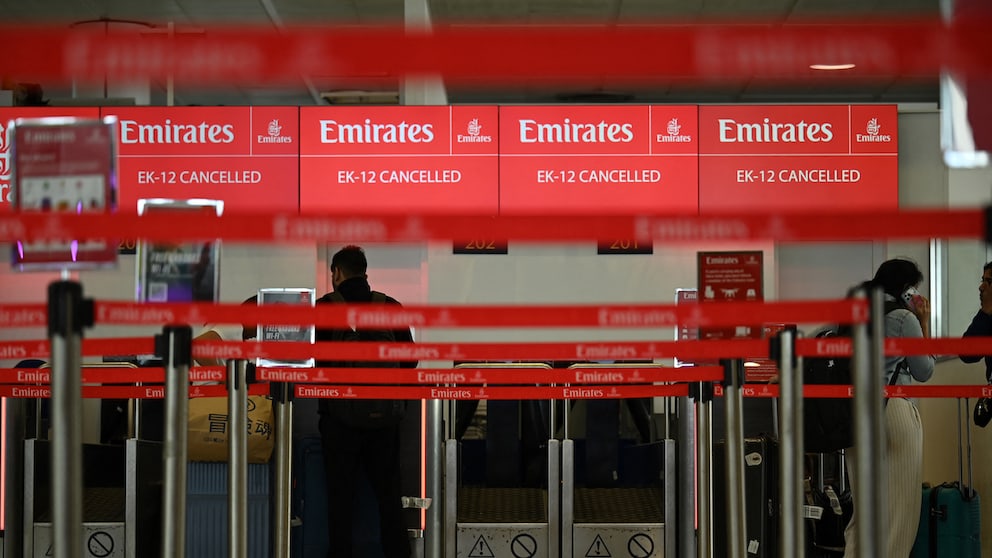
Since the start of the Iran war over the weekend, numerous travelers are stranded in the war zone, particularly in the Gulf states. Many others worldwide are affected by canceled flights. Chaos prevails. TRAVELBOOK explains what the Iran war means for travelers, what options are currently available, and what rights travelers have.
Flights canceled, cruises stopped, passengers stranded–the escalation in the Middle East is affecting hundreds of thousands of travelers in the region and beyond. According to the German Travel Association (DRV), 30,000 Germans are directly affected because they are on-site or have booked flights through one of the hubs in the Middle East. Some airspaces are closed, and several airports have been damaged by Iranian attacks. How many Germans are currently in the region is unclear. The situation is uncertain, and there is little hope from the German government. An overview.
Airports also under attack
On Saturday morning (February 28, 2026), Israel and the U.S. began targeted airstrikes on Iran. The religious leader Ayatollah Ali Khamenei and numerous high-ranking members of the mullah regime were killed. Iran responded to the attacks with massive airstrikes against Israel and various targets on the Arabian Peninsula, including Dubai, Abu Dhabi, and Bahrain. The U.S. has military bases in various neighboring Gulf states. However, the retaliatory strikes also hit airports, hotels, and other civilian locations.
For instance, as reported by “Spiegel,” a “suspected attack” was carried out on Dubai airport, injuring four people. In Dubai, the city’s landmark, the luxury hotel Burj Al Arab on its artificial island, also caught fire. At Bahrain International Airport, a drone attack caused property damage, and there was also an impact at Abu Dhabi airport.
Air traffic severely disrupted
International air traffic in the region has been massively disrupted since the start of the Iran war. Major hubs are closed or severely restricted. Many passengers are stranded in the Gulf region and elsewhere. Thousands of flights have already been canceled or rerouted.
According to “Spiegel,” Lufthansa has canceled its flights to and from Tel Aviv, Beirut, and Oman until March 7. The same applied last weekend for flights to and from Dubai. Additionally, the airline announced that it would not fly through Israeli, Lebanese, Jordanian, Iraqi, and Iranian airspace until March 7. Many large and small airlines are reacting similarly. Qatar Airways, for example, is completely canceling its flights due to the closed airspace over Qatar for the time being. For passengers, the canceled hubs and rerouted flights could become even more noticeable in the future. According to “Spiegel,” the “Guardian” already predicts that airlines could pass on the higher costs incurred by detours to passengers if the conflict persists.
Emirates cover accommodation and meals
In the United Arab Emirates, around 20,200 passengers have been assisted by airports and national airlines, writes the “Tagesschau,” citing the local General Civil Aviation Authority. Passengers on-site are provided with temporary accommodations, meals, and refreshments. They do not have to bear the costs, as the UAE intends to cover “all accommodation and meal costs for affected and stranded passengers,” according to the authority.
In addition to flights, cruises are also affected by the war. For example, two cruise ships from the provider TUI Cruises, Mein Schiff 4 and Mein Schiff 5, are stranded. The provider states on its website: “Due to the ongoing dynamic situation in the region and limited flight connections, we are in close contact with airlines to enable reliable planning of return trips.” As soon as reliable information is available, “affected guests will be informed immediately.”
Foreign Office advises taking warnings seriously
After the start of the war, the Foreign Office issued an urgent message warning against travel to the following countries: Israel/Palestinian territories, Lebanon, Jordan, Syria, Iraq, Iran, Bahrain, Kuwait, Oman, United Arab Emirates, Saudi Arabia, Qatar, and Yemen. The agency states: “Further attacks must be expected.” According to the Foreign Office, the airspaces of Israel and Iran are closed, and further airspace closures in the region could occur at any time. “Several airlines have ceased operations in the region,” the office adds. For Iran and Israel, a travel warning and an exit request were already in place before this outbreak of war, and the exit request for Lebanon has now been added, according to the “Tagesschau.”
Those staying in the region should immediately register on the crisis preparedness list ELEFAND, writes the office. According to the Foreign Office, more than 10,000 Germans are already on it, as several media outlets consistently report. These could be vacationers as well as Germans living on-site. Additionally, the office advises taking “warnings of impending airstrikes seriously” and “immediately seeking nearby shelters or the interior of a building” during an alarm and staying away from windows. Travelers and others on-site should also stay informed and follow the instructions of authorities and security forces. For questions about booked flights, the office refers to the respective airline or tour operator.
No photos of damaged buildings in Iran
In its travel advisories for Iran, the office explains, in addition to the urgent warning and exit request, that the German embassy in Tehran can currently provide “only limited consular assistance on-site.” Besides registering with ELEFAND, the office advises all Germans in Iran to also enable emergency notification via SMS. Furthermore, the Foreign Office advises “extreme caution with photo and video recordings.” In particular, one should refrain from “recordings of facilities hit by bomb, missile, or drone strikes and showing damage,” as there is also a risk of being arrested by Iranian security forces. Additionally, demonstrations and other gatherings should be widely avoided, and a stockpile of water, food, medication, fuel, and mobile communication should be maintained.
“Israel is formally in a state of war,” explains the Foreign Office in the travel advisories for the country. It further warns against travel to Israel, the Gaza Strip, and the West Bank. Those in the Gaza Strip or the West Bank should–“if possible”–leave immediately. Travelers in the United Arab Emirates are additionally urged in the office’s travel advisories to pay attention to the information from NCEMA (National Emergency Crisis and Disasters Management Authority of the UAE).
When will evacuation occur?
The situation for travelers in the Gulf region is uncertain due to the Iran war. Given the closed airspaces, leaving is currently not possible in most cases. However, there is a glimmer of hope for travelers. After Foreign Minister Johann Wadephul expressed little hope for a quick solution regarding the Iran war and the situation of travelers in the crisis area on the ARD program “Caren Miosga,” there is now hope. Crisis teams are being sent to Doha and Oman. Planes are to be provided so that vulnerable groups can be flown out. Currently, arrangements are being made with airlines. U.S. President Donald Trump expects the war to last four weeks.
Also interesting: How air travelers can easily check their rights

What Are the Guidelines for Tour Operators Planning Vacations in the Gulf Region?
Airspace Over Israel and Iran Closed–What Does This Mean for Travel?
Outlook unclear
The German Travel Association states in a Saturday announcement: “The security situation in the entire region is currently extremely volatile.” How long the airspace closures will last “is currently unclear.” Those who cannot fly home due to the airspace closures will be taken care of by their tour operator “and, if necessary, safely accommodated.” The tour operators are in close contact with local authorities and will inform their customers as soon as return trips become possible.
However, the DRV urgently advises customers of tour operators to “continue to follow the instructions of local authorities and remain in their booked hotel, and not independently travel to the airport or a neighboring country.” According to WELT, a spokesperson for the Foreign Office also said: “Travelers in the region are urged to check commercial exit options and to inform themselves directly with tour operators or airlines.”
What rights do travelers have?
In light of canceled and postponed flights, as well as interrupted or necessarily extended vacations, many travelers are asking about their rights, especially after safely returning home. While the war may not have been entirely unexpected for those who booked spontaneous trips, the impact has caught many vacationers off guard. This is particularly true for those in the Gulf states or those traveling from other parts of the world through the hubs there. Even those not directly affected, but planning a trip to the region or a flight through one of the hubs in the coming weeks or months, may wonder if they can now cancel, postpone, or change their plans without issue. TRAVELBOOK consulted attorney Jan Bartholl.
The Berlin attorney explains: “Travelers have a right to return home or be transported back to their home location by the tour operator. The tour operator must arrange alternative transportation and cover the additional costs if the original flight has been canceled.” If the operator does not offer an acceptable solution, travelers can “organize a return trip on their own under the right to self-help. They can later claim the costs from the tour operator.
Can you cancel the planned vacation?
For all package travelers who do not wish to embark on their booked trip due to the Iran war, the attorney has good news. He explains: “No one has to knowingly travel to a war zone or put themselves in danger.” In cases of violent conflicts between states, such as the current Iran war, package travelers can cancel their vacation free of charge according to § 651 h BGB. “The free cancellation right applies to all affected destinations, not just Iran,” Bartholl explains.
The legal requirement is that “unavoidable, extraordinary circumstances occur at the vacation destination or in its immediate vicinity that significantly impair the package tour.” This impairment is met for all travel countries in and around the current conflict for which a travel warning from the Foreign Office exists. Bartholl explains: “Travel warnings from the Foreign Office are considered an indication of the danger on-site and the significant likelihood of a substantial impairment.” Those who cancel their trip can demand a full refund from the tour operator. Travelers can, but are not required to, accept a voucher. Bartholl adds: “The same rules apply to cruises as to package tours.”
For those who have booked flights and accommodations separately, the right to withdraw before the trip according to § 651 h BGB does not apply. “Individual travelers must assert and enforce the cancellation directly with the contract partner (airline, hotel operator),” Bartholl explains. He adds: “Legal enforcement in the case of cancellation claims is significantly more challenging for individual travel than for package travel.”