

December 15, 2025, 10:12 am | Read time: 6 minutes
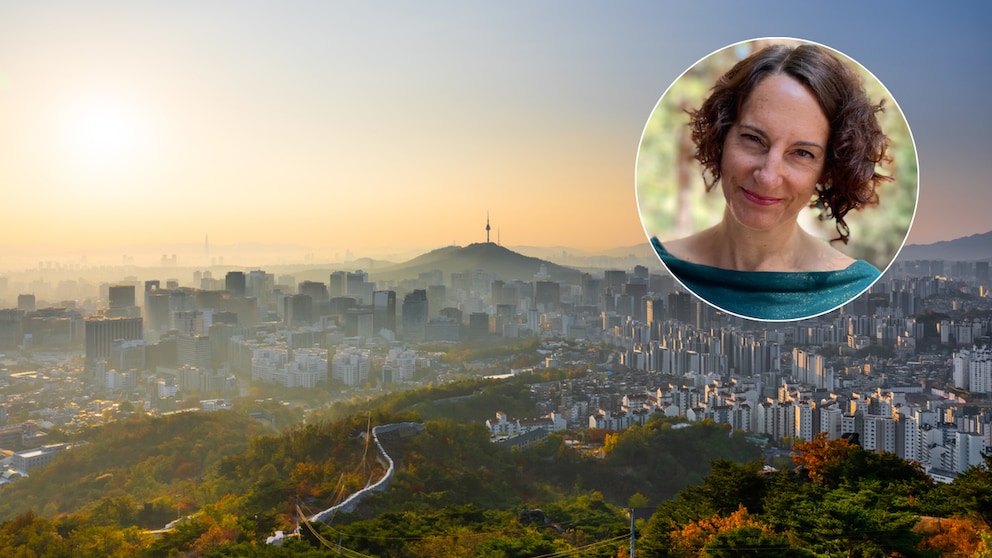
South Korea has become an international powerhouse over the past 20 years: K-pop, high tech, kimchi. The Republic has built a massive fan base in a very short time. This is also reflected in tourism: After 11.03 million visitors in 2023, the number rose to over 16 million in 2024, an increase of nearly 50 percent. This year, TRAVELBOOK author Doris Tromballa was drawn to trendy South Korea, and she reveals what particularly surprised her there.
With “Golden,” the K-pop hit from the film “KPop Demon Hunters,” Korean pop culture has reached even the farthest corners of the world (No. 1 in Germany, Austria, Switzerland, and the U.S., among others!). And when I was in Korea, every other store was playing the catchy tune from the fictional girl band. So it didn’t surprise me that there were noodle soups, nail polishes, and notebooks featuring the “Demon Hunters.” However, I was amazed by many things in South Korea that I definitely hadn’t anticipated!
1. Skincare as a Full-Time Job
I knew Korean cosmetics were trending worldwide, but I only realized how dominant skincare is in everyday life when I was in Seoul. Walking through the Myeong-dong district is essentially like walking through one giant drugstore: Hundreds of shops sell masks, serums, ampoules, creams, peels, and sunscreens—in every conceivable variation.
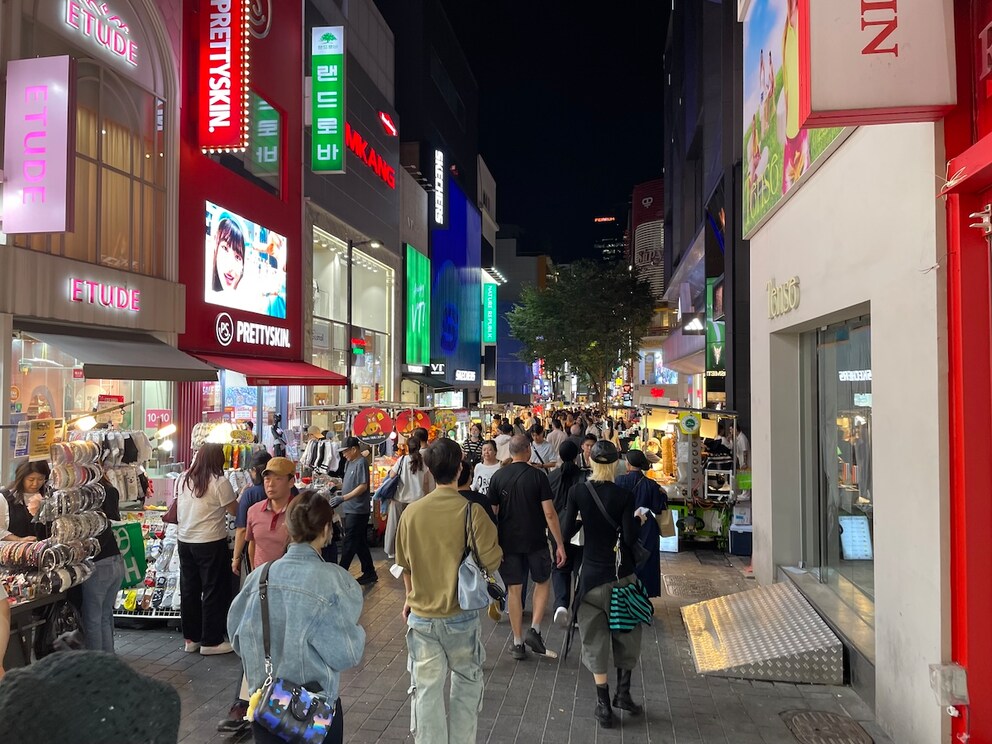
The famous “10-step routine” is only partly a marketing gimmick; it also has cultural roots: cleanse, cleanse again, toner, essence, ampoule, serum, mask, lotion, cream, sunscreen—all perfectly tailored to skin type, season, humidity, and daily condition. The dilemma: Should it be “Honey Skin” (smooth and moist like glass or honey) or “Cloudless Skin” (velvety, soft, and even)? A mask that hardens like rubber, or a cream with snail slime (allegedly a true miracle for moisture)?
Beauty enthusiasts will find paradise in South Korea, with endless opportunities to spend a large portion of their travel budget on skincare products.
2. Strollers Without Kids—But With Dogs
The first time I saw it, I thought it was a quirky affection: A young couple boarded the subway in Seoul with what I thought was a stroller, but inside was a small dog. Dressed neatly in a blouse and sweater vest. That is, the dog. On a cushioned bed with pink lace, on wheels, with a folding roof and rain cover.
Soon I realized: This is completely normal here. According to Gmarket, an e-commerce platform operator, sales of pet strollers surpassed those of baby strollers for the first time in 2024. The pet industry is booming, with many pet cafes and dog-friendly places and a growing market for products and services.
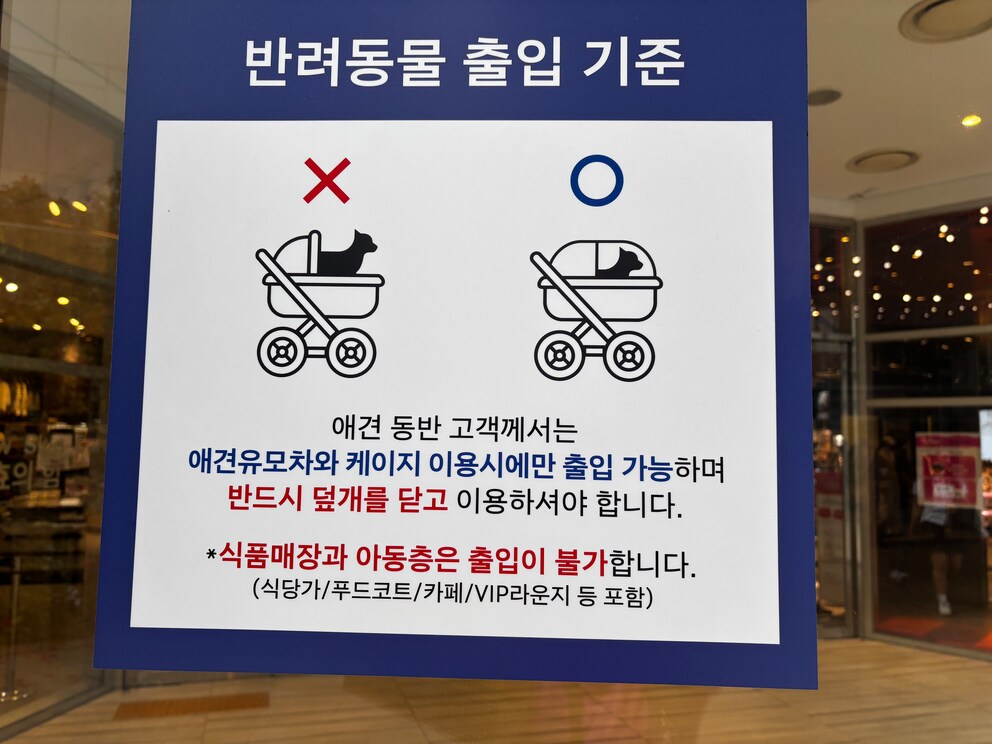
In parallel, a law was passed banning the breeding, selling, and slaughtering of dogs for the meat industry. A societal shift in attitude toward dogs has occurred. However, the main reasons for the “dog instead of baby” boom seem to be the ever-increasing cost of living and the often cramped living conditions: Family planning seems uncertain and unaffordable. As a result, South Korea has one of the lowest birth rates in the world, with 0.7 children per woman. Dogs in strollers, I found, are part of everyday life here.
3. Massive Skyscraper Complexes in the Countryside
As I drove my small car through South Korea’s rural areas, I noticed an astonishing architectural phenomenon: gigantic high-rise complexes suddenly rising from completely flat, rural terrain. And not just in the suburbs of Seoul or Busan, but in the middle of nowhere. Fields, meadows, pastures—and suddenly 80 skyscrapers, tightly packed together. Why? There’s plenty of space…
But row houses with small gardens like in Germany or the U.S. are the exception here: This juxtaposition of undeveloped areas and monolithic apartment towers is typical for South Korea. It reflects the political decision to densify housing to preserve space for agriculture and nature. Whether one finds the skyscrapers attractive is a matter of taste—but equipped with the latest home technology, their own parks, and shopping centers, they are certainly very comfortable.
4. Goethe in the Subways of Seoul
While waiting for the subway in Seoul, you stare at the “screen doors”—the safety doors on the platform in front of the tracks. These glass doors have texts (in beautiful Korean script!) that you can read while waiting. But what do they say? So I pull out my translation app. “Will you always wander farther? See, the good is so near…” I’m amazed. I know that from somewhere!
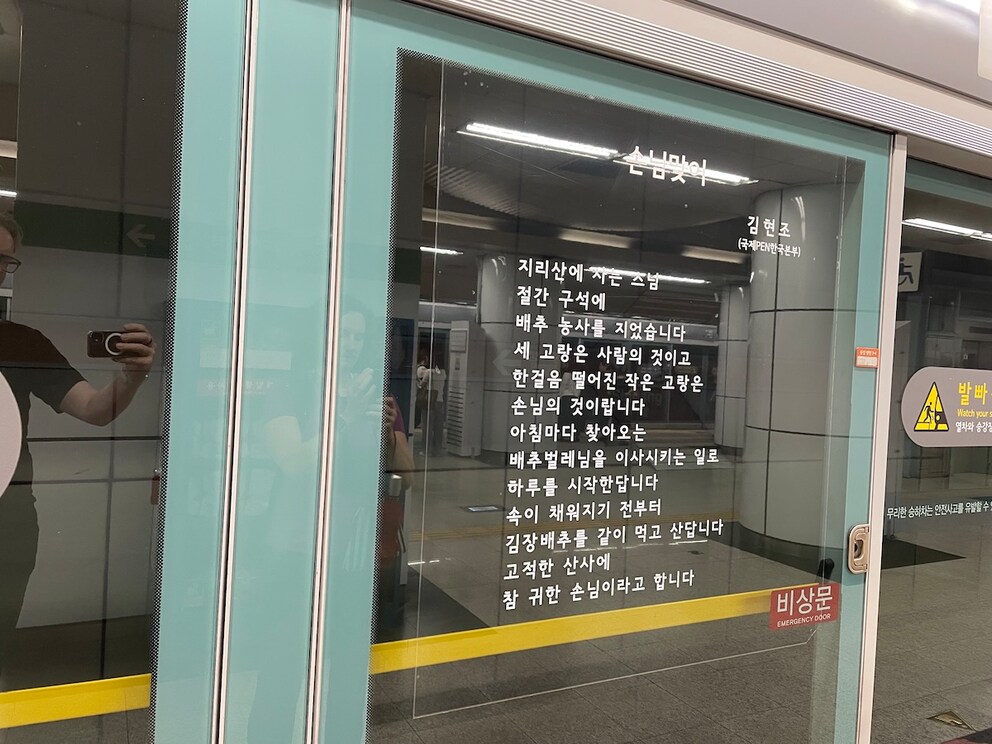
Indeed: In 2023, the city of Seoul decided to display poems by famous foreign poets on platform doors at subway stations frequently visited by foreign tourists. And that includes Goethe! So “Erinnerung” is emblazoned on the safety door in front of me. This poetic tradition started in 2008: Since then, 286 poems by citizens and poets have been displayed on platform doors at major subway stations. The aim was to bring a bit more poetry into everyday life. The goal was explicitly not to promote high literature or elitist reading comprehension, but to bring poetry into everyday life for everyone.
5. Gift Baskets with Grapes and Canned Meat
When invited, you also bring something yourself—a gesture of courtesy that is also a given in Asia. But what? The apartments can’t handle another dust collector, and the beauty regimen is very personal. So supermarkets in South Korea have a solution that almost always works: food. In specially set-up shelves, gift baskets with exquisite foods are piled up—which at first glance looked somewhat ordinary or even strange to me: grapes? Mangoes? And why is the fruit, wrapped in gold-glossy styrofoam nets, placed on black velvet cushions like jewelry?
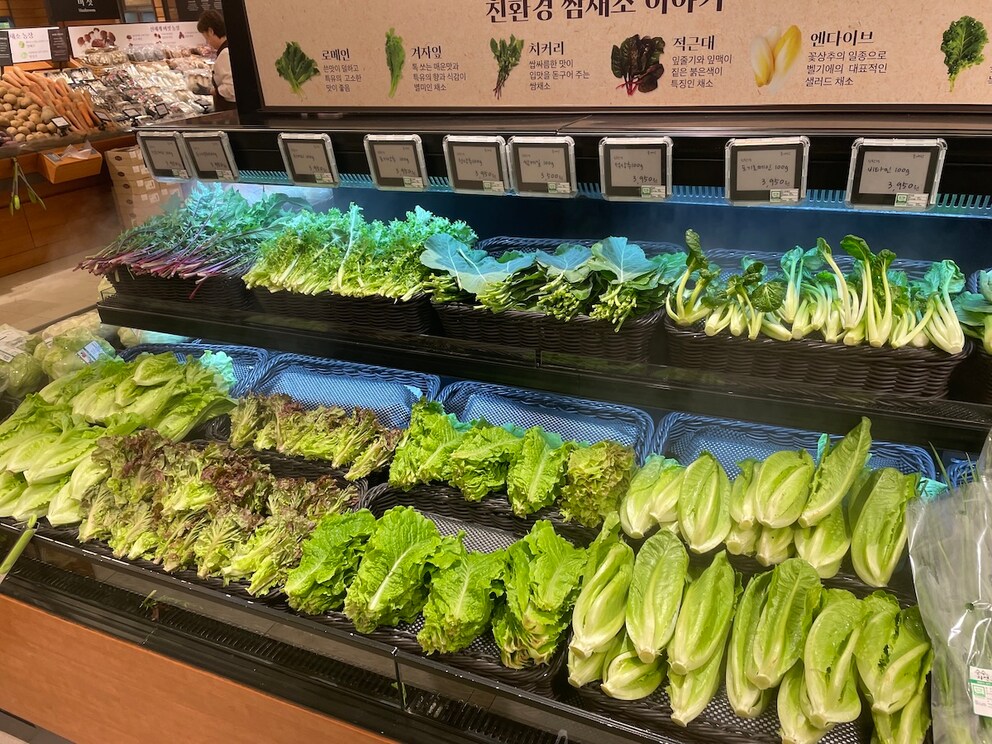
Answer: There is a significant tradition throughout Asia of bringing extremely high-quality fruit as a gift. Certain melon varieties, mangoes, or even tennis ball-sized grapes are especially popular and can cost thousands of euros. But even lettuce leaves are sold individually in supermarkets—washed, cleaned, polished to a shine. But that’s not all:
Canned meat (“Spam”) is also considered a delicacy and a gift that can score points. South Korea now has the highest per capita consumption of canned meat outside the U.S. The reason: After the Korean War (1950–53), the country was extremely poor. Meat was scarce, fresh food was rare, and Spam came into the country through U.S. military bases as a nutritious, protein-rich product that didn’t spoil and was ready to use. Spam became a valuable food in a time of scarcity. For many older Koreans, it is still associated with gratitude and a sense of “We made it.”