

June 5, 2026, 10:47 am | Read time: 5 minutes
Since 2018, the Canary Islands have officially been eight. La Graciosa is the island that was previously dependent on Lanzarote. A visit to the island, which is only 30 square kilometers and whose name translates to “The Graceful.” Our author was on-site and has the best tips.
As we drive around the rocky northern tip of Lanzarote and cross the Rio, a long strip of land appears on the horizon. What seem to be mountains rise from the flat disc. It’s hard to believe these four elevations measure only 157 to 266 meters. On this September morning, a fresh wind blows across the deck of our ferry. I enjoy the breeze, a welcome change from the heat of Lanzarote.
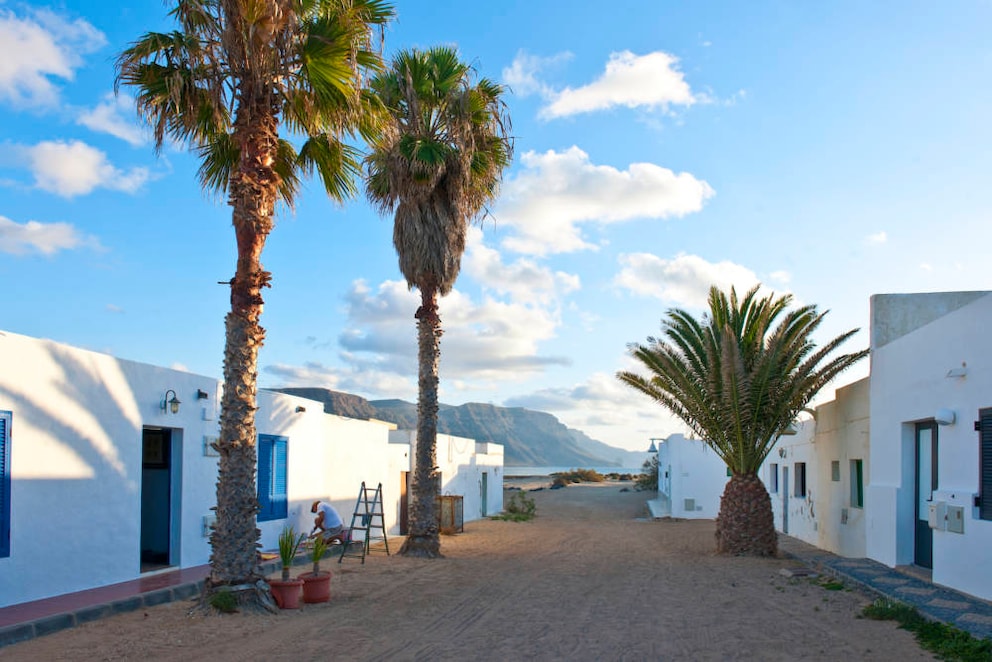
In front of us lies the island of La Graciosa, the Graceful, as it was once called by the Norman sailor Jean de Béthencourt. But the Canary Island can do much more than rest gracefully and elegantly in the turquoise Atlantic, waiting for its guests. La Graciosa can primarily surprise. Lonely beaches, only sand paths throughout, and a national park that begins behind the last row of houses in the only (serious) village and stretches across the entire island–this is a mix that dreams are made of.
Mostly Day-Trippers Visit La Graciosa
But Siggi, who has lived on this island for many years, quickly brings me back from this dream. In the height of summer, there are sometimes 3,500 guests who overrun the nearly 30 square kilometer island and its approximately 600 residents. But they come in the morning by ferry and disappear again in the evening. Only a few apartments offer space to stay. Today, it’s just a few couples who cross over to the graceful island with us and disperse on the island after arriving in Caleta del Sebo.
Also interesting: 9 good reasons to love Lanzarote
La Graciosa’s Dream Beach Las Conchas
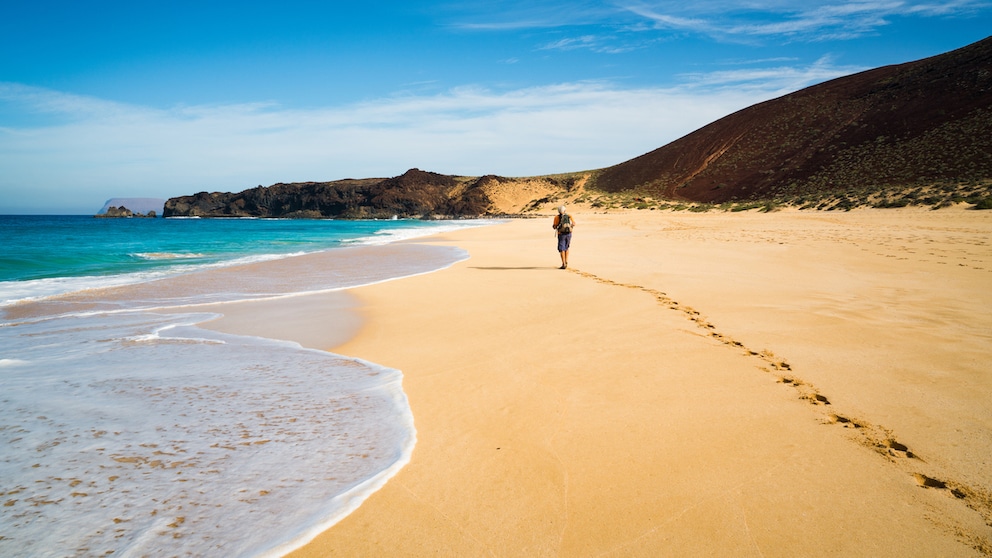
Siggi drives us in his off-road vehicle over the bumpy path, which consists of compacted sand ruts, to the beach Playa de las Conchas, five kilometers away. The pleasure costs 6 euros per person. La Graciosa is car-free, except for a handful of jeeps with which the locals drive around tourists who prefer not to walk. And that’s precisely what makes it appealing. Where else can you fully immerse yourself in the sound of the wind and the crashing of the waves without interruption?
When we reach Playa de las Conchas around 11 a.m., only a few bikes lean in the deep sand. My feet laboriously make their way through the beige-light brown sand, whose grains create a squeaky rhythm that almost sounds like music. It’s the rhythm of Graciosa. I settle on the steeply sloping strip of beach between mountains and sea. A red flag flutters in the wind, indicating that it’s better not to enter the water. Not only do the powerful waves command respect, but also a dangerous undertow. There is no tree to provide shade, but the wind alone cools.
Also interesting: The 11 most beautiful beaches of the Canary Islands
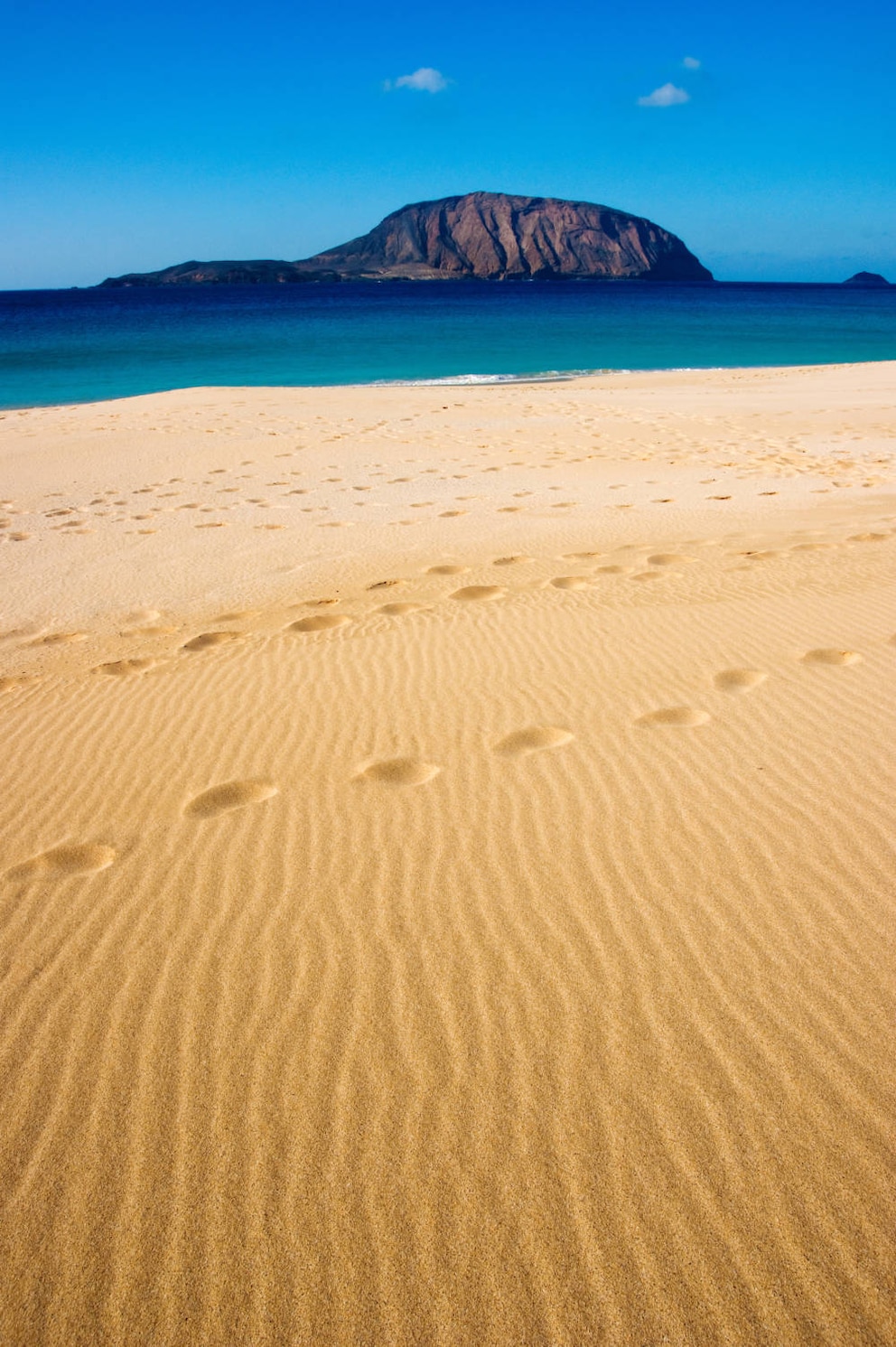
It is a land of stark contrasts–only a few tufts provide a bit of dull green in the play of brown and blue. In the south, the long strip of sand is stopped by black volcanic rock, small dark rock peaks jutting out of the turquoise shimmering sea. In the north, the red-brown Montaña Permeja invites you to climb it to view the rest of the uninhabited islands of the Chinijo Archipelago–Alegranza, Montaña Clara, Roque del Este, Roque del Oeste.
Also interesting: Which of the 8 Canary Islands suits me best?
The Best Tips for a Vacation on Gran Canaria
This Seaside Resort on Tenerife Is Still a Hidden Gem
At the Foot of Montaña Amarilla
After an hour of simply closing my eyes to enjoy the peace, I follow the tracks in the hard sand once more. A seagull battles with a fish. A woman has given up the fight against the wind and closes her umbrella. I leave the view of the island Montaña Clara, which rises steeply gray-brown into the sky right in front of me, behind and return to the village of Caleta del Sebo. From there, we take a path to the southeastern end of the island. Again, we pass beautiful bathing bays, which are somewhat more visited than Playa de las Conchas. Boats frolic in the water.
BILD Reisen: Discover the best hotels on Graciosa now!
The last bay is enclosed by a yellow-red volcano–the Montaña Amarilla, which shines particularly brightly in the sunlight. The Atlantic water unfolds a special luminosity under this play of colors and appears to me as the most beautiful bathtub in Europe. Here you can swim forever or let yourself drift–if there were no clock. But our ferry also waits at the end of the day. For every graceful lady like La Graciosa needs her beauty sleep.
Travel to La Graciosa
From Lineas Romero on Lanzarote, a ferry runs several times a day between 8:30 a.m. and 6 or 8 p.m. (depending on the season) to Graciosa. The ticket for the round trip costs about 30 euros.
The author Madlen Brückner runs the travel blog puriy.de, where she writes about different countries and cultures worldwide. Her trip was supported by Turismo Lanzarote and the Spanish Tourist Office.
Our standards of transparency and journalistic independence can be found at www.axelspringer.de/unabhaengigkeit.