

November 29, 2025, 1:50 pm | Read time: 2 minutes
TRAVEL Across Europe at high speed. The European Commission has unveiled ambitious plans to revolutionize rail transport and make short-haul flights less attractive. However, the project to connect Europe with a high-speed rail network faces enormous financial challenges.
In early November, the European Commission presented its strategy for a Europe-wide high-speed rail network. The goal is to connect major cities more efficiently and establish rail travel as an environmentally friendly alternative to flying. According to a report by BILD, the plan is for a Europe-wide high-speed rail network to be in place by 2040. On the newly planned routes, trains are expected to travel at a minimum of 200 kilometers per hour. This aims not only to significantly reduce travel times but also to boost tourism.
Significantly Shorter Travel Times Through New Routes
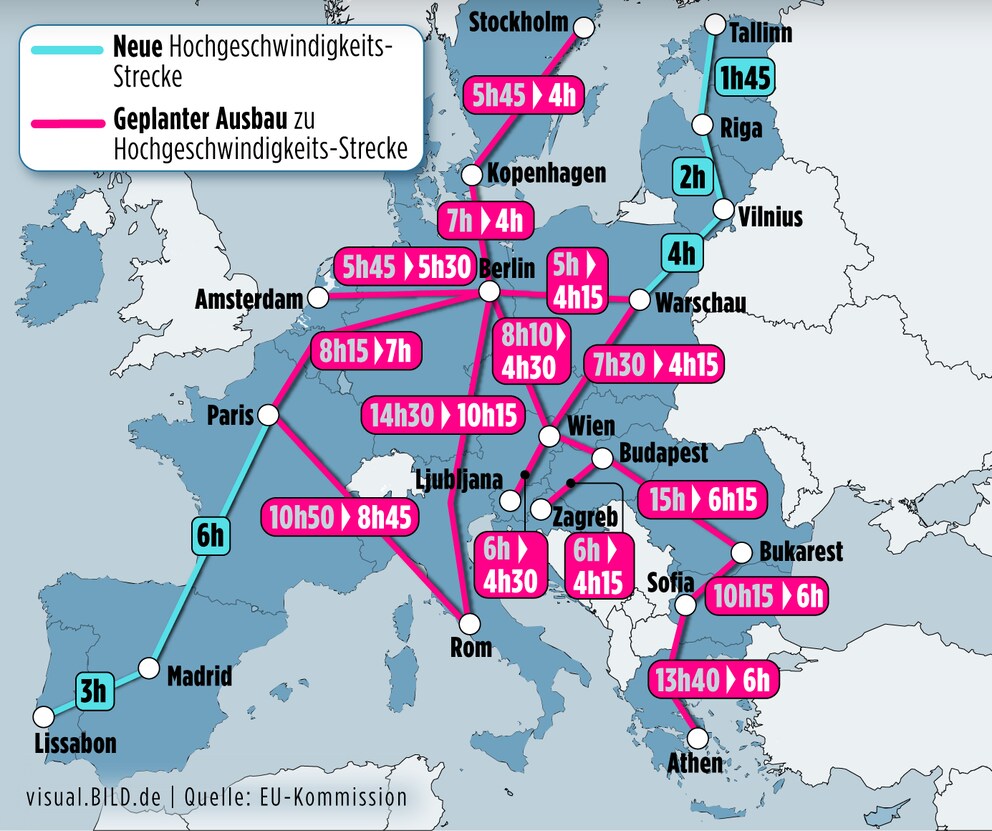
More speed on the rails also means less time on the train. The draft of the high-speed rail network shows which routes could particularly benefit in the future. For example, the journey between Berlin and Copenhagen is expected to take only 4 hours instead of 7, and from Sofia to Athens, the trip would be reduced from nearly 14 hours to just 6. New connections, such as Paris–Lisbon via Madrid, and faster rail links through the Baltics, are also part of the planned infrastructure initiative.
Overview of the Planned High-Speed Rail Network Through Europe:
Funding for the Mega Project Unclear
Despite the ambitious plans, realization is far from guaranteed. The reason is the enormous sum required for the project. According to the European Commission, the expansion of the high-speed network is estimated to cost 546 billion euros. Who will bear these costs remains open. Many member states are struggling with their own budget issues and are unlikely to be able to shoulder the costs alone.
While, according to the news portal “Die Presse,” the European Commission wants to provide additional funds, it will hardly be possible without external support. The prestige project is likely to rely on private investors.
Whether the high-speed rail network will become a reality by 2040 depends not only on political will but also on who is ultimately willing to co-finance the high-speed train.