

October 12, 2026, 5:04 am | Read time: 11 minutes
What fears accompany a woman on a world trip who uses a wheelchair? How accessible is the world? And how can one best prepare for a trip in a wheelchair? These and other questions are answered by Baden-Württemberg’s state commissioner for the disabled and author of the travel report “Around the World in a Wheelchair,” Nora Welsch, in an interview with TRAVELBOOK.
Traveling with a disability remains a niche topic in the travel industry, although there are gradual improvements to make travel easier for people with physical limitations. One person who knows from personal experience what it’s like to travel the world in a wheelchair is Nora Welsch.
Who Is Nora Welsch?
Nora Welsch has been in a wheelchair since early childhood due to spinal muscular atrophy. This hasn’t stopped her from traveling; quite the opposite. The Heidelberg native fulfilled a dream in 2024: with a wheelchair and 24/7 travel assistance, she embarked on an eight-month world tour. She writes about her experiences in her travel report “Around the World in a Wheelchair. Why I Did What Others Thought Impossible.” The book was published on October 1, 2026, by Knesebeck Verlag. Nora Welsch is a communications scientist and works as the state commissioner for the disabled in Baden-Württemberg.
Nora Welsch in an Interview with TRAVELBOOK
TRAVELBOOK: Since when have you dreamed of traveling, and when did you start?
Nora Welsch: “I’ve always dreamed of traveling. Especially as a teenager, the desire to see more of the world grew strong. At 16, I spent two and a half months in the U.S. That’s when it started, the longing to see something of the world.”
Did you travel in your childhood? What were those experiences like?
“Yes, I traveled with my parents and brothers. Those were classic vacations to various countries, such as Egypt, Spain, or Italy. It wasn’t more than what other families might do, but I already saw how exciting it is to see something new.”
What prompted you to go on your world tour?
“I was 30 years old when I started to seriously plan the trip. At that time, I felt I needed a new project. I felt a bit directionless. I had settled into my daily routine, but something inside me said: ‘You need to get out there again, experience another adventure.’ I felt like I was stuck in a rut. Although I enjoyed my job a lot, there was still a longing inside me.”
Where and how long were you traveling?
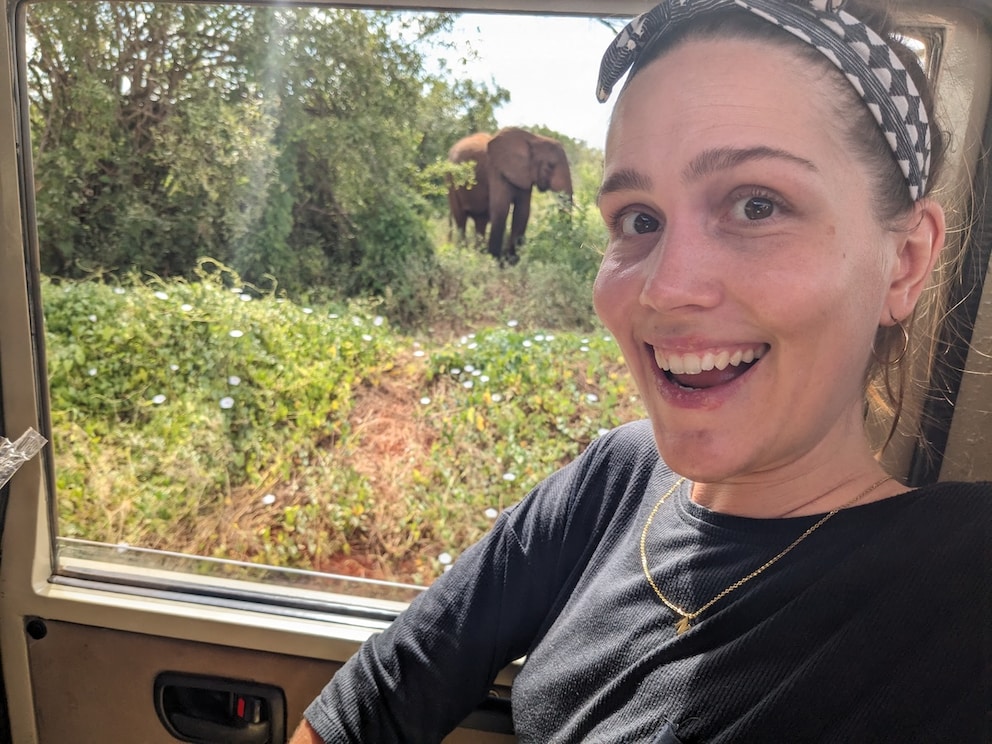
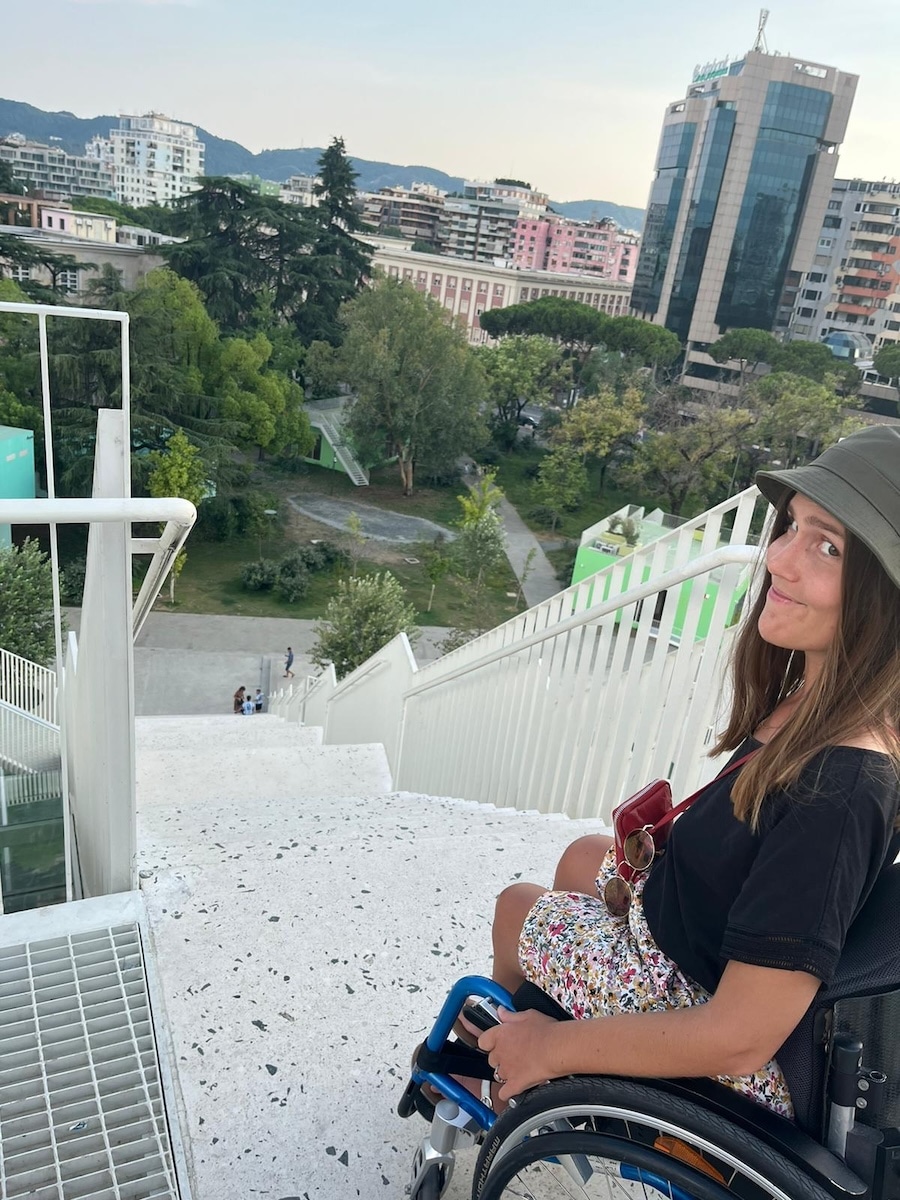
“I traveled for eight months across twelve different countries, including Kenya, the United Arab Emirates, Oman, Japan, Thailand, Albania, and Italy. In some of them, I visited various cities and other places. In between, I was in Germany, meaning I had two travel stages of three to four months each.”
What fears did you have before your trip? Which ones came true, and which did not?
“I was particularly afraid that something might break with the aids. I had a wheelchair with electric support to compensate for my lack of arm strength. Traveling with electronics and flying a lot is a big risk because things often break. I also had a transfer aid in a suitcase where I packed all my luggage. So I traveled with a large suitcase plus carry-on—I was also afraid something might break.
I had a repair kit for a flat tire and some tools, which were taken from me at an airport because they were deemed dangerous. Indeed, something on the wheelchair broke during a flight. In Cairo, a part of the wheelchair was missing, which apparently had fallen off. And in a taxi, something in the electronics for my wheels broke, but I was able to get it repaired. It was never so bad that I had to cancel the trip.
My second fear, the big one, was that something might go wrong with the assistance. I had nine different travel companions during the trip. I rely on my assistant; without them, I can hardly survive. I can’t stay completely alone for a day. So, of course, I was afraid that it might not be fun with them, that they might not feel comfortable, or that they might have assessed the situation differently beforehand. I was also afraid they might leave me behind. These fears were naturally there. Rarely did they come true. There was a situation where an assistant quit and was gone within two weeks.
But I knew beforehand that a world tour doesn’t mean everything will be rosy and great. Difficult situations would arise, and I solved them. Being able to handle it was a liberating feeling.”
What was the most beautiful moment of your trip?
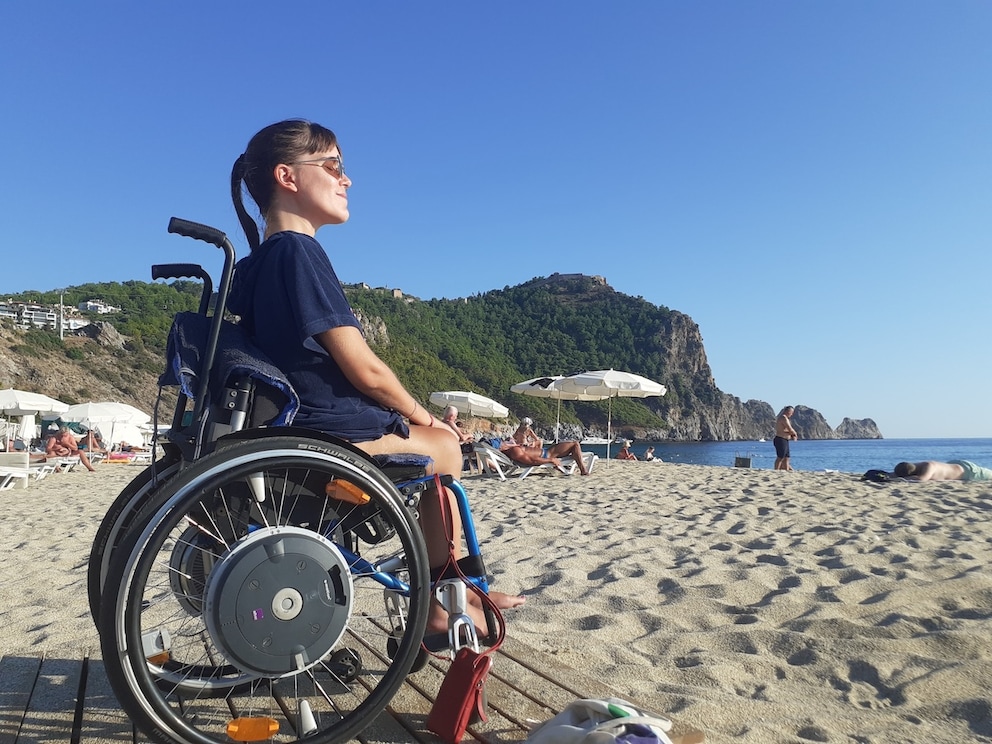
“There were plenty of beautiful moments. I’m a fish, not just by zodiac sign. I love the water, and on this trip, I swam in so many wonderful seas and was on ships. I also went snorkeling for the first time. I practiced floating on the water beforehand. I can’t free myself from this position, so it’s a big trust issue for me.
I also met many wonderful people. Sometimes I could hardly believe my luck. For example, when I saw a sunset, I thought to myself: Wow, I’m sitting here in the Philippines by the sea, seeing this, being here—those were particularly beautiful moments.”
How was accessibility during your travels? Which countries surprised you positively, which negatively, and why?
“I knew accessibility would be one of the major challenges on the trip for me, and that many countries would likely be less accessible than Germany. That was partly true. That’s why I decided not to travel with a fully electric wheelchair. It would have restricted me even more. It’s not easy to lift, harder to load, and requires more expensive accommodations. I didn’t have much money for the trip and additional costs because I had to pay for travel assistance. So I had to watch my budget and experienced situations where I wouldn’t have managed in public spaces without assistance.
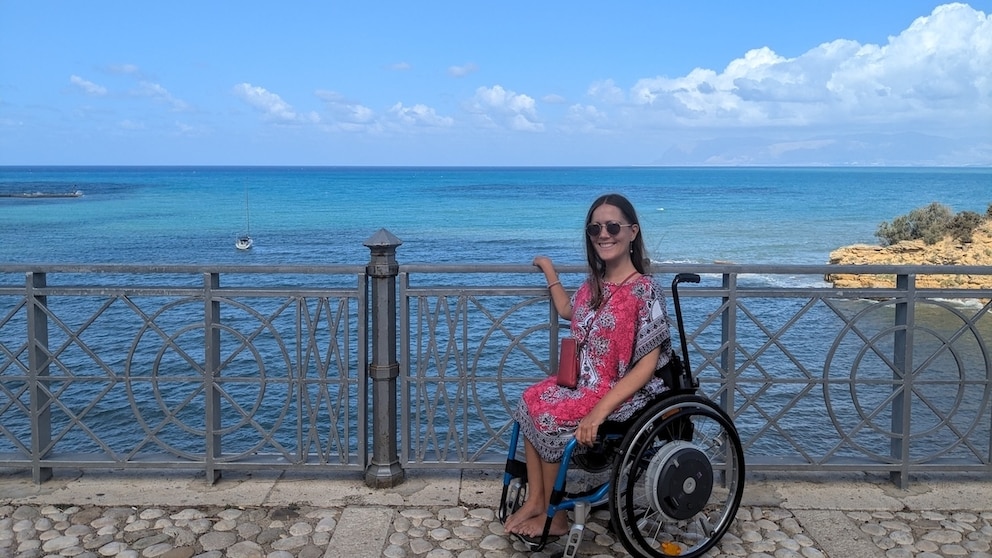
But there were also positive surprises where wheelchair users were considered. For example, in Palermo, I saw a path by the shore specifically set up for wheelchair users, with a sign and everything. I was totally thrilled. In Milan, the tram had an extra button to signal the driver that you’re ready to go. I’ve never seen anything like that in Germany or other countries. In Japan, there were dedicated wheelchair compartments on trains. You could even lay down a seat so that people who might need more care or just need to stretch out could travel comfortably. There were moments when I thought: Cool, I’ve never seen that before. That’s a real gain in accessibility.”
What were the biggest obstacles in terms of accessibility?
“Primarily, they were structural obstacles. For example, curbs, missing elevators, lack of transport options, things like that. And then it was also a major financial undertaking for me. I had to save a lot of money and spend a lot more money than I would have needed without a disability. On the one hand, because I was always traveling with at least two assistants, for whom I covered all travel expenses. On the other hand, because accessible accommodations and transport options are often more expensive.”
How much spontaneity was possible on your world tour?
“I’m a very spontaneous person by nature and open to many situations. However, my disability forces me to plan and organize a lot in advance. For example, I had to arrange flights early to register the wheelchair. Sometimes I had to rebook accommodations because some didn’t work for the wheelchair, and I had to arrange my assistants in advance.
At the same time, I also noticed how much spontaneity came to me during the trip. For example, in a situation where I decided within a few days that we would fly to Japan. Such a thing would have stressed me out earlier, not knowing a few days before the end of the stay in Egypt how it would continue. During the trip, it didn’t stress me out as much anymore. I became more relaxed. But of course, the trip still required a lot of pre-planning and organization for me.”
Which countries would you recommend to others—with and without physical limitations?
“Of course, there are countries—especially those with more money—that are generally better equipped in terms of accessibility. Dubai, for example, specifically targets tourists with disabilities. But people in wheelchairs are very different, with very different needs. Personally, I’ve always tried to find accessible vacation rentals because they’re often cheaper than hotels. But if you have the option to book hotels, you’ll certainly have more comfort there. Otherwise, everyone knows what they long for and what they want to experience. You should go by that. I’m someone who prefers warm countries, water, and swimming. I was, of course, always in cities, but I was very drawn to the water. That’s just important to me.”
What tips do you have for people who want to travel in a wheelchair? What should they pay attention to, bring, prepare, etc.?
“In general, it makes sense to travel as minimally as possible. What that looks like is different for every person with a disability. For me, it meant traveling with an active wheelchair and transporting my aids, the charger for the wheelchair, and a few other things in the suitcase. This, in turn, meant I couldn’t take many other things and exceeded the maximum weight. But the more minimally you can travel and the better you plan things in advance to have less stress on-site, the easier it is. Ultimately, you just have to embrace the adventure. It will never be 100 percent perfectly planned and prepared; you just need the courage to leave gaps.”
What needs to improve in the travel industry to make traveling with a disability easier?
“There needs to be accessibility that is enforced as a standard. Additionally, more information about accessibility is needed. Finding out whether accommodations or tourist attractions are usable for me took a lot of time. It requires the experiences of other travelers. In general, more travel options for people with disabilities are needed. There were entire countries or cities I skipped because my online research led me to conclude that while it might be a nice place, I couldn’t do anything there in a wheelchair with assistance.
Including people with disabilities in travel experiences would be super important. They also want to see something of the world and need ways to get information. Common platforms need to be better thought out. I used platforms like Booking.com or Airbnb, but often the information I needed was missing.”
What have you learned about yourself, traveling in a wheelchair, and the world during your journey?
“On the trip, I experienced that the world is simply beautiful. I knew that before, but it became even clearer to me that we humans, who always think we know so much and march through the world so arrogantly and also destroy it, are just a tiny part of a much larger mechanism. I met so many nice people everywhere. In all cultures, all nations, in all possible languages.
Of course, I reached my limits, but I was also able to push those limits further. I went to places I never thought I would ever go. If someone had told me five years ago that I would spend a night in the desert, I wouldn’t have believed it. But that’s exactly what I did, and it made me stronger, of course. To see that I can achieve my dreams. Maybe not every single one, but I can reach dreams that might initially seem unattainable and then continually challenge and push my own boundaries, which are individual for everyone. And those I can’t overcome, I can learn to accept. These many images I saw on the trip, they just stay with me and have definitely made me grow.”
What trips are planned for the future?
“I’m currently looking for a barrier-free accommodation in Greece for next year, near a beach with a Seatrac. That’s a seat on rails that goes into the water. It’s available in Greece and some other European countries. It must be a very pleasant way to get into the water when you’re in a wheelchair. I’d also like to revisit other travel destinations I saw on the world tour, but with more time. My big dream is also to go diving or swim with dolphins, both of which I couldn’t realize on the trip. I always have new ideas.”