


August 17, 2026, 12:43 pm | Read time: 5 minutes
Fare evasion can lead to revenue losses for Deutsche Bahn (DB). That’s why the company’s employees are keen on identifying travelers without valid tickets. They are now familiar with the tricks passengers use to dodge ticket checks. As a train stewardess revealed to TRAVELBOOK, one tactic is particularly popular among fare evaders–though it rarely succeeds anymore.
Fare evasion, colloquially known as traveling without a valid ticket, can legally constitute the offense of “obtaining services by deception” (§ 265a StGB). Nevertheless, people continue to attempt traveling on public transport or Deutsche Bahn’s long-distance services without a valid ticket.
Fare Evasion Appears to Be Considered a Minor Offense
It might seem that fare evasion is often perceived as a relatively minor offense in society. While theft is generally viewed as a clear-cut crime, traveling without a ticket often encounters a certain level of tolerance. Could frustration with public transport be behind this? Delayed trains, cancellations, and high fares seem to make it easier for some to justify breaking the rules.
According to the German government, 144,348 cases of “obtaining services by deception” were recorded nationwide by police in 2024. Of these, 97.4 percent were related to fare evasion. However, there is no current comparable data on how many passengers travel without a valid ticket on Deutsche Bahn alone. The last publicly available company-wide figures are from 2018: At that time, Deutsche Bahn issued 1,528,925 increased transport fees. These figures are not directly comparable, as they involve different types of data collection. But they do paint a certain picture.
DB Employee Shares Experiences with Fare Evaders
TRAVELBOOK spoke with an employee from DB’s catering service. Ticket checks are not part of her job–yet she has often witnessed fare evaders trying to dodge them. And those involved are hardly inventive.
“It regularly happens that passengers try to avoid ticket checks,” reports the train stewardess. She admits that some fare evaders do manage to succeed. However, a relatively crude yet popular tactic no longer works.
Fare Evaders No Longer Get Away with This Trick
“Fare evaders really believe they can hide in the restroom and avoid the check,” the insider says. But this trick is now “old hat”: Hiding in the train restroom during ticket checks is no longer an unknown tactic to train staff. Inspectors are familiar with this ploy and are not easily deterred.
If someone locks themselves in the train restroom and tries to wait out the check, trained staff quickly notice. And then? “We knock on the door and ask the person to come out,” says the insider. The next step usually involves discussions where fare evaders feign digestive issues. But aren’t such issues possible? “Certainly. We also wait for a while. But if there are health problems, that can be a reason to act.”
Staff Unlock Restroom Doors When Necessary
The employee explains that colleagues sometimes have to intervene if a passenger spends an unusually long time in the restroom. It’s not just about identifying a potential fare evader: For safety reasons, train staff must respond, such as if there’s suspicion that someone in the restroom needs medical help or has become unconscious.
Not only the train conductors responsible for ticket checks but also service staff in the onboard restaurant have special keys–usually standardized square keys–that can unlock train restrooms when needed. As the train stewardess explains, these are used in emergencies, technical malfunctions, or maintenance work.
Hiding Is Usually Futile
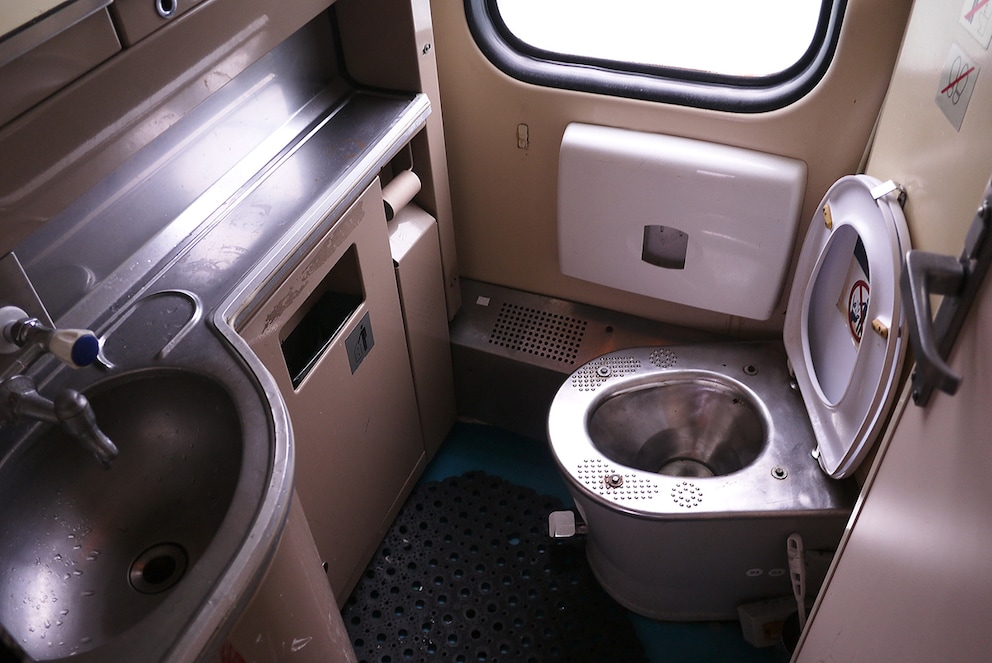
Regardless of the fact that few would find it particularly pleasant to spend unnecessary time in a cramped restroom stall, such an attempt to hide is also shortsighted. Ticket checks occur during the journey and can also be conducted randomly at a later time. More details are explained by DB here. Just because someone has temporarily avoided detection doesn’t mean the tactic worked and the fare evasion was successful!

DB Employees Warn: “Many Passengers Are Very Reckless”

DB Employees Warn: “Many Passengers Are Very Reckless”
What Happens When You’re Caught Fare Evading?
If a passenger cannot present a valid ticket, they are asked to provide their personal information. Depending on the situation, an increased transport fee may be charged. Additionally, the regular fare for the distance already traveled or for continuing the journey may be due.
Locking oneself in the restroom during a check looks particularly unfavorable. Ultimately, the extent of the consequences depends on whether the journey was intentionally undertaken without a valid ticket. After all, § 265a StGB specifically requires intentional deception to obtain transport services.
The insider reports exceptional cases where her colleagues show particular leniency. If someone was clearly in a state of emergency and genuinely couldn’t afford the journey, it has occasionally happened that they were only asked to leave the train at the next station. Whether further consequences follow depends on the individual case.
Please Don’t Try Other Fare Evasion Tactics
In summary: Fare evasion is not worth it. A missing ticket alone doesn’t automatically make a journey a crime. But just as you would naturally pay for the bread you buy at the bakery, transport services are not free. Anyone boarding an ICE train is using a service–and must generally pay for it.