

September 29, 2026, 4:19 am | Read time: 4 minutes
Many people have to travel long distances on public transportation, some regularly, others even daily. Depending on the region, they might need a well-trained bladder. In Germany, S-Bahn trains with toilets are by no means a widespread standard.
The Rhine-Main area is currently a prime example of this issue. The Rhein-Main-Verkehrsverbund (RMV) recently unveiled the first modernized S-Bahn trains for the Frankfurt metropolitan area. Existing trains of the ET 430 series were extensively redesigned. The renovation could have addressed a well-known criticism. However, even in the revamped S-Bahn trains, there will be no toilets–and this is a deliberate decision.
Why No Toilets in New S-Bahn Trains in the Rhine-Main Area?
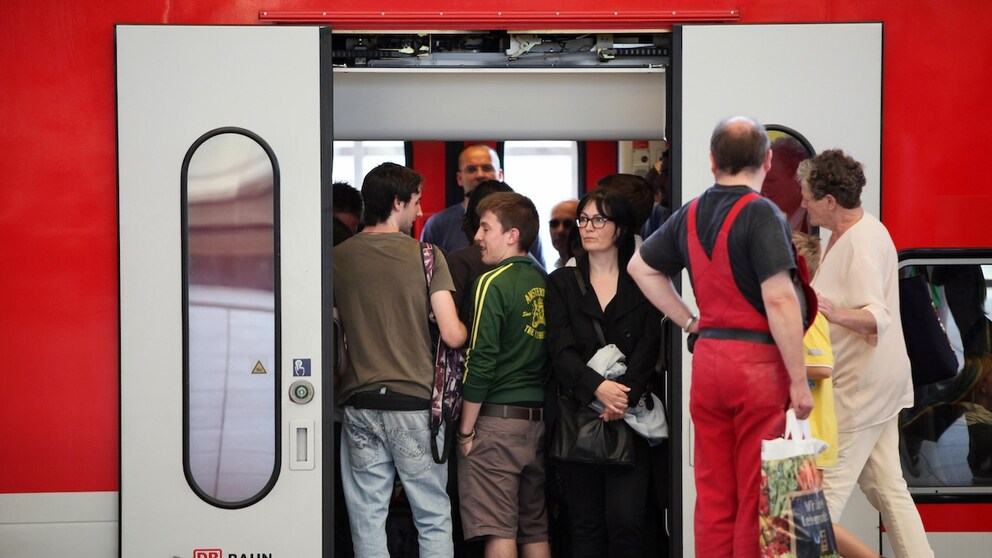
The modernization of a total of 98 existing S-Bahn trains is primarily intended to provide more space and enable faster passenger exchanges. This includes eliminating first class, introducing new entry areas, larger screens, and more power outlets. Capacity will increase by about 15 percent.
Sanitary facilities would have taken up space that is instead intended to increase capacity. This is how the RMV justifies the decision in a statement picked up by the “Tagesschau.” Additionally, passengers are typically on the S-Bahn for only about 15 minutes on average.
While that may be the average, there are certainly routes where the bladder might call for attention. For instance, the S1 from Wiesbaden to Rödermark-Ober-Roden is about 73 kilometers long–the longest S-Bahn route in the RMV area. The S8 runs from Wiesbaden to Hanau and takes about 70 minutes from start to finish.
In the comments on an Instagram post by the “Hessenschau” about the new trains and their lack of toilets, opinions differ on the necessity of sanitary facilities in public transport. Some users report long S-Bahn connections and point out that many stations also lack toilets. Others suggest planning a bathroom visit before departure once the trip duration is known.

New “Dresdner Bahn” Halves Travel Time to BER Airport

Here is Germany’s longest train platform
Regions Where You Can Find a WC on the S-Bahn
In some regions, the situation is different. For example, the S-Bahn Rhein-Neckar includes toilets as part of its equipment. The trains of the 425 series used there each have a WC, which was even renewed during a recent vehicle modernization. More information can be found in a press release from Deutsche Bahn.
The S-Bahn network in the Rhine-Ruhr area also has trains with toilets. For instance, Coradia Continental trains on the S8 are equipped with WCs. The vehicles on the S7 and the newer FLIRT trains on several other lines also have toilets. However, the ET-422 trains on the S1 and S4 lines, for example, are again without toilets.
In Nuremberg and Central Germany, S-Bahn trains do have toilets. In Nuremberg, the ET 442 and ET 1440 trains each have an accessible WC, and the Talent 2 trains in Central Germany are also equipped with toilets.
In the Rhineland, toilets are currently missing in S-Bahn trains–for now. Improvements have been made during modernization. The new S-Bahn trains, which will be deployed starting in 2029 and will operate in the Cologne area, will each have a WC in the end cars.
Do S-Bahn Trains Need Toilets or Not?
In Germany, it is generally not the norm to have access to a toilet during an S-Bahn ride. Yet, this might be necessary at times. Not only do examples from the Rhine-Main area show that an S-Bahn ride can last significantly longer than the 15 minutes cited by the RMV.
In the capital, Berlin, there are also long S-Bahn rides without onboard toilets. The S7, for example, connects Ahrensfelde with Potsdam and covers 47.3 kilometers or about 71 minutes. Those needing a WC must rely on station toilets. To assist, the Berlin S-Bahn offers a dedicated WC search feature that shows which stations have available toilets.