

February 22, 2026, 6:14 am | Read time: 4 minutes
Anyone who has walked through a moving train can attest that it can be quite bumpy at times. It’s similar in airplanes, where the seatbelt signs can come on not only during takeoff and landing but also at cruising altitude in case of turbulence. Trains, however, don’t have seatbelts at all. Why is that? TRAVELBOOK investigated.
Why Trains Don’t Have Seatbelts
Trains are considered an extremely safe mode of transportation compared to cars. This is regularly confirmed by updated safety reports from the European Union Agency for Railways (ERA). However, serious accidents do occur in rail transport, as recent train disasters in Spain have shown (BILD reported).
But you don’t have to go that far to discuss the potential usefulness of seatbelts in trains. After all, those in airplanes are not just for rare emergencies. Passengers must buckle up mainly in situations where the plane can shake violently. During turbulence, unbuckled passengers can be thrown around the cabin—a common cause of injuries to travelers and cabin crews. Cars, of course, have seatbelts, and in this case, they are indeed for worst-case scenarios. So why are they missing in trains?
Different Accident Mechanics in Planes, Cars, and Trains
The absence of seatbelts in trains is a topic often discussed in public forums, such as on the user platform Reddit. It is frequently pointed out that the typical risk situations differ among these modes of transport. The lap belts used in airplanes are primarily intended to prevent passengers from being thrown around the cabin during turbulence.
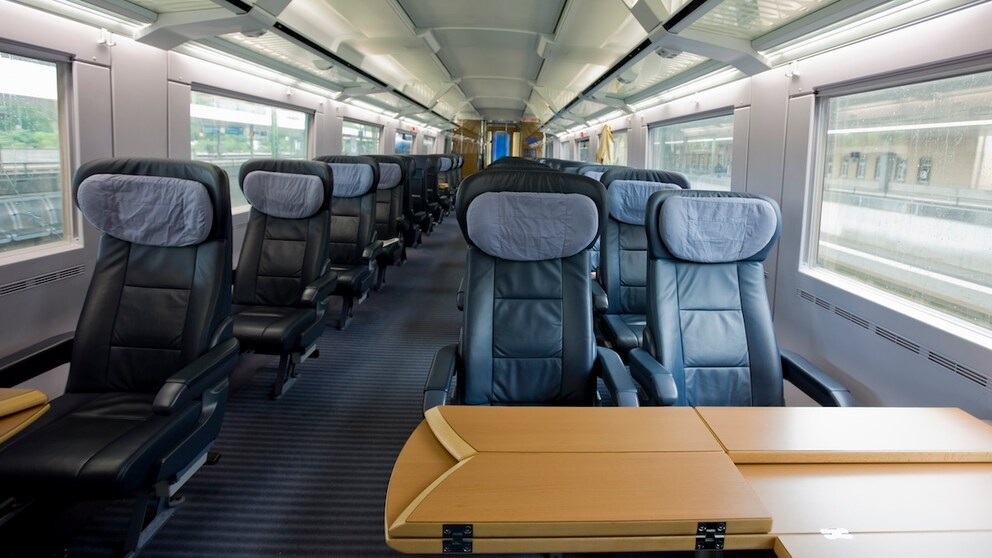
It’s important to note that severe train accidents are rarely “classic” head-on collisions like those known from road traffic. More common are derailments, side collisions, or more complex scenarios where cars shift against each other, tip over, or brake without coming to an abrupt stop. For the accident mechanics of passengers, what happens inside the trains is crucial, as a scientific study from 2019 shows. According to this, a significant portion of injuries is due to so-called secondary movements: passengers bump into seatbacks, tables, or luggage racks, or are thrown forward or sideways in the car. The impact energy of the train itself is less decisive.
Doesn’t that make seatbelts even more necessary? Intuitively, one might think so—but safety research points in a different direction.
Seatbelts in Trains Could Potentially Add Risks
Analyses from the rail industry conclude that seatbelts in trains could even increase injuries in certain accident scenarios. This includes a scientific study by the British Rail Safety and Standards Board (RSSB).
The study showed through tests with modified seats that buckled passengers are indeed held more securely in their seats and thus somewhat better protected. However, the presence of seatbelts in trains would increase the overall injury risk for passengers. As the RSSB study shows, train seats are reinforced and thus stiffer to accommodate seatbelts. Unbuckled passengers who crash into such a seat during an accident experience stronger, concentrated forces on their bodies.
Better Sleep on the Plane Thanks to Seatbelt Trick? Experts Warn Against It
Why Older Adults Shouldn’t Sit Next to Each Other on Planes
Tethered to the Seat in Dangerous Situations
In the study, the RSSB also analyzed several severe train accidents from the 1990s and early 2000s to better understand passenger movements in different types of accidents. The analysis showed that in many cases, unbuckled passengers were better protected than they would have been with seatbelts. In derailments or side collisions, for example, cars can tip over, twist, or experience structural deformations. Unbuckled passengers had the opportunity to move out of the immediate danger zone within the car. A buckled passenger, on the other hand, would have been held in a stiffer seat.
Rail Focuses on Accident Prevention Rather Than Mitigation
Modern trains are equipped with a variety of safety systems designed to prevent excessive speeds and collisions. In Europe, the European Train Control System (ETCS) ensures that trains are automatically stopped or slowed down before a critical situation can arise. The stated goal is to prevent accidents in advance—mitigating the consequences of accidents is less of a focus. However, as already explained, unwanted events are not excluded.
This may sound a bit grim. But should truly severe accidents occur, and the train cars be heavily damaged, seatbelts wouldn’t make much difference. This is noted by a former train driver in the aforementioned Reddit discussion. However, trains are extremely heavy and have buffer zones and crumple zones that significantly reduce the forces in a collision. According to the insider, even standing passengers experience only minor deceleration in many accidents because the kinetic energy is distributed across the train car. In such extreme cases, the vehicle structure primarily determines passenger survival rates—not seatbelts.