

April 21, 2026, 12:39 pm | Read time: 3 minutes
Statistically, flying is one of the safest modes of transportation in the world. However, situations can arise where planes need to be evacuated—and in those cases, efficient procedures are crucial. A study has examined the impact of older passengers in this context. TRAVELBOOK presents the findings.
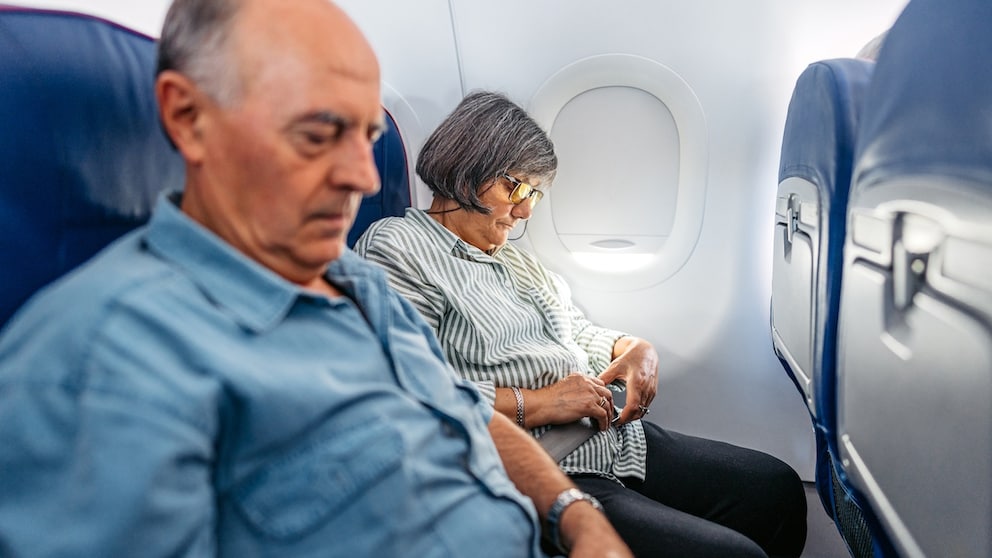
When traveling together, people often want to sit next to their companions. This is not only more enjoyable, but it also provides comfort, such as having someone to hold hands with if you’re afraid of flying. However, older individuals ideally should not sit together, as a new study shows.
How Do Older People Affect Procedures on the Plane?
Older people may not move through the aircraft cabin as quickly as younger passengers. Fellow travelers should be understanding and assist them, for example, with stowing carry-on luggage. Fortunately, most people generally show patience.
Objectively, people with limited mobility can slow down procedures. The study examined the impact of the proportion of older passengers on board during critical situations where delays could have serious consequences. The focus was on evacuating an aircraft. In such emergencies, regulations require that all passengers must leave the plane within 90 seconds, according to the study. Researchers defined “older” passengers as those over 60 years old. They also analyzed how the seating distribution of this passenger group affects the evacuation process.
Details of the Study
The researchers simulated a particularly critical scenario using an Airbus A320: a fire in both engines, where the use of emergency exits over the wings is not possible. To model this situation, they developed a detailed computer model of the aircraft cabin. Using specialized simulation software, they ran through 27 different scenarios. These varied in three key factors:
- the seating arrangement in the aircraft,
- the ratio of older to younger passengers,
- and the spatial distribution of older individuals within the cabin.
Additionally, the model considered age-related differences in movement behavior, such as walking speed and mobility.
Results
The evaluation showed that in none of the simulations was the required evacuation time of 90 seconds met. Even in the “best-case” scenario, where only a few passengers over 60 were placed near the exits, the evacuation took 141 seconds. With a high proportion of older people, the evacuation time could even extend to over 200 seconds.
In summary, the distribution of older passengers on the plane proved crucial for delay susceptibility. When concentrated in certain areas of the cabin, bottlenecks and delays occurred, significantly slowing down the entire process.
Will Airplane Overhead Bins Soon Be Locked?
Flight Attendant: “Using Tape to Restrain Passengers Is Actually Taboo”
Reasons for the Results–and Recommendations for Safe Travel
In addition to classic age-related factors—such as reduced mobility and limited fine motor skills, which can make quick standing or unbuckling seatbelts difficult—the researchers also cite possible cognitive impairments of older passengers as an explanation for the study results. These could lead to delayed reactions or orientation problems, especially in stressful situations.
Of course, older people should not be excluded from air travel. Instead, the researchers derive concrete recommendations from the study results to avoid bottlenecks on the plane and better utilize available exits. Older passengers should be seated as evenly distributed as possible. Grouping or even random placement is discouraged.
New Safety Regulations Could Be Beneficial
The researchers further emphasize that existing safety regulations may need to be adjusted. These often rely on idealized conditions, assuming that (young) passengers react quickly, move swiftly, and reach exits without major obstacles. Factors such as limited mobility, age-related delays, tight seating, or stressful situations have so far been inadequately considered. However, the aging society makes it necessary to include these realistic factors in planning.