


October 7, 2025, 10:15 am | Read time: 5 minutes
If you’re informed of a delayed arrival at your destination while still at the platform before a trip with Deutsche Bahn (DB) and learn that the train-specific ticket restriction is lifted, you might consider it a silver lining. In this case, you can skip waiting for the affected train and possibly board a “better” train without expected delays to your desired destination. But what you might not realize: With the information “train-specific ticket restriction lifted,” you gain even more freedom.
What “train-specific ticket restriction lifted” really means
You’ve probably been on a delayed Deutsche Bahn train before. If the expected arrival is more than 20 minutes after the scheduled time, the train-specific ticket restriction is usually lifted. For passengers of the affected train, this might not seem like much comfort at first–at least it seems that way. But you’ll find it’s definitely helpful to know what “train-specific ticket restriction lifted” actually means.
When the train-specific ticket restriction is lifted, it means exactly what it says. It applies to travelers who chose one of Deutsche Bahn’s two cheaper fare options when booking. These tickets are tied to a specific train–passengers must travel with that exact connection. It’s different with a Flex ticket. “With this ticket, you are flexible and can use any long-distance train (ICE, IC/EC) and regional train (RE, RB, IRE, S-Bahn) on the chosen route on the booked travel day,” explains Bahn.
However, the train-specific ticket restriction can also be lifted for saver fare tickets under certain circumstances. In this case, travelers–even with a less flexible fare–are allowed to use other long-distance trains of the Bahn.
Why the train-specific ticket restriction can be lifted
There are various reasons that can lead to the lifting of the train-specific ticket restriction (see also DB website):
- For domestic travel, there is a delay of more than 20 minutes at the destination.
- For international travel, the expected delay must be around 60 minutes.
- The relevant train is completely canceled or your stop is omitted.
- You cannot reach your connecting train due to a Bahn oversight.
- There is a schedule change–for example, if the train departs early, no longer stops at the intended starting station, or the connection has been altered.
Anyone who regularly travels by train probably knows that delays are not uncommon. On the other hand, when booking, you often have a choice between different connections. These vary in comfort. For example, on the route between Frankfurt am Main and Berlin, you can choose a so-called Sprinter, which makes few or no stops, or opt for a connection with up to eight stops. The latter naturally extends travel time and increases the risk of delays–the more stations a train stops at, the more potential disruptions. Frequent passenger changes can also cause unrest. However, the less comfortable options are usually cheaper. So if you have the “misfortune” of your train arriving about 20 minutes late at the destination, you might end up traveling more comfortably.
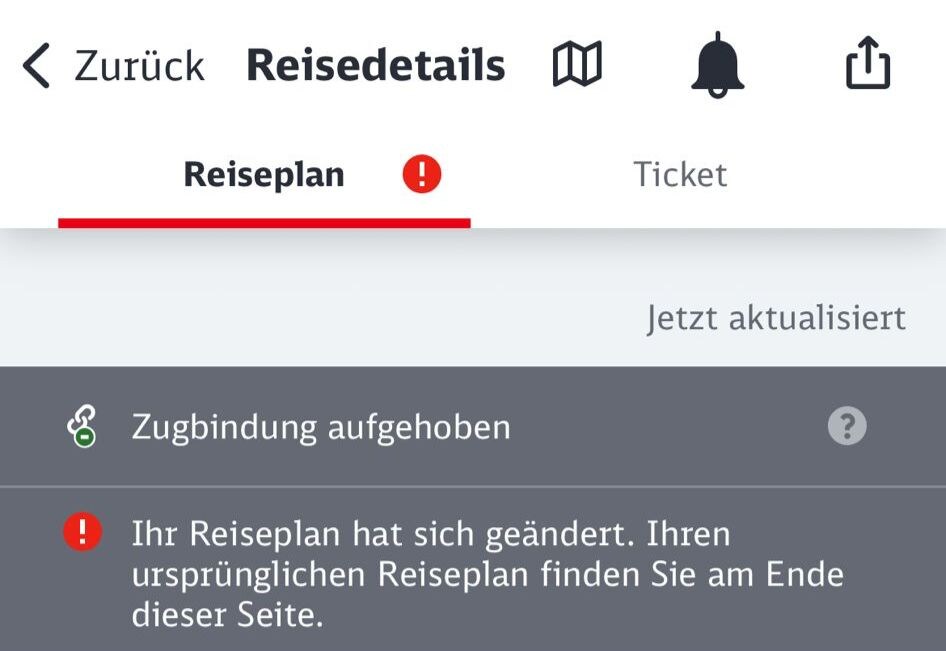
Important: A delayed departure alone does not lift the train-specific ticket restriction. The decisive factor is the expected delay in arrival at the destination. If a delay of 20 or 30 minutes is already apparent before boarding, it’s worth checking the DB app. Under “Travel Plan,” you can see if the train-specific ticket restriction has been lifted.

“Connection No Longer Operable” – What This Message Means at Deutsche Bahn
These compensations are available to travelers for train delays
Your ticket is valid for about 1 year–how to use it
If you don’t feel like waiting an hour or longer for the next train–and of course, if your schedule and commitments allow it–you can simply postpone your trip. With the lifted train-specific ticket restriction, you are no longer bound to the booked travel day. You can make the trip on any later day. This is possible up to one year after the original travel date, as explained on the DB website.
Even if an expected delay is later made up, the train-specific ticket restriction remains lifted. Once you receive the corresponding notification, you are free to decide when and how you want to continue your journey. If other trains are also affected by delays, you might switch to a long-distance bus, car, or even a plane. Then you have your train ticket for another occasion. Or: You switch to an alternative starting station. “You have free choice of travel route,” explains the Bahn. “The journey to the destination specified on the ticket can also take a different route.”
No new booking or issuance is necessary. When you’re ready to travel, simply board a long-distance train of your choice. During the ticket inspection, have the QR code or booking code of your original ticket scanned, no explanations are needed.
Train-specific ticket restriction lifted when you’re already on the train
It’s more common for delays to occur during the journey, meaning when passengers are already on board. In this case, you have the option to continue on the originally booked train or to disembark and switch to an alternative connection. Perhaps a train with a better route to your destination departs from a stopover station.
If it’s already late and you suspect your journey will extend into the night, your fate is not sealed. You can disembark to spend the night and continue the journey the next day or at a later time without buying a new ticket. The only condition is that you continue your journey toward the original destination. Deutsche Bahn recognizes these cases as “journey interruption due to train delay or cancellation.” These passenger rights are regulated in the EU Regulation 1371/2007. Since your ticket has already been scanned, you must have the circumstances confirmed by train staff or at the DB information desk. You can also have the costs for accommodation and meals reimbursed if you can no longer reach your destination on the same day due to the disruption.