

October 21, 2025, 7:46 am | Read time: 5 minutes
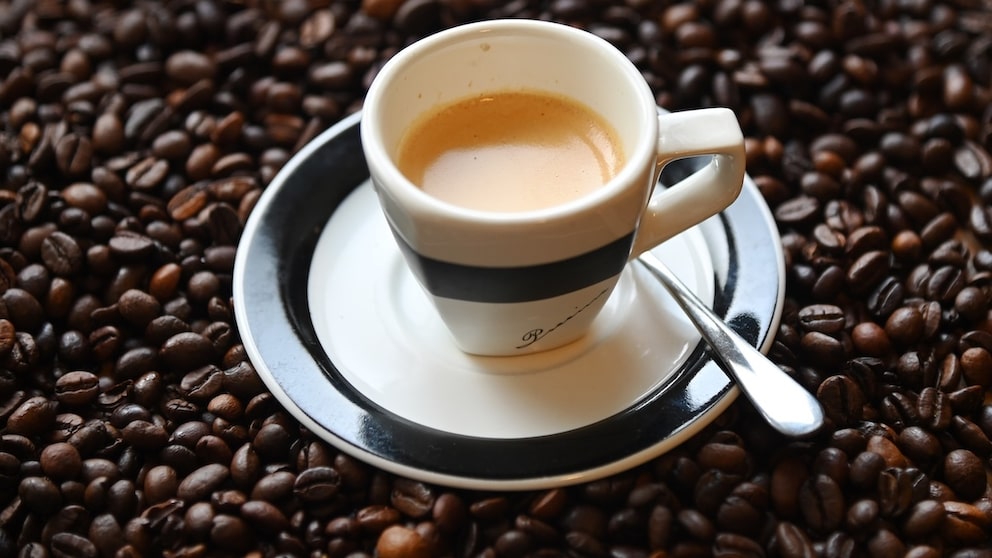
Espresso–for some, a piece of lifestyle; for others, a quick way to wake up. No other drink symbolizes European coffee culture as much as the small cup. But what will an espresso cost in 2025 in the capitals of the European Union? TRAVELBOOK has done the math and created this year’s “Espresso Index.”
Whether in the morning on the way to work, in the afternoon at a favorite café, or on vacation: For many, an espresso is simply a must. The small cup of the popular hot beverage is much more than just a pick-me-up. Originally from northern Italy, specifically Milan, the strong shot is now indispensable in private households and the gastronomy industry. Where you can still get an affordable espresso on your next vacation and where it becomes a small luxury.
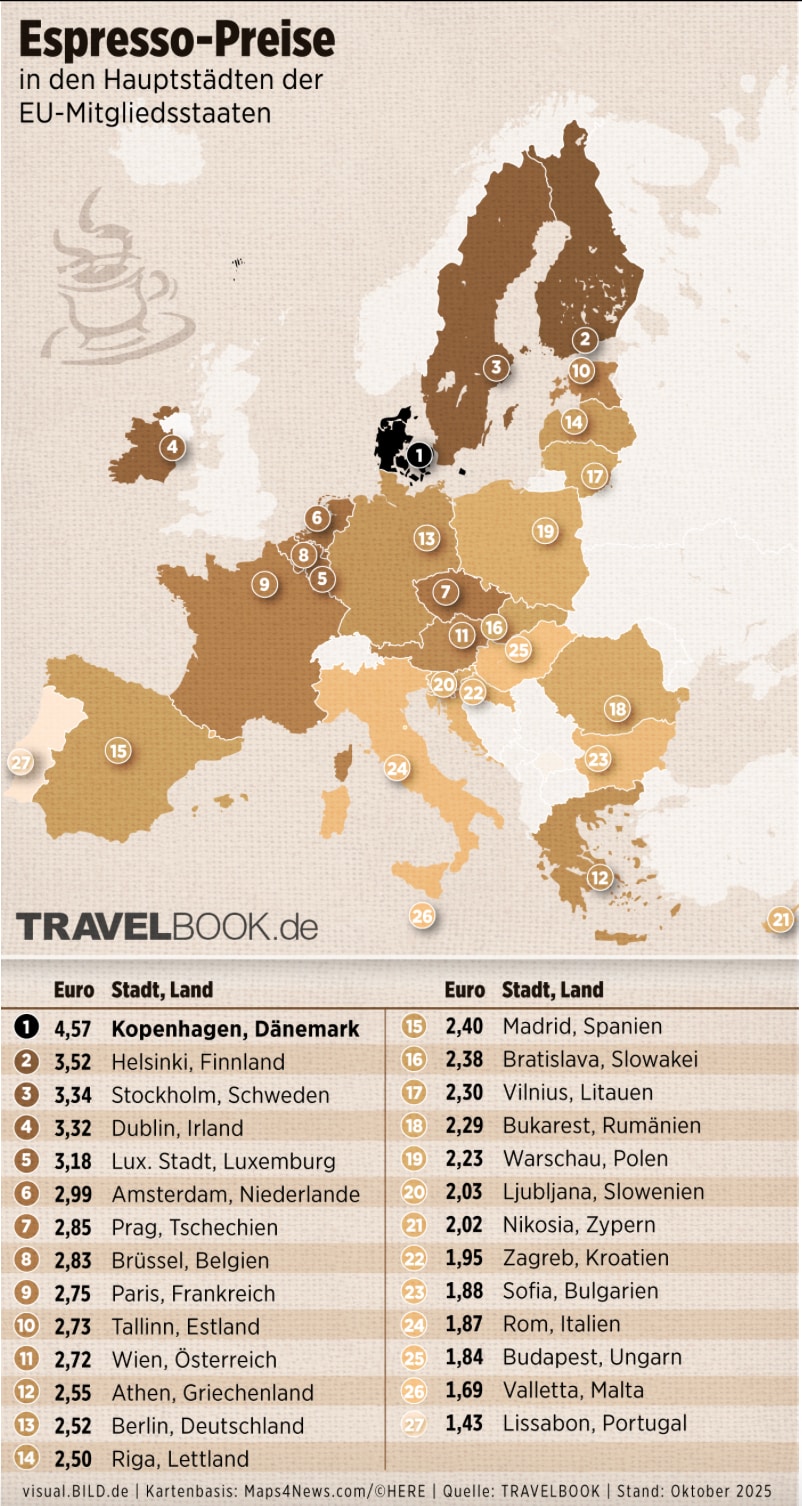
TRAVELBOOK reviewed at least six menus per city and determined an average espresso price for each of the 27 European capitals. The ranking goes from the most expensive to the cheapest price.
Overview
In these capitals, espresso is the most expensive
In many northern European capitals, espresso will have its price in 2025: In Copenhagen, Helsinki, and Stockholm, coffee fans pay between 3.34 and 4.57 euros for the small caffeine kick–making them some of the most expensive espresso cities in the EU.
At the top of this year’s Espresso Index–as in 2022–are mainly Nordic and Western European capitals. Copenhagen remains the most expensive place in Europe at 4.57 euros per cup (2022: 4.00 euros). Prices have also risen in Stockholm and Helsinki: Coffee fans now pay 3.34 and 3.52 euros, respectively.
As a reminder: TRAVELBOOK had already created an Espresso Index in 2022. Three years later, it shows that the ranking has hardly changed–but the prices have increased significantly. In Dublin, for example, the average price rose from 2.20 to 3.32 euros, and in Luxembourg and Amsterdam, the values are now over 3 euros.
A major factor in the price increase is that coffee prices have generally risen more sharply this year. According to the Federal Statistical Office, consumer prices for coffee beans in Germany alone were about 12 percent higher in April 2025 than in the same month the previous year.
This is partly due to the increased prices for raw coffee. Import prices in April were about 53 percent above the previous year’s level. A noticeable upward trend is also evident in other parts of Europe. According to Statista, the inflation rate for coffee in the European Union has risen again to around 15 percent since mid-2024. Reasons for this include rising world market prices for coffee beans, higher import costs, and increasing energy and labor costs in many European countries.
These cities are in the middle range
Capitals like Paris, Berlin, Madrid, Brussels, or Prague have secured a place in the mid-price segment. Here, espresso costs between 2.30 and 2.75 euros, so it is neither particularly cheap nor excessively expensive. In the Baltic states of Estonia, Latvia, and Lithuania, as well as in Slovakia, the price is in this range.
This shows that in large parts of Central Europe, espresso remains moderately priced in 2025–it has become more expensive, but it is still an everyday drink and not a luxury item.
By the way: When you order an espresso in Italy, the birthplace of espresso, you are actually ordering a “caffè.” The machine presses hot water with high pressure through finely ground coffee powder from dark roasted beans, creating the strong espresso known worldwide.
In southern and eastern Europe, espresso remains affordable
Espresso remains cheapest in the south and east of the EU. In cities like Vilnius, Bucharest, Warsaw, or Ljubljana, the small cup costs around two euros on average. It gets even cheaper in Zagreb (1.95 euros), Sofia (1.88 euros), Rome (1.87 euros), and Budapest (1.84 euros)–here, espresso remains an affordable classic in 2025.
At the very bottom of the price scale is Lisbon: At just 1.43 euros per cup, the Portuguese capital is the cheapest in the entire comparison. There, you can get an espresso, or as it is called locally, the “Bica” (“Bebe isto com açúcar”) (in English: “Drink this with sugar”) for almost half the price of a cup in Scandinavia.
Whether in Portugal, Italy, or Sweden–the prices for the small cup vary widely. But one thing remains the same everywhere: Where the espresso tastes best is a matter of taste.
Where Camping in Europe Is Affordable – and Where It Gets Expensive
In this European city, going out is particularly affordable, according to Time Out.
On the methodology of the “Espresso Index”
For the current Espresso Index, TRAVELBOOK examined prices in all 27 EU capitals. At least six online menus per country were evaluated–including cafés and restaurants. In total, over 160 menus were included in the evaluation. The prices were for a “simple” espresso (not a Caffè Doppio).
The determined prices were then added up, and the respective average price was calculated. In countries that do not use the euro as currency, prices were converted into euros using a currency converter to create a fair comparison basis.
The location also played a role: Only establishments in the center of the respective capital or in busy, popular districts were considered. The selection was editorial, so the Espresso Index is not representative or official but should be understood as a snapshot.
On the selection of countries
For this year’s evaluation, TRAVELBOOK deliberately focused on the 27 member states of the European Union. The focus is thus on countries that are economically and monetarily comparable–many of them use the euro as a common currency, which significantly simplifies price comparison. Unlike in 2022, non-EU countries such as the United Kingdom, Norway, or Switzerland were not considered this time.