

November 19, 2025, 10:15 am | Read time: 13 minutes
Eating bratwurst, drinking mulled wine, standing around in the cold: That’s how many Christmas market visits look. But it can be different, much more extraordinary. In Germany, there are plenty of quirky Advent markets–from vegan to risqué to kitschy-playful and completely underground. A selection of the quirkiest Christmas markets–one in each state!
Mulled wine, bratwurst, and a more or less shapely fir tree with plenty of lights and glitter: You can find this during Advent in almost every major city, and many of these Christmas markets are very beautiful. But where are the markets under railway bridges, in an Advent calendar, or with an erotic twist? TRAVELBOOK presents 16 extraordinary Christmas markets for a guaranteed varied Advent season.
Overview
Baden-Württemberg
Lights Under the Railway Viaduct
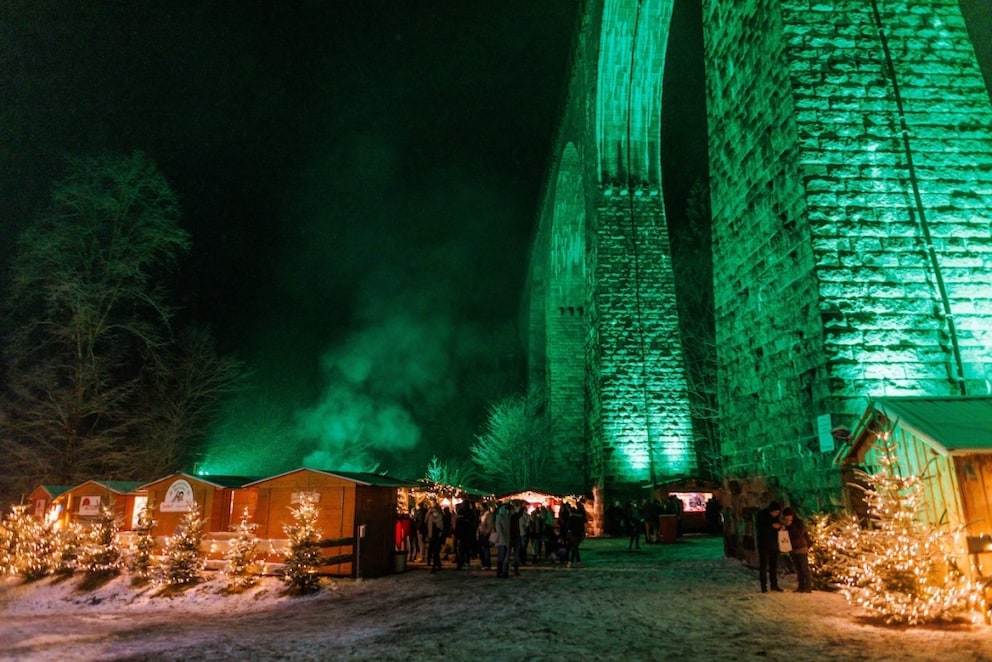
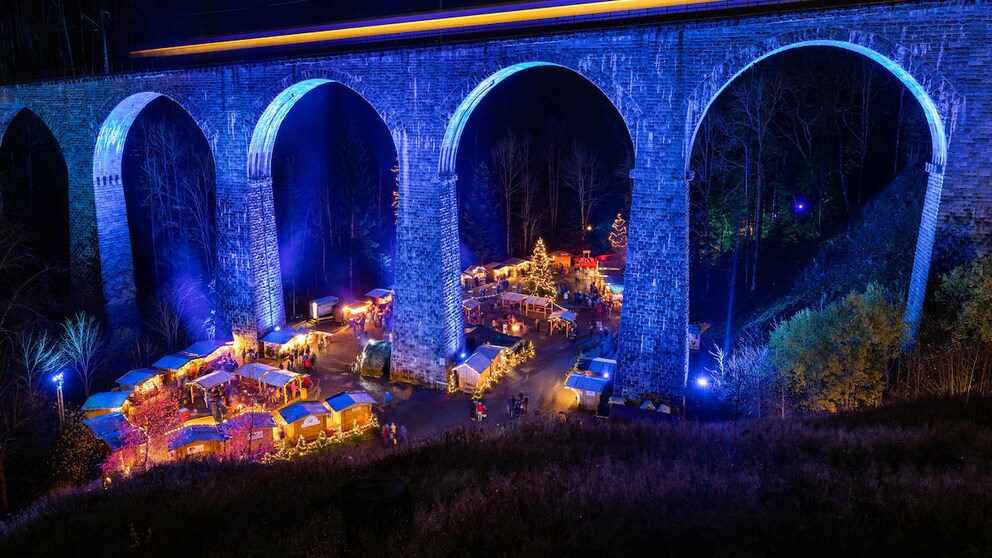
At the exit of the gorge to the upper Hell Valley in the Black Forest, a Christmas market takes place that is undoubtedly one of the most extraordinary in the country: Under an illuminated viaduct, 40 wooden huts are set up, offering arts and crafts and hearty as well as sweet treats from the Black Forest–such as ham, potato noodles, tarte flambée, and hot baked apple liqueur.
At the Christmas post office on the Ravenna Gorge Christmas Market, postcards with wishes can be submitted to Santa Claus. On a nativity trail in the forest, the story of Jesus’ birth is told. The stalls also offer a variety of arts and crafts. For young visitors, a Christmas market rally is organized, with a small reward at the end.
Bavaria
Western Meets Christmas

Lasso throwing, pony rides, and daring shows at high noon are usually on the program at “Pullman City” northeast of Passau. But during Advent, the Western theme park transforms into a “Winter Western Wonderland,” according to its own advertising.
On Main Street, Santa Claus sings, takes Christmas wishes in front of his ranch, and invites visitors to take a photo with the elves, while around the “Christmas Alehouse,” about 30 vendors set up their stalls with jewelry, pottery, clothing, and wood or leather goods.
Mulled wine and pastries are, of course, not to be missed, and in the “Pullman Barn,” live music accompanies the serving of bratwurst and burgers. Dancing is encouraged. A show team brings various Christmas customs from around the world to the stage, featuring Saint Lucia, the witch Befana, and others.
The German-American Christmas Market is open from Nov. 14 to Dec. 21, Thursdays through Sundays.
Berlin
Organic Christmas
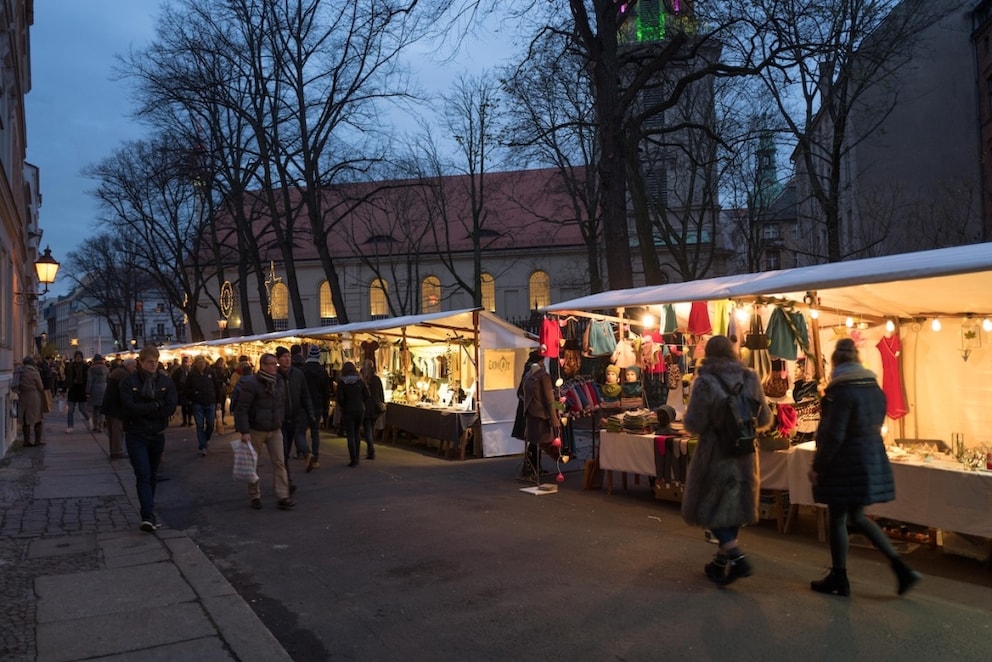
Sustainability is the focus here, as the name suggests: At the Environmental and Christmas Market in Berlin-Mitte, everything from bratwurst to mulled wine is organic, and the crafts offered emphasize fairness and environmental awareness, as the portal berlin.de writes.
There are no rides to save energy. Instead, angels and fantasy creatures on stilts roam around, and Santa Claus visits daily. The market takes place every Advent weekend on Sophienstraße, centrally located near tourist attractions like the Hackesche Höfe.
Brandenburg
Polish Christmas Tradition in Potsdam
What is Christmas culture like in other countries? Often also contemplative, but different in details than here. This is also true for Poland, where Christmas traditionally begins on Christmas Eve with the appearance of the first star in the night sky, as described on the Sternenmarkt website, which takes place from Dec. 5 to 7 in Potsdam: in the Kutschstallhof, part of the city palace of the Brandenburg capital.
At the market stalls, traditional crafts await, and there are pierogi, cabbage stew, waffles, gingerbread, and Tatar specialties to eat. According to the organizers, the highlight is the Sternenfest with a 20-hour cultural program featuring children’s theater, circus, traditional dance, and concerts, spread over the three market days.
Bremen
Cozy Wooden Winter Village
Around the town hall and along the Weser are the classic but also heavily frequented Bremen Christmas markets. Those who prefer it quieter can visit the Findorff Winter Village north of the city center. The huts are self-built.
This year, the Winter Village will be set up for the eleventh time–it opens on Nov. 7 and will remain until the end of January. That’s why it’s called Winter Village, not Christmas Village. The atmosphere is cozy, with mulled wine and hot cocktails. You can also enjoy crepes, bratwurst, hand bread, and soups. Perfect for a few relaxing hours.
Hamburg
A (Be)Sensual Christmas Market
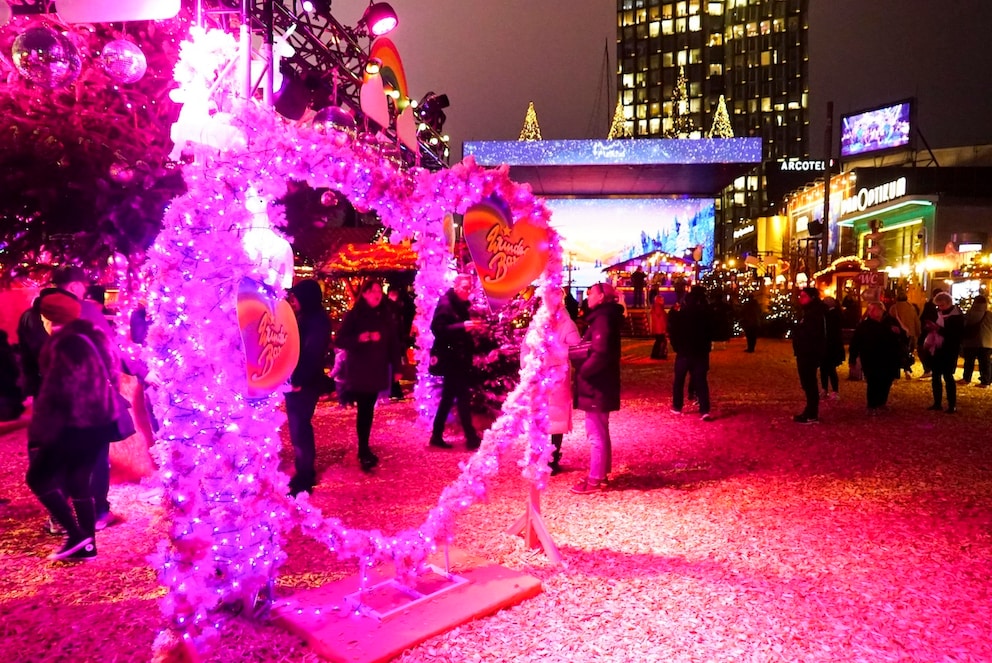
On Spielbudenplatz, St. Pauli becomes Santa Pauli during Advent: As expected, the Christmas tradition is interpreted frivolously–with “hot angels on the show stage” and “erotic gift ideas,” as the operators write. Children are also allowed, they clarify. The market has been running since Nov. 10 and continues until Dec. 23.
A visit to the mulled wine pharmacy is worthwhile, where you can create your own warming concoction based on red or white wine. You can use pipettes to add your choice of flavors–plum, star anise, orange, and much more are available.
At the pharmacy, there’s also pink unicorn mulled wine. However, only on Mondays, due to the “rare” ingredients like “hand-grated unicorn tail extract” (quote from the website). Although the drink might also be served on other days–if you ask the staff nicely.
Hesse
Christmas Between Reindeer and Fairy Tales
In Sababurg Zoo, there are also reindeer. If that doesn’t make the place predestined for a Christmas market. Indeed, once a year, there’s a big Christmas market–though the date for this year is not yet set, according to the website. Where else, besides reindeer, you can find wolves, various deer and horse species, turtles, and birds of prey, there are also market stalls with blacksmithing, pottery, and woodworking. Knights, medieval music, and fire shows can be seen and heard. Food is, of course, available.
By the way: The namesake Sababurg, located at the edge of the zoo, is also known as Sleeping Beauty’s Castle. With its rose garden and towers, it is said to have served as the inspiration for the castle where Sleeping Beauty fell into her 100-year sleep after pricking her finger on a cursed spindle, until a prince came and woke her with a kiss.
Mecklenburg-Vorpommern
Festive in the Fieldstone Barn
Once it housed 650 cows, today the huge barn in Bollewick on the Müritz is a cultural and event venue–and once a year, it becomes very Christmassy on the 10,000 square meters of space available under the building’s roof.
On the first two Advent weekends (Nov. 29/30 and Dec. 6/7), there is an Advent market in what the operators claim is Germany’s largest fieldstone barn.
Lower Saxony
The Christmas Forest in Goslar
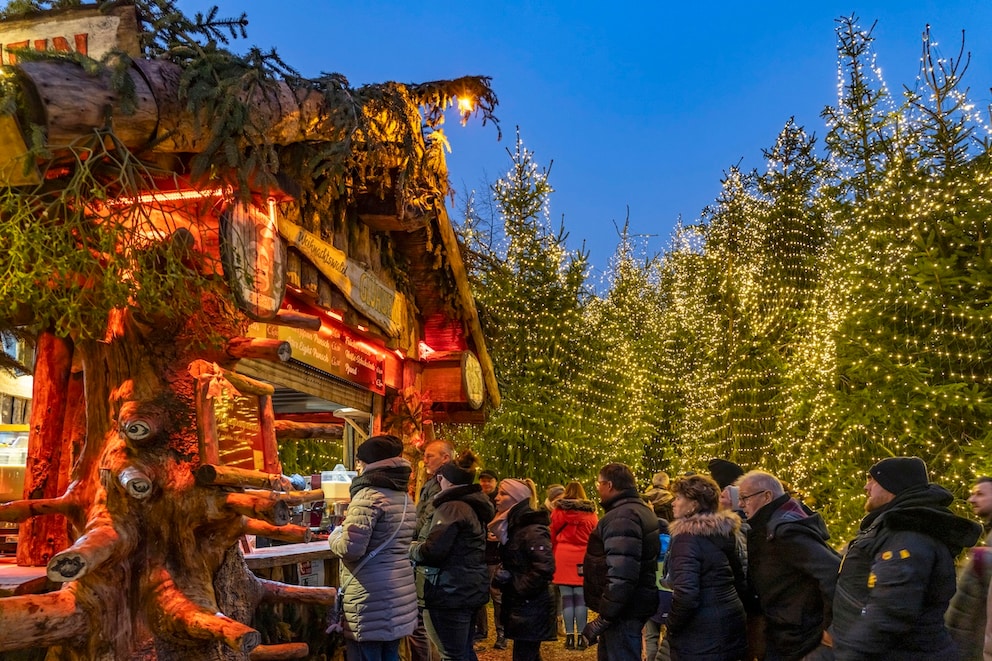
Together with the over 1,000-year-old Rammelsberg mine and the structures of the Upper Harz Water Management, the old town of Goslar with its more than 1,500 half-timbered houses is a UNESCO World Heritage Site. In the middle, on the Schuhhof, the Christmas Forest “grows” again this year.
Fir trees from the Harz are set up close together, adorned with 160,000 lights, and “fresh forest floor” is spread out, with stalls offering mulled wine, crafts, sweets, and savory treats. The atmosphere is unique. And to keep it that way–also this year from Nov. 26 to Dec. 30–the idea was protected by the German Patent and Trademark Office.
Those who want to combine a visit to the Christmas forest and market with a guided city tour of the UNESCO World Heritage Site in Goslar can book it for 15 euros per person here–including a drink in the Christmas forest.
North Rhine-Westphalia
Christmas Flair in a Renaissance Setting
A moated castle is romantic in itself. When a medieval Christmas market is held there, nothing can go wrong in this regard. Merode Castle, built in the Renaissance style on the edge of the Eifel near Düren, is the best example of this.
The pre-Christmas spectacle, which requires an entrance fee (starting at 4.50 euros), is open from Nov. 26 to Dec. 21. Food stalls offer potato pancakes and candy canes, and the program includes regular appearances by the Christ Child and St. Nicholas, as well as tours with the Light Queen Lucia. The operators of the traditional craft stalls encourage participation.
By the way: Last year, the Christmas market at Merode Castle was voted the coziest in Germany by TRAVELBOOK readers.
Rhineland-Palatinate
Good Wine from the Underworld
Upon entering the gate, visitors are greeted by the scent of mulled wine, roasted almonds, and pine greenery–so far, so normal. The difference that the “Mosel Wine Nights Market” in Traben-Trarbach makes: It takes place underground in the former wine cellars of the city on the Middle Mosel. And the motto is: “Wine, Enjoyment & Culture.”
Twenty-two kilometers of wine cellars stretch through the underground of Traben-Trarbach; around 1900, the city on the Mosel was even the largest wine trading metropolis alongside Bordeaux (France). Eight of these wine cellars will open again this winter, Fridays through Sundays, as a Christmas market, or rather: “Mosel Wine Nights Market.” In addition to classic treats and decorations, there’s much to discover about wine and wellness.
The Traben-Trarbach Christmas market is open on weekends between Nov. 21 and Jan. 3. Admission to the “Wine Nights Cellars” costs 5 euros (from age 16, free for younger visitors). The ticket bands remain valid for the entire duration of the event.
Saarland
Where Santa Flies In
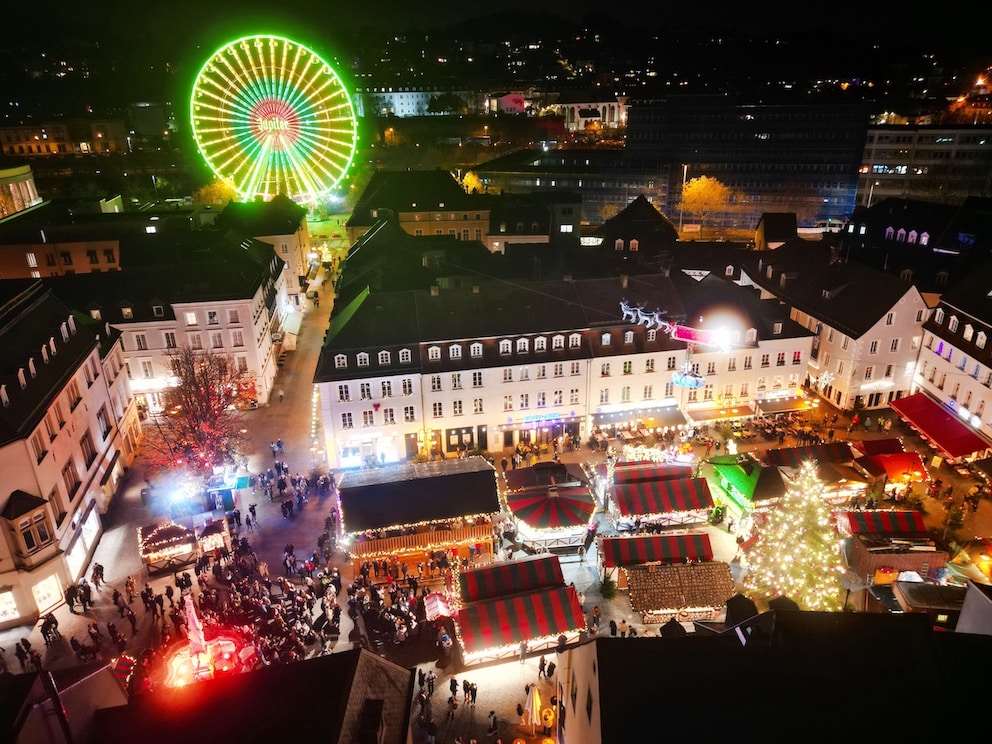
Always at 5:00 and 7:00 p.m. on opening days, it’s time: Santa flies in. He in a reindeer sleigh, the Christ Child waving on a cloud below, they float high above St. Johanner Markt. And if you imagine the supporting wire away, you can indulge in this Christmas illusion–at the Christkindl-Markt in Saarbrücken.
It is open from Nov. 17 to Dec. 23 and from Dec. 27 to 30: Stalls with crafts, mulled wine, and roasted almonds on Bahnhofstraße and St. Johanner Markt are a given, with special features including a nearby ice rink on Bahnhofstraße (admission: 6 euros) and the opportunity to view the festive Saarbrücken city from above: during a ride on the 50-meter-high Jupiter Ferris wheel (regular 7 euros, children from three years: 4 euros).
Saxony
Historic Market with Weather Protection
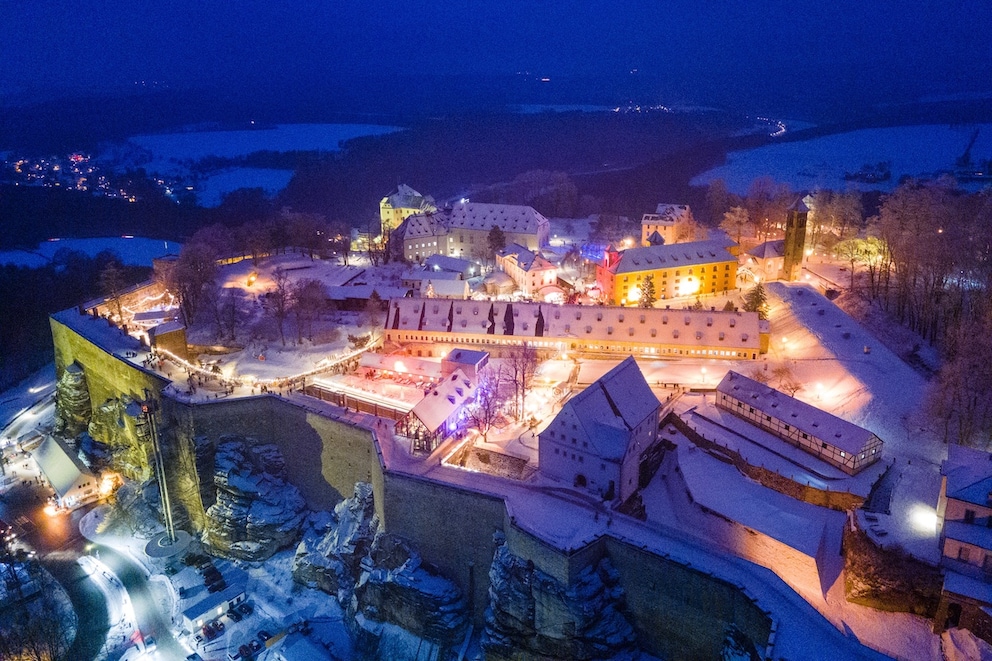
The setting on Königstein is impressive: High above the Elbe stands the massive fortress in the Elbe Sandstone Mountains. On Advent weekends, a historic Christmas market takes place here: In keeping with the location (Königstein was expanded into a fortress from 1563), “hand-hewn” wooden stalls stand in the courtyard, and the vendors wear old costumes.
“Goulash soup and fortress punch steam in large copper kettles over open fires,” the organizers write. And if the weather doesn’t cooperate on the fortress southeast of Dresden: In the underground vaults (casemates) of Königstein, there is a weather-protected promenade area.
Because the demand is often high, tickets are limited–to 7,000 per market day. But that’s almost as many as the previous visitor record, the organizers reassure. Adults pay 15 euros, children from seven years 12 euros, younger ones get in for free but also need a (free) ticket. Tickets are available exclusively online, and presales have been running since September.
Saxony-Anhalt
Christmas World Heritage
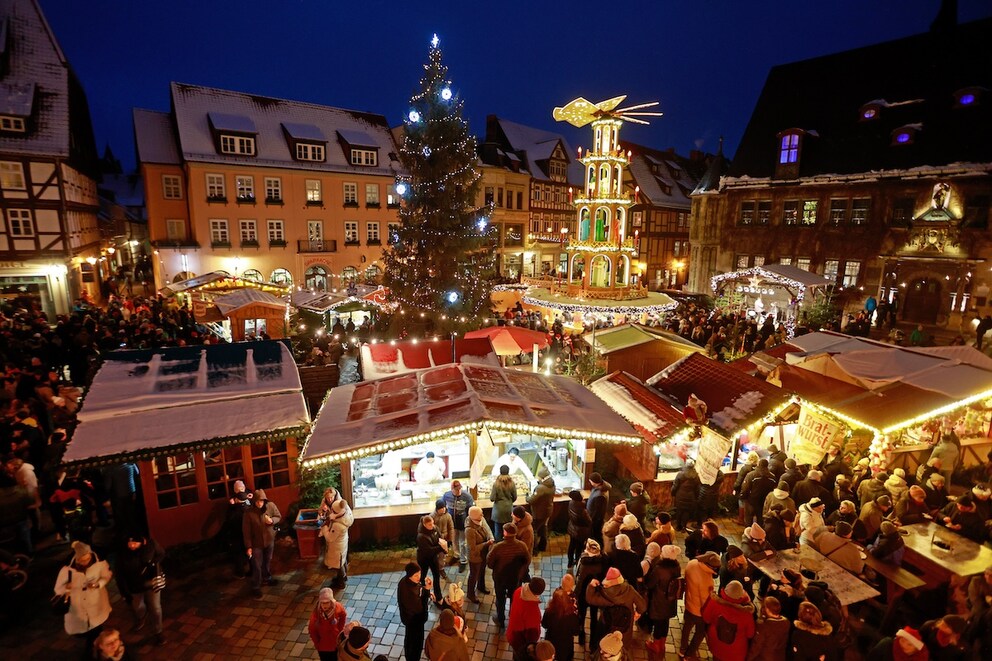
More beautiful than in Quedlinburg, a location for a Christmas market is hardly possible: Surrounded by historic half-timbered houses, stalls, a large pyramid, and the big Christmas tree stand. The market in the Harz city runs from Nov. 26 to Dec. 22. In the area, which has been a UNESCO World Heritage Site since 1994, there are about 2,100 half-timbered houses from eight centuries, according to the city.
A visit to Quedlinburg is particularly worthwhile on the first three Advent weekends: Then, in addition to the Christmas market, private courtyards that are usually closed open for visitors–with crafts to buy or culinary delights to enjoy.
For children, the living Advent calendar is great: Every day at 4:30 p.m., the search for the Christmas door of the day starts from the central tourist information on the nearby Schlossberg, with sweet surprises and costumed fairy tale characters behind it. Only on Christmas Eve does the search start earlier, at 1:00 p.m. After all, many already have their gift-giving in the afternoon.
5 of the Most Beautiful Christmas Markets in Schleswig-Holstein
4 of the Most Beautiful Christmas Markets in Thuringia
Schleswig-Holstein
The Great Advent Calendar of Tönning
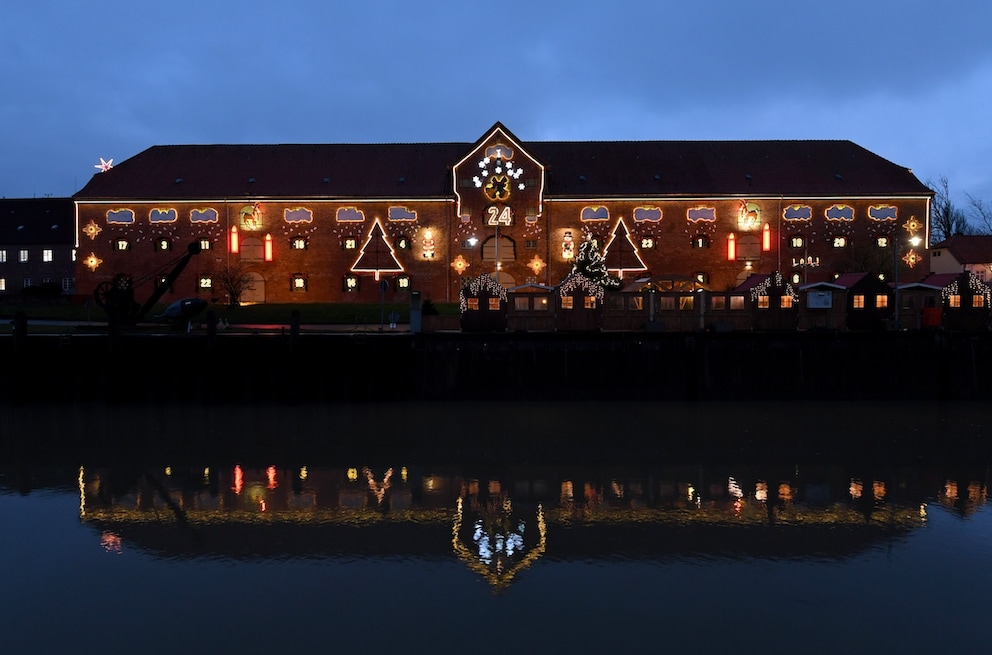
It is 77.5 meters long and 13 meters high, and when Advent begins, it is illuminated with nearly a million lights: That alone makes the historic packhouse at the harbor in North Frisian Tönning an eye-catcher that evokes pre-Christmas feelings.
At the same time, the architectural landmark on the Eider Canal is, according to the Guinness Book of Records, the longest Advent calendar in the world. From 1 to 24, windows are numbered, and from Dec. 1, a new number lights up daily.
The large calendar is accessible via the central main entrance on the ground floor: Inside, coffee and delicacies await. And stalls with crafts, from felt work and jewelry to wooden toys and carvings. Santa Claus, of course, also stops by.
Admission to the so-called Tönning Christmas Event is free. The packhouse is open on Advent weekends.
Thuringia
Christmas Market at the Wartburg
Disguised as Junker Jörg, Martin Luther translated the New Testament into German over 500 years ago at the Wartburg. The famous Luther Room of the fortress is also open to visitors during the historic Christmas market.
But Advent in the courtyards of the castle, which has been a UNESCO World Heritage Site since 1999, mainly means a lesson in almost forgotten crafts: candle makers, glassblowers, garment masters, lantern builders, soap makers, stonemasons, and pewter casters present products for sale. Musicians in medieval costumes roam around.
Guided tours through the medieval palace are also on the program. Those who climb the south tower of the castle have a great view of the Thuringian Forest. Admission to the market, which opens on Advent weekends, costs 10 euros, half for those aged 7 to 18.