

June 6, 2026, 1:11 pm | Read time: 6 minutes
When the Swiss-French architect Le Corbusier inaugurated his residential complex “Cité Radieuse” in Marseille in 1952, it was not just the completion of a building but the birth of a new way of living. An icon of modernity was created here—the House of the Madman! TRAVELBOOK author Frank Lehmann was on site and reports on his impressions.
The “Unité d’Habitation” was the first prototype of his famous “housing machines.” It was a radical concept that combined living, working, shopping, and leisure in a single vertical building. Le Corbusier built five of these colossi: in Marseille, Nantes-Rezé, Briey-en-Forêt, and Firminy, as well as in Berlin near the Olympic Stadium. But Marseille remained the model, the place where utopia first became reality. So let’s take a look: off to southern France to discover this wondrous house.
The “Elephant on Stilts”
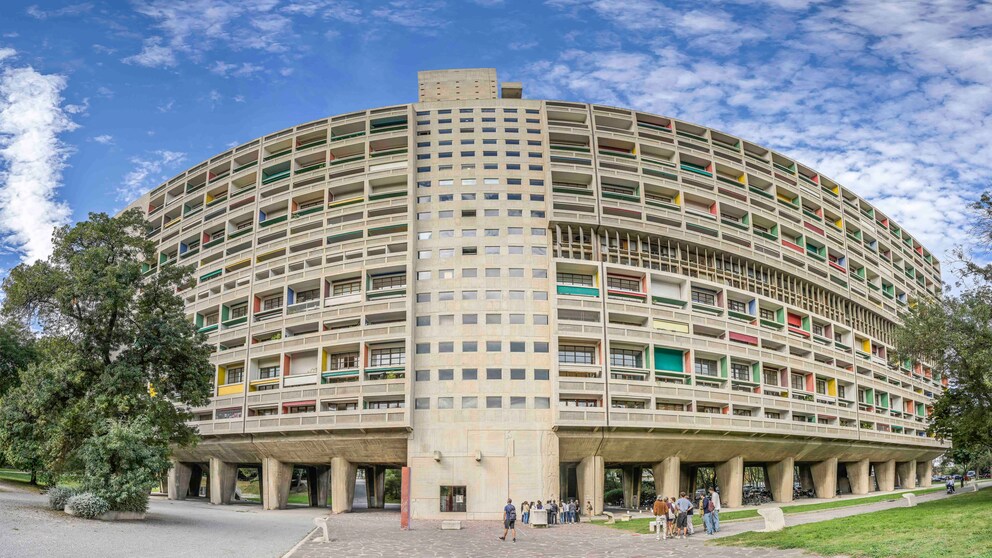
We take the 21 bus from the center of Marseille and immediately see the concrete monster. It quickly becomes clear that this is not just another gray prefab building. The fascination is immediate when you first glimpse the gray-colored block. The people of Marseille quickly called the building “La Maison du Fada”—”The House of the Madman.” A name that has stuck to this day. There is also a second, less-known nickname: “L’éléphant sur pilotis”—the “Elephant on Stilts.”
Why? Because the building, with its massive concrete pillars, the famous pilotis, and its massive, almost animal-like silhouette, indeed resembles an elephant balancing on thin legs. The stilts lift the building off the ground, creating space for a public area underneath—and give the whole thing a light, almost floating feel, despite its 18 floors and 337 apartments.
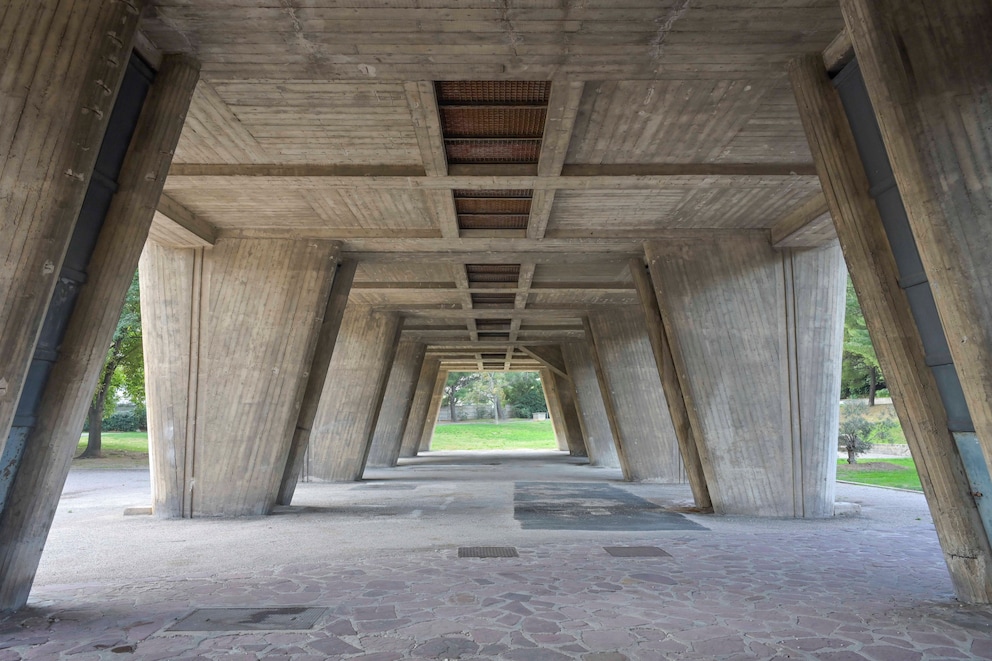
But how do the French live with this concrete monument? Opinions are divided: Some love it because it is a UNESCO World Heritage Site, a piece of living architectural history, a place where you live in the light of the rising sun in the morning and the warm glow of the sunset in the evening. Others find it cold, bulky, impersonal. But those who have lived in it often rave about the unique atmosphere—and what it’s like to live in a monument that tourists admire daily.
Why Every Apartment Gets Plenty of Light Daily
Corbusier’s genius lay in the details: Each of the 337 apartments stretches from the east to the west facade—meaning every apartment gets sunlight in the morning and evening. The apartments are two-story and so interlocked that they span the entire width of the building. Those who live here experience the sunrise over the hills of Marseille and the sunset over the sea daily.
And then there’s the Hotel Le Corbusier: 21 rooms, each a small design jewel of the 1950s, with original furniture and views over the city or the sea. Prices start at about 120 euros per night, and those who sleep here literally stay in a monument. The hotel’s restaurant, “Le Ventre de l’Architecte,” serves creative French cuisine—naturally in a room that is itself a work of art.

Bauhaus Dessau Celebrates 100th Anniversary – Here Are the Highlights
Hidden Gem De Haan: The Beautiful Town on Belgium’s Coast
The Café, the Concierge, and the Visitor Book
Is it easy to explore this building? Yes, it’s child’s play, we just walk in. The concierge checks who comes and goes, friendly but firm. Visitors only need to sign the guest book—a ritual that gives the whole thing an exclusive touch. Then you can roam freely.
On the third and fourth floors is the “Rue Intérieure”—a shopping street with a bookstore, gallery, tea salon, and the café “L’Archi Gourmand,” where you sit among original Corbusier furniture. There used to be significantly more shops, including a supermarket, but most have since closed. The remaining stores are mainly on the third floor, which is open to the public. And those who fancy 1950s nostalgia will find everyday items from the era in the design shop, from coffee grinders to ashtrays.
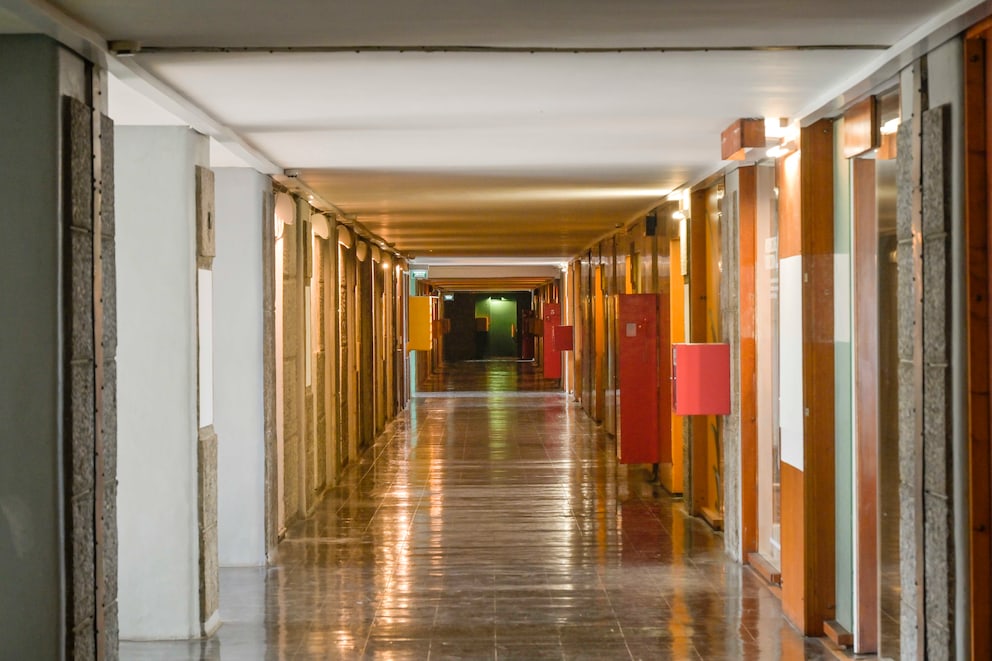
Since 2016, the Cité Radieuse has been a UNESCO World Heritage Site—an honor that comes with obligations. The facade must be preserved in its original state, and the apartments cannot be remodeled at will. Living in a monument also means living with rules. But perhaps that is precisely the appeal. The Cité Radieuse is not a cozy home but a manifesto. A place where you ask yourself: Can architecture change life? Perhaps not always for the better—but it forces us to think about it.
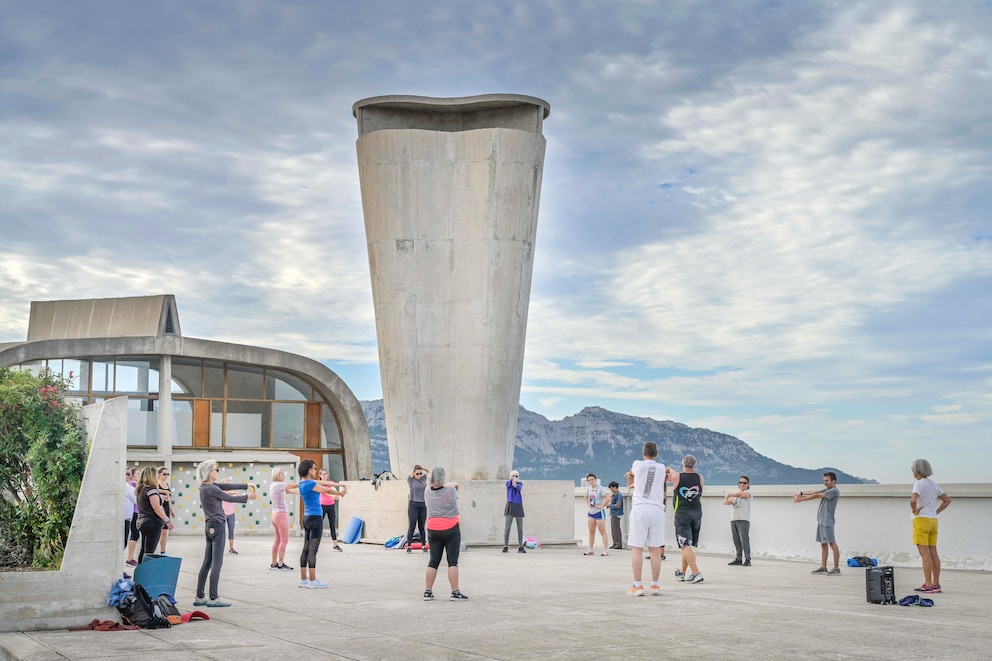
We think best in the fresh air high above. Let’s take the elevator to the flat roof. This roof was intended as a collective living space. Here you will find a kindergarten with play areas, a running track for sports, a small amphitheater for events, as well as sculptures and seating areas that invite you to linger. The roof was not just a mere conclusion of the building but an active part of the living concept. The distinctive ventilation shafts and concrete forms are not only technically necessary but also artistically designed. They resemble abstract sculptures. Particularly impressive is the view over Marseille—a contrast between Corbusier’s concrete vision and the Mediterranean landscape.
Bauhaus, Concrete, and the Birth of Modern Settlements
Corbusier’s housing machine was the radical answer to the housing shortage after World War II. It was inspired by the Bauhaus. Less ornament, more function. The architect was even more consistent: Concrete served as the material of the future. There were open floor plans and communal spaces. The Cité Radieuse was not a luxury project but a social design—affordable housing for the masses, but with style and vision.
Today, it seems like the ancestor of all concrete settlements—but while these are often dreary and anonymous, the housing machine has character. It is a statement. And it remains a provocation: Can you be happy in concrete? The answer is only found by experiencing it yourself.