

January 7, 2026, 11:34 am | Read time: 5 minutes
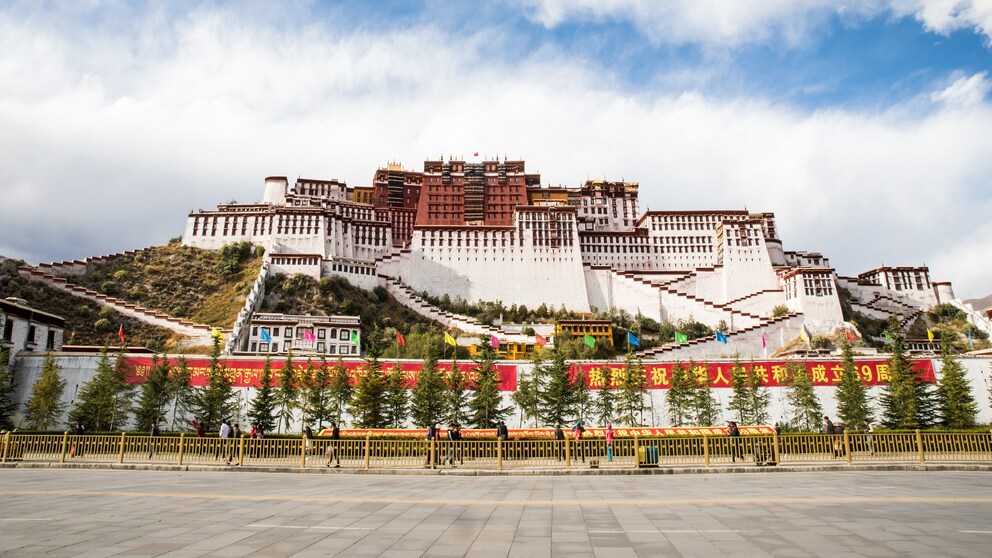
Built in the 17th century by a predecessor of the current Dalai Lama, the Potala Palace in Tibet’s capital, Lhasa, has long been one of the holiest sites for Buddhists worldwide. This is despite the fact that, since China’s occupation of the country, its spiritual leader has had to live in exile. The immense building holds such cultural significance that it is unfortunately even used for propaganda purposes.
In the Tibetan capital of Lhasa, the Potala Palace sits atop the 130-meter-high Mar-po-ri Hill, making it one of the most impressive structures in the world. Situated at an altitude of 3,700 meters above sea level, this immense fortress is the highest palace in existence. It is also one of the holiest places in Buddhism, having been built in the 17th century by a predecessor of the current Dalai Lama. However, since China occupied Tibet over 70 years ago, the site has unfortunately been repeatedly used for propaganda purposes due to its great cultural significance.
According to the “Encyclopedia Britannica,” a first version of the current Potala Palace was built in Lhasa in the 7th century. King Srong-brtsan-sgam-po had it constructed and named his grand building Potala. Translated from Sanskrit, this means “Pure Land” or “High Heavenly Kingdom.” The origin of this name is no longer traceable today, but it is likely that the inspiration came from Mount Potalaka in India. According to Buddhist belief, the holy Avalokiteshvara once lived there. He is considered the forefather of the Dalai Lamas, who see themselves as his reincarnation, as well as the patron saint of Tibet.
Final Resting Place of Several Dalai Lamas

According to the site “Wonders of Tibet,” the king enjoyed meditating on Mar-po-ri Hill, as Avalokiteshvara is also said to have lived there at times. Thus, he chose the “Red Mountain” (the translation of Mar-po-ri) as the location for his Potala Palace. However, it would take another thousand years for the site to gain the spiritual and cultural significance it holds today. Srong-brtsan-sgam-po’s fortress eventually fell into ruin. It is historically documented that construction on the Potala Palace, as it stands today, began in 1645.
The project was commissioned by the fifth Dalai Lama, who was both the religious and political leader of the country at the time. In just three years, the first building complex of the Potala Palace, the so-called Potrang Karpo, was completed. Translated, this means “White Palace.” It wasn’t until 1694 that the Potrang Marpo, the “Red Palace,” was finished. The fifth Dalai Lama had died 12 years earlier, but his death was only officially announced to the public at that time. The holy man was laid to rest with all honors in the massive fortress, which remains the final resting place for a total of eight Dalai Lamas. More importantly, it became their main residence during their lifetimes.
Jal Mahal – India’s Spectacular “Drowned” Palace
The Best Prague Alternative? This City Has Everything Except the Hustle and Bustle
Gigantic Dimensions
The dimensions of the Potala Palace are hard to imagine. It has more than 1,000 rooms, where significant cultural treasures from several centuries of Buddhist history are still displayed today. Among other things, there are more than 200,000 statues and 10,000 altars. According to “UNESCO,” there are also nearly 700 intricately crafted murals and about 10,000 scrolls. The most important room in the entire complex is the so-called Phakpa Lhakhang, where a statue of Avalokiteshvara is kept.
When the so-called “Jewel Palace”, Norbulingka, was built in Lhasa in the 18th century, the Potala Palace began to lose its significance. Once the main residence of the Dalai Lamas and the Tibetan government, it is now used only as a winter residence. The darkest hour for this still significant pilgrimage site came in 1950, when China invaded Tibet and annexed its small neighbor. This status remains to this day, and the 14th Dalai Lama, the spiritual leader of Tibetans and Buddhists worldwide, had to flee into exile in India. Since then, he has lived in the city of Dharamsala.
Great Cultural Significance

The significance of the Potala Palace and the hope for a possible return there still hold for the Dalai Lama today, as shown on his official website. It features an image of the holy site. Meanwhile, the Chinese have made it very clear that they now consider the mega-structure part of their own culture. The back of the Chinese 50-yuan note features the Potala Palace. Additionally, numerous websites about the site almost unanimously place the former residence of the Dalai Lamas in China.
Despite this fact, UNESCO designated the Potala Palace as a World Heritage Site in 1994. According to the site “Tibet Travel,” several thousand people visit the impressive fortress on the Red Mountain daily during the peak season. The holy palace is open to visitors daily from 9:30 a.m. to 3 p.m. Admission during the peak season from May to October is 200 yuan per adult (about 27 euros), and otherwise 100 yuan (about 13 euros).