

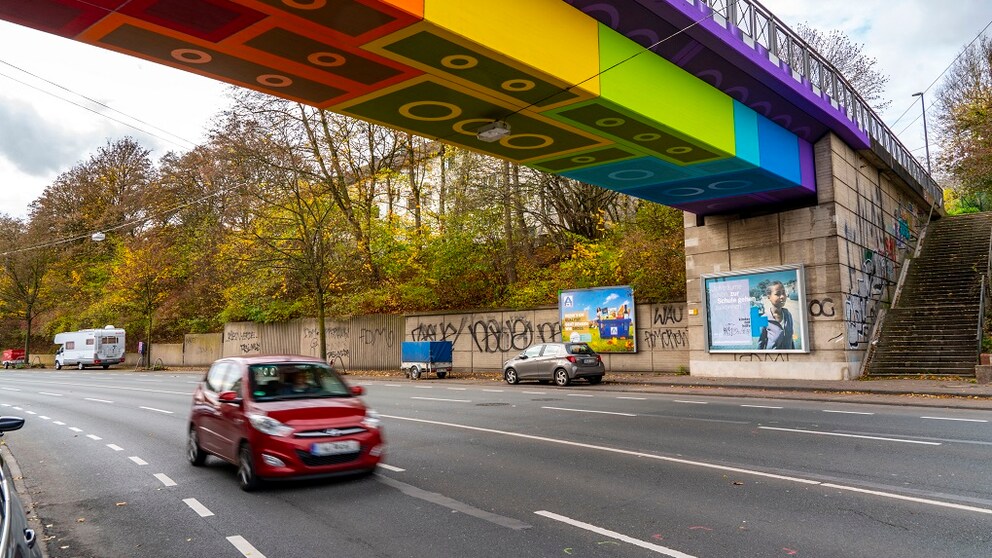
December 4, 2025, 9:35 am | Read time: 5 minutes
In Wuppertal, North Rhine-Westphalia, two unusual structures captivate both locals and visitors. The Lego bridges truly look as if they are made from giant versions of the globally popular building blocks. However, behind the unique design is a local artist who has been awarded multiple times for his idea. He spoke with TRAVELBOOK about his works, his past as a graffiti artist, and obtaining Lego’s approval for the bridges.
In the North Rhine-Westphalian city of Wuppertal, two structures are sure to delight Lego fans of all ages. Here, two bridges stretch across, appearing as if they are made from giant versions of the globally beloved building blocks. Now known as the LEGO bridges, they captivate locals, visitors, and fans worldwide, becoming one of the most popular photo subjects in the city. But how did this unusual design, which has won multiple awards, come about?
TRAVELBOOK reached out to the artist Martin Heuwold, who has called himself MEGX since his youth and also on Instagram, and who designed the Lego bridges, on a sunny afternoon. In the background, the sounds of spray cans can be heard. Heuwold is painting privately on a legal wall–even at nearly 50 years old and as an internationally known street artist, graffiti remains his great passion. “Hold on, I’ll switch to my AirPods,” Heuwold laughs. “Then we can talk while I spray.”
“Try it with Lego bricks”
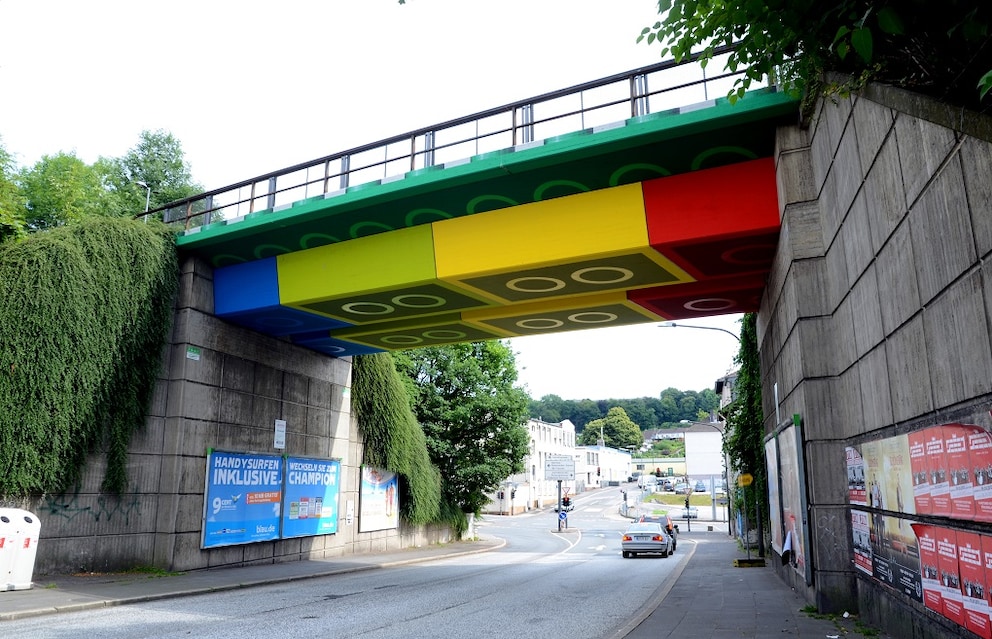
“Actually, it was my wife’s idea,” he openly admits at the start of the conversation. “I had the commission for the design from the ‘Wuppertalbewegung e.V.‘ association. I had tried several designs but was somehow dissatisfied with all of them. Then she said, ‘Try it with Lego bricks.'” For context: The association was transforming the so-called Nordbahntrasse, a disused railway line, into a 20-kilometer-long pedestrian and bicycle path. They approached Heuwold for the beautification of the drab overpasses. Thanks to his wife’s suggestion, he realized the first of his now two Lego bridges in 2011.
Also interesting: London’s Millennium Bridge is known for its chewing gum art
“That was about two weeks of work, six to seven hours a day,” the artist recalls. “I painted the entire base area of 250 square meters by hand with a roller and paint, and did the details with spray paint. It’s not every day you get offered an entire bridge as a canvas, so I was, of course, highly motivated.” His training as a painter helped him in his work. But Heuwold could never have imagined what would happen after completing the first of his Lego bridges.

Why a visit to Marrakech is definitely worthwhile

This Observatory in Rhineland-Palatinate Is Simply Galactic
International media hype
Initially, the local press reported on it, but then pictures of his bridge appeared on blogs in the U.S. “And suddenly, inquiries came from media around the world. First from England, where my work was featured in newspapers like the ‘Telegraph’ and the ‘Sun.’ Reports followed from Asia, South America, Turkey, Switzerland, and many other countries. They were even kind enough to send me copies. I still have them today; it’s a very nice collection and memory.” But that’s not all: Heuwold’s Lego bridges have now been widely copied. There are replicas of the original in France, Argentina, and India, among other places.
Also interesting: Kelburn Castle: Scotland’s quirky graffiti castle
Curiously, before the realization of the first of his LEGO bridges, the Wuppertalbewegung e.V. association even obtained official approval from the toy giant. “We politely wrote them an email in English and attached the planned design. They were convinced and quickly gave us the go-ahead.” What followed for Heuwold were several awards. He won, among others, the 2012 sponsorship award of the German Facade Prize from the company Brillux, whose paints he also used for his project. Another award came in 2013 from the “Germany – Land of Ideas” initiative.
One month in detention

For his career, the first of today’s two LEGO bridges was certainly a significant boost, as Heuwold candidly and with a bit of pride in his voice says. “Even abroad, people often know my bridges. They were even once the subject of a question in the original U.S. version of the quiz show ‘Jeopardy.’ They politely asked me and later sent me the stream of the show.” Even today, it still serves as a door opener when he mentions that he is the artist behind the Lego bridges.
Heuwold, or MEGX, has undergone a remarkable transformation, as he says he constantly had trouble with the law for illegal graffiti as a teenager, even spending a month in detention. He began his “career” in 1989 as a 13-year-old on the streets he still loves today: “The constant court cases drained me, and by 19, it all became too much.” He enrolled at the local university of applied sciences for design, dropped out, and met his future wife. When she “quickly” became pregnant, he started his painting apprenticeship at 23.
Also interesting: This building is a giant musical instrument
Soon, he became self-employed, taking on only design projects since 2005. He painted the second of his Lego bridges, also known as the Rainbow Bridge due to its color palette, in 2020. “It’s a work for all people, a symbol of openness. As a sprayer, I can’t just represent one color.” Whether there will be more LEGO bridges, he can’t say yet. Only that he wants to continue as he has been. “Legal, illegal, I never cared,” he laughs. And then: “Feel free to write it just like that.” With that, the artist bids farewell to return to his great love: beautifying a surface.