

January 1, 2026, 1:06 pm | Read time: 5 minutes
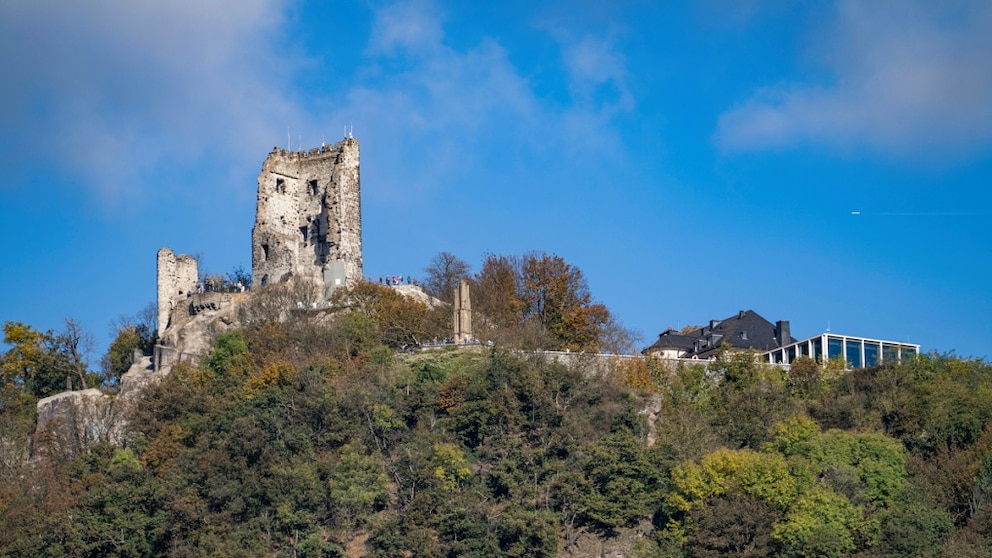
High above the city of Königswinter, with a spectacular view of the Rhine Valley, Drachenfels Castle has stood for nearly 900 years. Now a ruin, it was once the scene of a tumultuous history—and allegedly even a significant chapter from the Nibelungen saga. For it is said that nowhere else but here did the hero Siegfried slay the evil dragon Fafnir. And indeed, you can still admire the beast on site today.
Rising 331 meters above the Rhine Valley near Königswinter is the ruin of an almost 900-year-old fortress, impressive even in its dilapidated state. This is Drachenfels Castle, where a chapter of the Nibelungen saga, perhaps the most significant German tale, is said to have taken place. The story involves a brave hero and a bloodthirsty monster, which likely gave the Drachenfels, the mountain of the same name, its designation. This site has long inspired poets, who in turn made the old structure the tourist magnet it remains today.
According to the official site of Drachenfels Castle, the history of this historic site begins in 1138. Arnold I, the Archbishop of the nearby city of Cologne, began constructing a private residence with status symbol character in Königswinter. Due to its strategically advantageous location high above the Rhine, it symbolizes power and wealth. The Drachenfels is also forever linked to the Rhine metropolis in another way. Early on, trachyte stone was delivered from here, which was used in the construction of Cologne Cathedral. However, Arnold I would never see its completion.
Celebrated by Poets
It wasn’t until 1149 that Drachenfels Castle was finally completed under the aegis of Gerhard von Are, provost of Bonn. He presided over the St. Cassius Abbey and, like his predecessor, was a significant figure. Over the centuries, the fortress experienced a tumultuous history, was besieged, and was finally destroyed in 1634 during the Thirty Years’ War (1618 to 1648). The once-proud structure increasingly became a quarry, and only its purchase by the Prussian state in 1829 prevented its complete destruction. Even at that time, it gained popularity as some prominent contemporary poets immortalized it in their works.
Among them was the English Lord Byron, who wrote “The Castled Crag of Drachenfels.” In German, it is called “Der turmgekrönte Drachenfels.” As early as October 1819, the German poet Heinrich Heine wrote about his visit here in the piece “Die Nacht auf dem Drachenfels.” They were likely all inspired by a much older legend that is said to have taken place on the Drachenfels. In the most significant German tale, the Nibelungen saga, the hero Siegfried slays the evil, bloodthirsty dragon Fafnir. And it is said that this dragon once made its home right here on the mountain.
Also interesting: Wat Samphran: Thailand’s Gigantic Dragon Temple

Which of these places is the spookiest in Germany?
The Creepy Legend of the Mäuseturm in Bingen
Legendary Place
According to legend, after defeating the dragon, the hero bathes in its blood, which makes him invincible. However, during the bath, a linden leaf falls on his shoulder, leaving that spot vulnerable, much like Achilles’ heel in Homer’s ancient poetry, which ultimately leads to Siegfried’s downfall. This tale and the works of the mentioned poets have undoubtedly contributed to making Drachenfels Castle a tourist attraction early on. Since 1913, halfway up to the castle ruins on the rock, there has been a unique monument honoring the most famous German hero saga: the Nibelungen Hall.
According to the “German Foundation for Monument Protection,” the attraction opened on the 100th birthday of composer Richard Wagner, who spectacularly set the epic to music. Since 1933, there has also been a dragon cave where a stone replica of the dragon Fafnir rests eternally. In the hall itself, Berlin painter Hermann Hendrich created a total of 12 murals that retell the legend in an impressive way. After the stone dragon lost its head in 2023, it has been fully restored and has resided in its original home since June 2025.
Star Chefs and Superstars

Drachenfels Castle remains a highly popular destination for visitors today. The ruin is accompanied by a restaurant, and the site is also popular as a wedding, conference, and event location. For those who don’t want to tackle the strenuous climb, there’s the option to take Germany’s oldest cog railway to the top. According to the official website, it has connected the old town of Königswinter with the Siebengebirge since 1883 and ends at the Drachenfels plateau. In its time, it has already transported 40 million passengers. Please refer to the website for fares and schedules.
Also interesting: Frankenstein Castle: Birthplace of a Legend
Hermann Joseph Nolden, managing director of Drachenfels Gaststätten GmbH, says in response to a TRAVELBOOK inquiry: “We have up to 750,000 day visitors annually who come to Drachenfels Castle. It is a very popular excursion destination and offers a fantastic view over the Rhine Valley.” On clear days, you can even see the spires of Cologne Cathedral from here. “We have also been a location for film and television shoots.” For example, the show “Deutschland sucht den Superstar” has visited Drachenfels twice.
Many guests also come for the cuisine, Nolden proudly notes. “Two of my chefs have earned a Michelin star over the course of their careers.” He also hosts large companies for conferences. For young visitors, there is a machine with a dragon figure that tells the legendary story of Siegfried and the dragon Fafnir in a child-friendly way when a coin is inserted. And if that’s not enough history for you: Close to Drachenfels Castle are two more impressive and historically significant sites in the Rhine Valley—Drachenburg Castle and Wolkenburg.