

January 23, 2026, 6:51 am | Read time: 4 minutes
In the American city of Miami, there’s a genuine European monastery from the 12th century. Now one of the city’s most unusual tourist attractions, it was once transported stone by stone from Spain to the U.S. by a powerful media mogul. TRAVELBOOK shares the story of this adventurous endeavor and explains why a visit can be quite expensive.
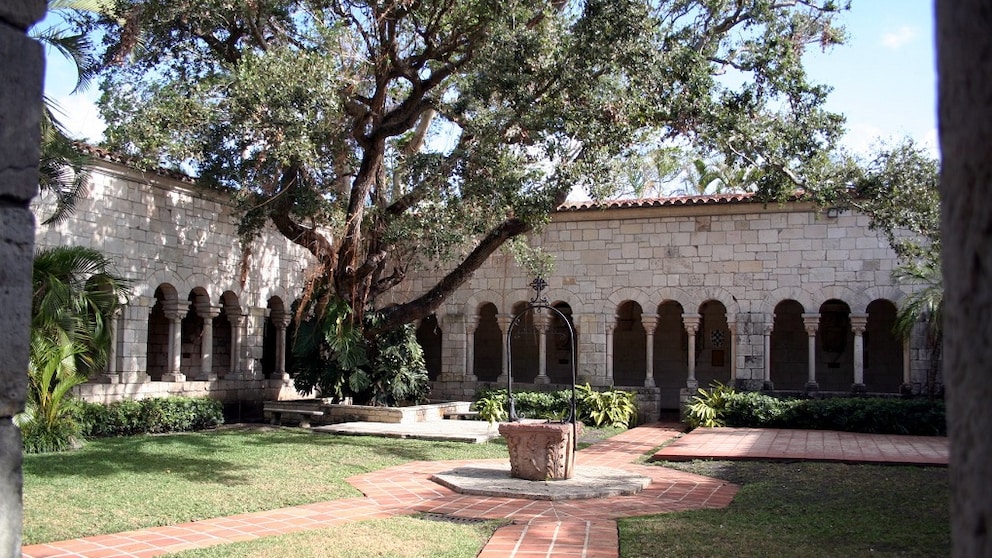
In the heart of the American metropolis Miami, not far from the dream factory of Hollywood, there is a place that many might initially mistake for a very lifelike film set. This is an old monastery that has stood in place for more than 70 years. However, the history of this building dates back to the Middle Ages and begins on another continent. It tells the story of a wealthy but unlucky media tycoon, a spectacular journey, and finally the triumphant reconstruction. TRAVELBOOK takes you on a wild adventure.
How Does a Building Cross an Ocean?
Our story begins in the year 1133, in the Old World, specifically in Spain. According to the official site of the monastery, construction began in Sacramenia near the city of Segovia. The construction of the house of worship took eight years, and it was consecrated in 1141 as the “Monastery of Our Lady, Queen of Angels.” In 1174, it was named after the Cistercian monk Bernard de Clairvaux, who was canonized that year. It served this order as a home and residence for nearly 700 years. But how did the monastery eventually end up in Miami?
Perhaps it is thanks to the megalomania of one man, but certainly to his immense wealth. In 1925, U.S. media mogul William Randolph Hearst bought the old Cistercian monastery. His plan: to have it rebuilt, not just anywhere, but in Miami. But how was the massive building supposed to get there? Well, Hearst actually had it packed stone by stone in hay-padded boxes and shipped. More than 11,000 of these boxes were needed to send the old structure across the sea to its new home. But the endeavor was ill-fated from the start.
The Exciting History of the Monastery Kloster Lehnin
Why St. Mary’s in Lübeck Is Known as the “Devil’s Church”
11,000 Boxes of Stones
As the Miami tourism office reports, the foot-and-mouth disease broke out in Spain during the shipment. The U.S. Department of Agriculture was concerned that the hay might contain the pathogen. Therefore, upon arrival in America, the shipment was placed under special quarantine. Twenty-three men spent three months opening all 11,000 boxes. They then burned the suspicious hay and repacked the stones. Unfortunately, many were lost because they were stored in incorrectly numbered boxes.
But things got even worse for Hearst. The former tycoon soon found himself in financial trouble. His problems grew so overwhelming that he was eventually forced to sell the monastery at auction. The remains languished in a warehouse for 26 years. In 1952, businessmen William Edgemon and Raymond Moss finally bought the centuries-old monument. They planned to turn it into a tourist attraction and had it rebuilt at its current location.
“The Largest Puzzle of All Time”
The renowned Time Magazine reverently called the unprecedented action “the largest puzzle of all time” in a 1953 article. The construction work took 19 months and consumed the astronomical sum of $20 million today (about 17 million euros). But by 1964, Edgemon and Moss had already sold their monastery to banker and multimillionaire Colonel Robert Pentland Jr. He generously donated the house of worship to the Bishop of Florida. Today, it is owned by the Episcopal Diocese of Southeast Florida. And it is one of the most unusual and perhaps largest tourist attractions in Miami.
Those who wish to visit the monastery can do so from Monday to Friday between 10 a.m. and 4 p.m. Admission costs around $10 (about 9 euros), with a reduced rate of $5 (about 4.50 euros). During this time, guided tours of the grounds are also available. The venerable building is also popular as an unusual location for weddings, proms, and communions. On Sundays, services are still held here in English and Spanish.