

January 5, 2026, 5:29 pm | Read time: 5 minutes
A rock in the North Atlantic has been the subject of a dispute between the United Kingdom, Ireland, Denmark, and Iceland for more than 50 years. What the dispute over “Rockall” is about and why these countries are interested in the small, uninhabited rock in the middle of the ocean—TRAVELBOOK informs.
The British want it, the Irish want its independence, and the Danes and Icelanders want the ground around it. The small rock, Rockall, has been a longstanding point of contention among neighboring countries. And it’s not just the United Kingdom, Ireland, Denmark, and Iceland involved. Greenpeace also intervened in the past and even briefly established its own state on Rockall. The unresolved story of Rockall.
Overview
What and Where is Rockall?
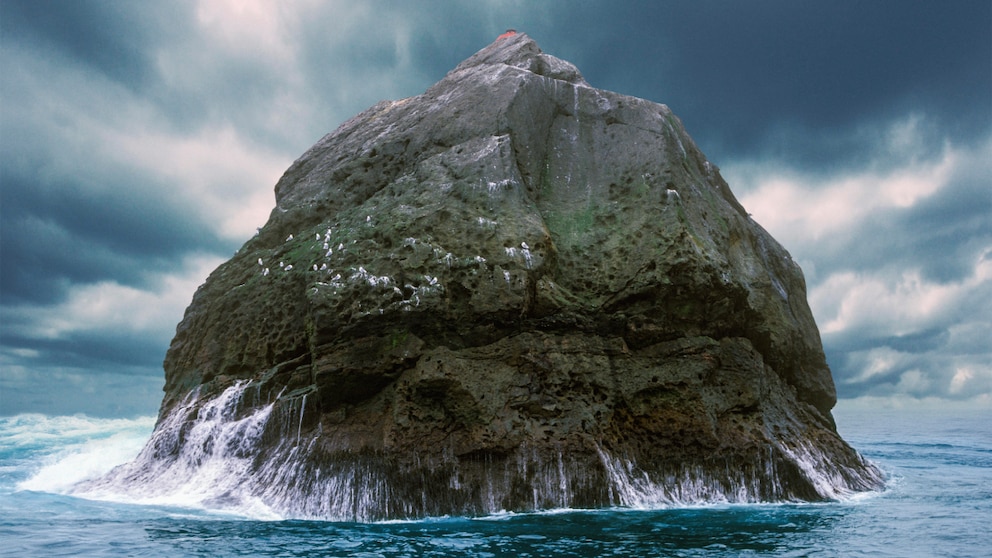
Rockall was first officially noted on a Portuguese map from 1550. Referred to as “Rochol,” there are various theories about the name of the volcanic peak, which rises between 17 and 21 meters above the water in the North Atlantic, far from the mainland. The guano-covered islet is located about 220 miles west of the Scottish Outer Hebrides. It is approximately 264 miles from Ireland.
The rock is just 82 feet wide and 98 feet long (at the base), uninhabited, and hardly habitable. This is partly because the granite rock is sometimes hit by waves as tall as skyscrapers, as reported by the TV channel Arte in a documentary. Among other things, the name “Rockall” is traced back to “Rocabarra.” The latter is a rock from Gaelic mythology, whose third appearance is said to signal the end of the world. The Gaelic “Roc-ail,” translated as “all rock” or “roaring,” is also suggested. None of these theories has been confirmed.

British Annexation 1955
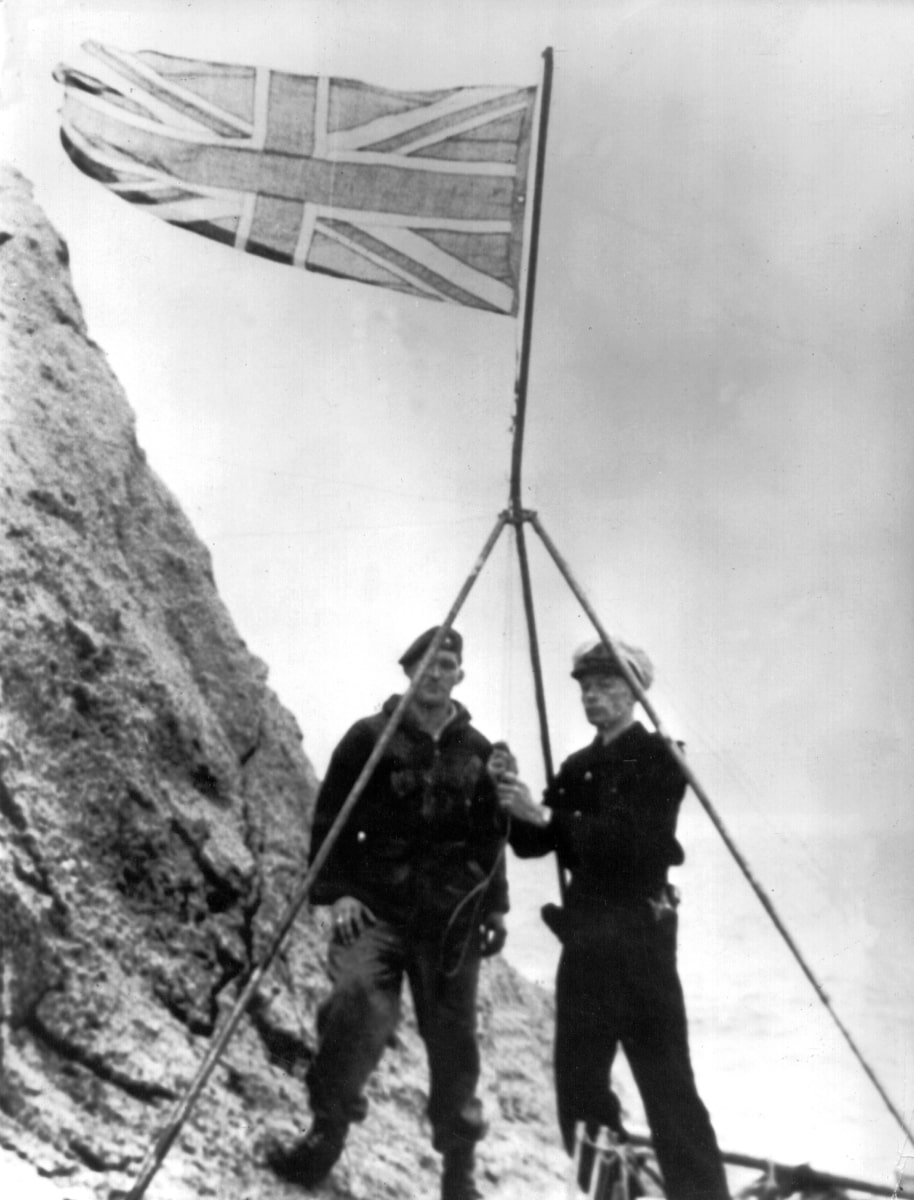
The contentious history of the small rock begins later, in the mid-20th century, during the Cold War. As early as the 19th century, specifically since 1811, the British have been interested in the rock in the North Atlantic after Royal Navy sailors first climbed it and other military personnel measured its position during an expedition 20 years later. However, it becomes important to the United Kingdom only when it wants to test nuclear missiles and fears the Soviets might spy on them from the no man’s land. Consequently, Britain annexes the rock giant on September 18, 1955, complete with flag-raising and plaque installation. With the Island of Rockall Act of 1972, Rockall became part of the United Kingdom and henceforth belongs to Scotland. The rock is quickly transformed into an island. Thus, Rockall is subject to the United Nations Convention on the Law of the Sea. This means that British claims extend beyond the rock into the sea, where fish stocks and oil are suspected. At least in theory.
The Legendary Cave on the Scottish Hebrides
Setback in the search for Amelia Earhart’s missing plane
Dispute Over Rockall
The British claims, in turn, prompt the Irish to object to Rockall, including the surrounding waters and seabed, belonging to the British Empire. They declare that Rockall is uninhabitable, meaning that under a new version of the law of the sea, the UK has no claims to the surrounding waters, including the seabed, oil, gas, and fish stocks. The British do not initially sign the convention with this article (Art. 121,3 UNCLOS), and the dispute continues.
In an attempt to strengthen his country’s claims, former British soldier Tom McClean climbed the island in 1985. He stayed there for 40 days, proving that Rockall is at least temporarily habitable.
Negotiations between Ireland and the United Kingdom continue. In November 1988, they finally agreed on a delimitation of the seabed in the region. Disagreeing with this, Denmark and Ireland now intervene, asserting their own claims to the seabed in the region.
Rockall Becomes Capital of Waveland
About ten years later, in 1997, there is a renewed dispute over Rockall, but with a new main player. Oil and gas exploration is now underway to the west of the granite rock—something the environmental organization Greenpeace does not approve of. As part of its “Atlantic Frontier Campaign,” Greenpeace sends three activists to Rockall, who occupy the rock and declare it independent a few days later. From Rockall, Greenpeace proclaims the new world state of Waveland, a micronation with Rockall as its capital. The activists stay for 42 days–longer than anyone else. At least so far. During and as part of this Greenpeace action to protect the adjacent sea from oil pollution from drilling, around 15,000 people apply for Waveland citizenship. There are passports, stamps, and even ambassadors. Waveland eventually collapses, but the Greenpeace action has an impact.
Britain eventually recognizes the UN Convention on the Law of the Sea, including the weakening clause. However, the dispute between the countries is not resolved. The United Kingdom continues to claim Rockall for itself, including the surrounding territorial sea, while Ireland continues to dispute the claim. Scotland and Ireland regularly clash over fishing rights in the region, and the story continues.
In the meantime, another Briton set a new record on Rockall: Nick Hancock spent 45 days on the rock in 2014—longer than anyone else who has stayed there since the 19th century.