

April 21, 2026, 8:23 am | Read time: 9 minutes
For more than 120 years, Bad Sachsa in the Lower Saxony part of the South Harz has been a state-recognized spa town and a hidden gem for nature lovers and those seeking relaxation. Our author discovered the town on one of his many excursions through the region and was instantly smitten. Here, he shares his best tips for hikes, dining options, and experiences. He also reveals where you can find a particularly magical place of power.
I sit on a wooden bench, my legs dangling in the air, and I am in a state of deepest peace. I’ve been sitting here for hours, daydreaming on the gloriously sunny day. Birds chirp, the wind rustles, a fountain splashes into a winding stream. Around me, archaic basalt cliffs rise up to 40 meters high, cast from the lava of a long-extinct volcano millions of years ago. Occasionally, I fill my canteen with the deliciously cold water, sipping eternity one gulp at a time. Nothing but silence and inner reflection at another favorite spot in my beloved hiking region, the Harz. My latest adventure has led me to Bad Sachsa, specifically to the Reinhardtsbrunnen in the Kuckanstal.
In the fall of 2025, I embarked on a roughly 230-kilometer long-distance hike that took me through all three states where the Harz extends. Bad Sachsa was my last stop, and I quickly fell in love. A mild September evening, and everything exuded a unique charm. Along the bustling main street, the Uffe meandered, setting the pace for a very relaxed small-town tempo in the spa town recognized by the state since 1905. The streets, ice cream parlors, and restaurants were bustling without feeling overcrowded. An atmosphere that made me want more, so I returned with my girlfriend in the spring of 2026, hopeful and expectant. What we found was even more than the first visit had hinted at.
The Town Under the Volcano
Compared to some other Harz towns, Bad Sachsa is a truly healthy and thriving city. On Market Street in the center, shop after shop lines up, including three butchers. Virtually no vacancies, even a furniture store and a real estate office. There’s a thermal bath with a sauna area, a bowling and ice skating hall, an indoor playground, and an adjacent holiday park, as well as tennis and mini-golf courses and a bird of prey park. It’s never far to the very beautiful and well-maintained spa park and the Schmelzteich, a small, artificial lake created in the 16th century. As soon as the first rays of the sun warm up, numerous small boats sail here, and walkers circle the forest-lined shores. Everywhere, grand half-timbered villas, some practically palaces. Signs everywhere point to vacation rentals, and besides numerous smaller guesthouses, the town also has two grand hotels.
And before you know it, you’ve already strolled into the forest, which, according to the official tourism site of Bad Sachsa, makes up a third of the city’s area. It’s also bordered by five valleys, which ensures particularly good air quality. If you want, you can go really high here, because at 659 meters above the town, the Ravensberg, the aforementioned extinct volcano, towers. It’s also the only mountain in the Harz that you can drive up. But it’s naturally nicer on foot. Early ground cover like corydalis, wood anemones, and coltsfoot already add color, and cheerful babbling brooks run through both the Kuckanstal and the Ostertal. One of them soon led us to a particularly magical place of power, the Reinhardtsbrunnen.
Place of Inner Peace
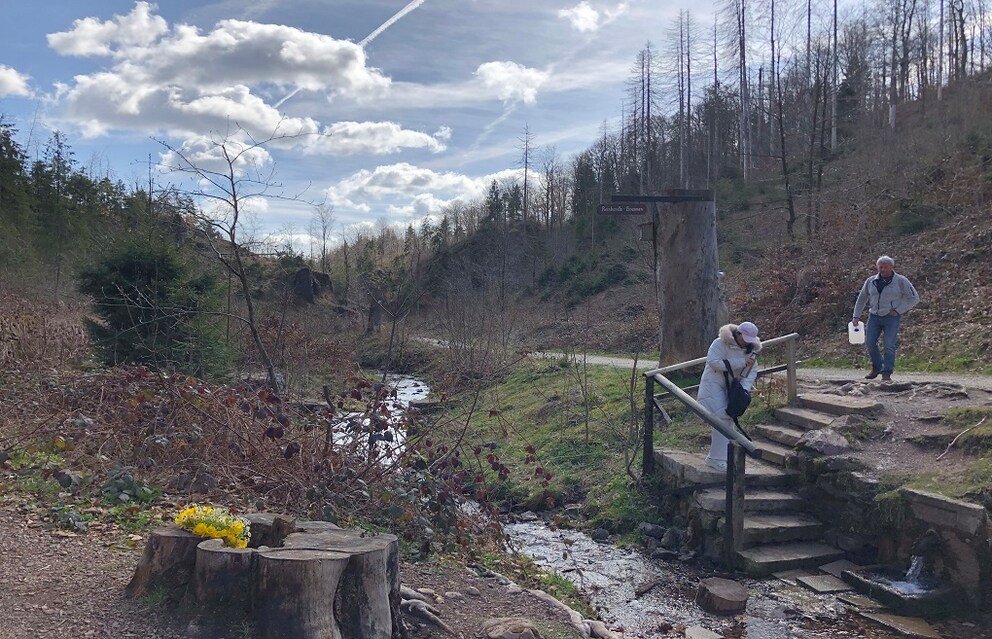
This is a forest spring that the businessman Friedrich Wilhelm Reinhardt had turned into a fountain in the Kuckanstal in 1889. Since then, the residents of Bad Sachsa have flocked here to supply themselves with the truly, absolutely delicious water. From our accommodation, my girlfriend and I didn’t have far to the spring. And we were always amazed by the true processions of people loading the water into five-liter bottles or even canisters on handcarts. We sat here in the sun for hours, making many nice and sometimes quirky acquaintances. The fountain is so famous that some even drove for hours from other states to supply themselves here.
A good measure of inner peace is always to see how long you can just sit without feeling the urge to do something specific. At the Reinhardtsbrunnen, I became practically a Zen master. We even had an encounter with one of the rare fire salamanders here. If you look closely, you might also spot some fairy-tale residents of the valley in the basalt cliffs. Some wonderful people have placed garden gnomes and other figures there. From Bad Sachsa, a total of ten so-called terrain cure paths lead into the area around the town and the nearby surroundings. If you have a car, you can find a lot of sights here in just a few days.
Magical Primeval Forest
A possible tour might start in Steina, a neighboring town of Bad Sachsa. Here, you first pass the Steina Dam, inaugurated in 1954, a beautiful reservoir. Then the path climbs steeply to another unusual Harz location, the Elbe-Weser watershed on a hill. The viewpoint here is called “Hohe Tür,” and from there, a short hike leads to the forest lake Wiesenbeker Teich. At the campsite there, you can stop at “Dombrowsky’s Baude,” a very idiosyncratic but cozy restaurant. In general, in the Harz, if a restaurant bears the honorary title “Baude,” it indicates rustic coziness and local, often hearty cuisine. Unfortunately, the previously low prices are now often hard to find in the Harz.
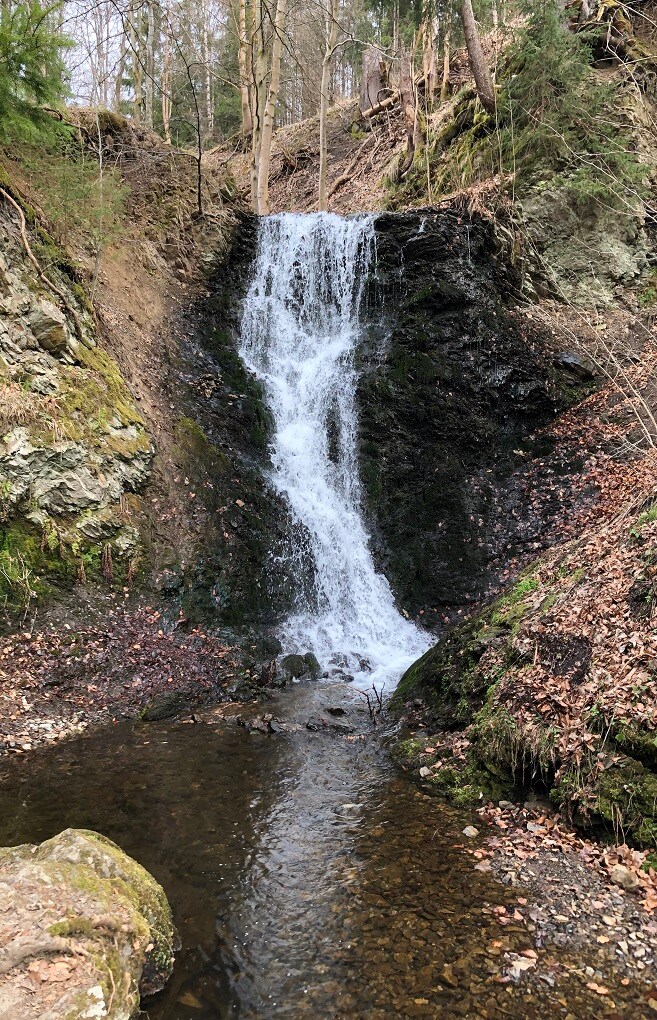
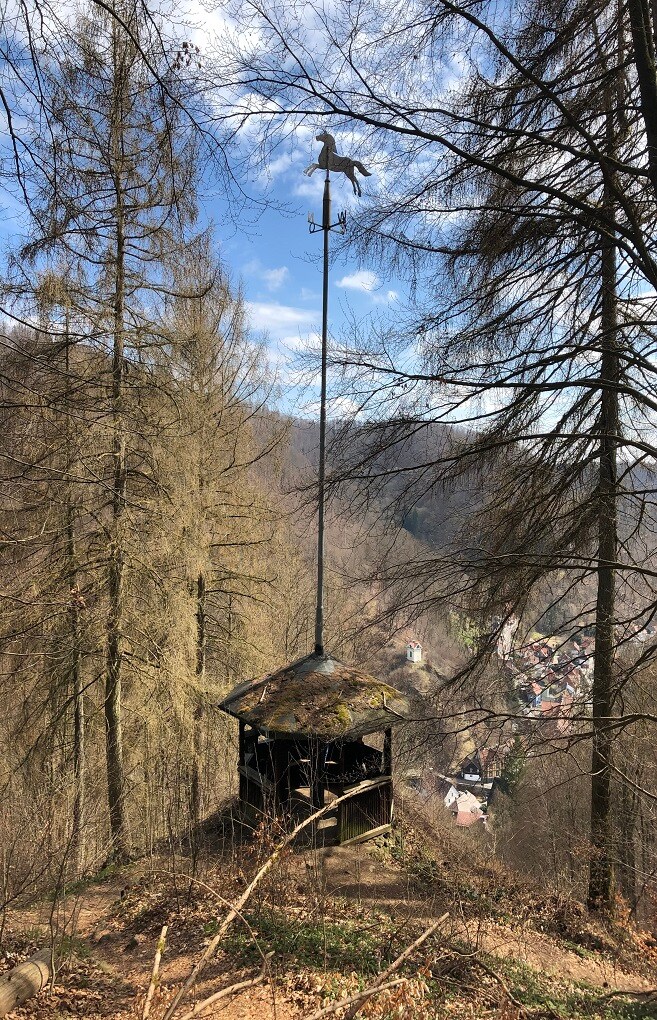
Another great tour leads to Zorge, a neighboring town of Bad Sachsa, which celebrates its 777th anniversary in May 2026. Here, too, the path starts steeply from the spa park to a very beautiful lookout pavilion called “Pferdchen.” A small horse is on a flagpole above the hut, overlooking the village in the valley—a great photo opportunity. The descent brings hikers closer to another scenic highlight, the Zorger Waterfall. Although only about five meters high, the wild cascade also lights up the phone cameras. The hike through the Wolfsbachtal is particularly special. This is a nature reserve and practically a primeval forest, where humans have not intervened for 200 years. Along the Wolfsbach, you then return to Zorge.
The Best Tips for Bad Harzburg
The Most Beautiful Castles and Palaces in the Harz
Tradition and Modernity
By now, it’s time for a refreshment, and in this regard, Bad Sachsa scores with a balanced mix of tradition and modernity. If you want something hearty after a long day of hiking, “Harzer Winkel,” where you can order half a duck, among other things, is the place to be. The portion is manageable with sides, but only for good eaters. It also tastes good at the “Harzer Schnitzelhaus und Waffelbäckerei,” where the name really says it all. The meeting point for the younger, hipper crowd is clearly the “Ravensberg Basecamp,” which stands out with a pretty ingenious combination. The heart is the climbing hall “Clip & Climb,” to which both an outdoor store and the gastronomic offerings “Backwood Burger” and “Backwood Coffee” are connected.
The burger joint serves local beef and unusual combinations in a cozy, solid wood-furnished atmosphere. The highlight: From some seats, you can look into the climbing hall. A clever trick to attract new customers. After all, those who climb are sure to have an appetite afterward. However, the prices here are, in my opinion, close to the pain threshold, especially since you even have to pay extra for sauces. Delicious cake and good coffee are then available at moderate prices in the adjoining café. If you want, you can also stock up at one of the butchers. I can never resist traditional businesses and Harz wild specialties, and therefore clearly recommend “Klembt” on Market Street.
Discover and Indulge

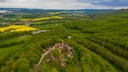
The other excursion possibilities around Bad Sachsa are indeed so numerous that I must conclude with a few real highlights. For one, there’s the town of Scharzfeld, where you can hike three great spots on a fantastic tour. First, head up to the Hausberg, where the imposing ruins of Scharzfels Castle stand. From here, continue to the Unicorn Cave, which was once thought to be the home of the famous mythical creature (and they made quite a profit from it, but that’s another story). Tours are available Friday through Sunday from 11 a.m. to 4 p.m. It’s not far to the Rock Church, an old cult site, and finally to the Ritterstein. Here, you have a spectacular view of the town and the surrounding area.
A visit to the ruins of the Cistercian monastery in Walkenried, a neighboring town of Bad Sachsa, is also worthwhile. Visitors can expect a unique setting and a very interesting museum. Here, you can learn all about the history of the abbey, which was once the largest and probably the most powerful in all of Germany. And how could it be otherwise, my latest ode to the Harz ends with two more recommendations for culinary indulgence. In the tiny village of Rothesütte, you’ll find the “Kaminstube,” which serves homemade food in a rustic atmosphere. The namesake fireplace burns very cozily in winter. And then there’s the “Ziegenalm” in the 60-soul hamlet of Sophienhof, where everything revolves around the delicious products of the wiry four-legged creatures. If you get the chance, order the “Kaspressknödel.” But you simply must try the delicious goat milk ice cream.
Should I now mention the world’s largest witch’s broom in Ellrich, a quirky observation tower? Or the fact that Bad Sachsa is also in close proximity to the legendary Brocken Mountain and thus to the Harz National Park? I want to leave a few discoveries for you, dear readers, because otherwise, I’ll never stop raving once I start talking about the Harz. One thing is certain: I will visit Bad Sachsa again soon. For hiking, indulging, and discovering.