

November 16, 2020, 3:25 pm | Read time: 5 minutes
The Masaya Volcano in Nicaragua was once the site of brutal human sacrifices–and overnight, a particularly violent eruption changed the entire country. TRAVELBOOK tells the incredible story.
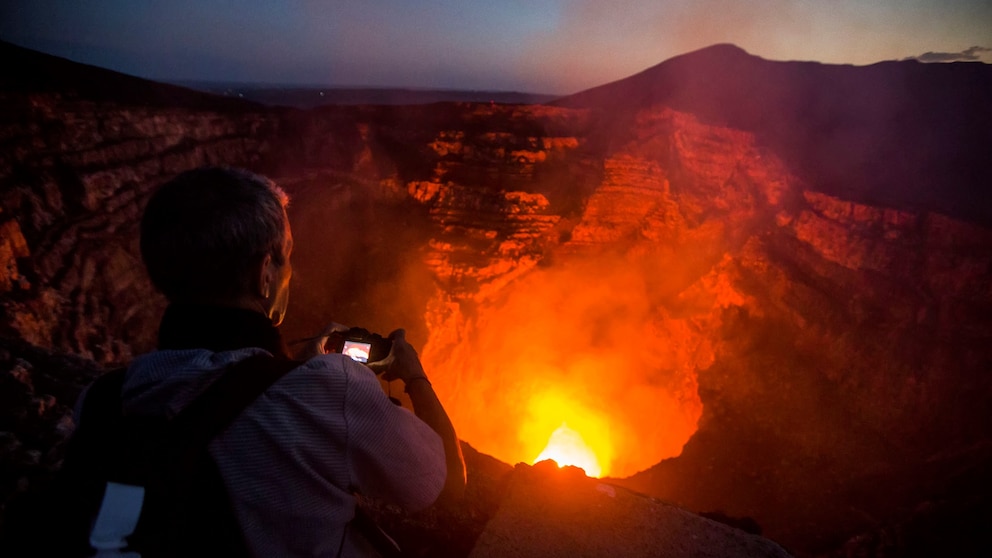
Not far from Managua, the capital of Nicaragua, lies one of the most dangerous places in the country: the Masaya Volcano. The fiery mountain is still active today. Lava has been bubbling in its 200-meter-deep crater since ancient times, and toxic sulfur fumes rise into the air. Located in the Masaya National Park, named after it, the largest volcano in Nicaragua is an inhospitable place. Yet it was this very mountain that changed the country forever nearly 250 years ago.
The Masaya, which still erupts irregularly, was revered as a sacred site by Nicaragua’s indigenous people due to its destructive power. According to their beliefs, the fire goddess Chaciutique lived there, as reported by the local newspaper La Prensa. To gain her favor and curb her destructive (wrathful) eruptions, the indigenous people repeatedly offered human sacrifices, according to chroniclers. They dragged these unfortunate souls to the edge of the crater and threw them in, where they burned alive. Children and young women were particularly affected.
Masaya Volcano, the “Gateway to Hell”

Even the Spanish conquerors, who began colonizing the land under Francisco Hernández de Córdoba in 1524, had great respect for the Masaya, as they suspected its crater was nothing less than the “Gateway to Hell,” the devil’s dwelling place. Therefore, the monk Francisco de Bobadilla had a cross erected at the highest point of the crater to drive away evil forces and prevent further eruptions.
The glowing lava evoked other associations, such as with Blas del Castillo, another monk, who suspected it might be nothing other than liquid gold. He wanted to extract it from the crater and distribute it to the poor, which is why he rappelled down three times to verify his suspicion—naturally, without actually finding gold, though this did not stop his compatriots from speculating. According to a contemporary chronicler, other explorers believed the Masaya Volcano might contain silver, copper, or iron.
Also interesting: 13 of the world’s most active volcanoes

Nine Days of Fire Rain
One thing was clear to the Spaniards from the start: They wanted to bring the Christian faith to the indigenous people, whom they considered unbelievers. In the end, it was the Masaya Volcano, this pagan sacred site, that helped them—specifically, a particularly violent eruption that occurred in 1772. For nine days, glowing lava, rocks, and ash reportedly rained down on the land, threatening to destroy the nearby towns of Nindirí and Masaya.
By this time, the indigenous people already believed their fire deity had turned away from them as punishment for allowing the Spaniards into the land. In their desperation, they were easy prey for the Christian missionaries, who promised them that God would stop the volcano if they converted to the “true faith.”
The Tragic and Beautiful Story of This Church Ruin in Mexico
This Volcano Caused One of the Largest Natural Disasters in U.S. History
Volcano Converts the Country to Christianity
Initially, almost all the residents of Nindirí and Masaya left their homes, but a few daredevils, led by Deacon Don Pedro Castrillo, stayed and soon organized a procession, carrying their most important religious relics to a lagoon near the volcano, where they prayed to God to stop the natural disaster. According to legend, this was indeed successful, as the lava flow miraculously changed direction. Historically, it is only documented that Nindirí and Masaya were spared from destruction, and Christianity subsequently spread throughout the country from there. Today, the majority of Nicaragua’s population is Catholic.
However, further eruptions of the Masaya Volcano were not prevented by the conversion, and it remains active to this day. In 1853, an eruption even created the Santiago Crater, where lava still boils today. According to volcanologist Alexander McBirney, quoted by “La Prensa,” the Masaya erupts approximately every 20 to 30 years. Currently, no one knows when it might happen again—only that it has been particularly active since 2016.
Atomic Bombs and Waste Incineration Plant
In the past century, the volcano made headlines again in a different way, thanks to two truly bizarre ideas. In 1946, Anastasio Somoza, then president of Nicaragua, proposed silencing the volcano with an atomic bomb—fortunately, a volcanologist was able to dissuade him, as a possible explosion could have destroyed large parts of the capital, Managua (in fact, a severe earthquake nearly destroyed the city in 1972, and it has not been adequately rebuilt to this day). Later, Herty Lewites, mayor of Managua from 2000 to 2004, suggested using the volcano’s crater to burn the country’s waste, but this idea was also abandoned.
Today, visitors can explore the volcano and its Santiago Crater, as the Masaya National Park is only a few kilometers from Managua. Due to the still-rising sulfur fumes, signs advise staying at the crater’s edge for only a short time, but the natural spectacle of the glowing lava remains impressive. Thus, it is almost certain that the last chapter in the story of the Masaya Volcano has yet to be written.