

December 16, 2022, 3:59 am | Read time: 10 minutes
When planning a trip to Southeast Asia, most people choose one of the typical destinations: Vietnam and especially Thailand. Myanmar, however, is still off the radar for many tourists. TRAVELBOOK author Martin Lewicki visited and shares his experiences in the country.
Note: The trip discussed in this article took place before last year’s military coup. Since then, tourism in the former Burma–which had finally begun democratic reforms under the government of Nobel Peace Prize laureate Aung San Suu Kyi after decades of isolation–has completely collapsed. In this Buddhist country, once described by travelers as peaceful and idyllic, chaos, fear, and violence now reign. Currently, travel to Myanmar is strongly discouraged, and German nationals are advised to leave the country.
For more tips and inspiration about Myanmar, Adrian and Christoph from “Welttournee” offer insights in the following podcast episode of In 5 Minuten um die Welt. This trip also took place before the military coup:
Overview
Bagan – 2,000 Temples, Pagodas, and Stupas
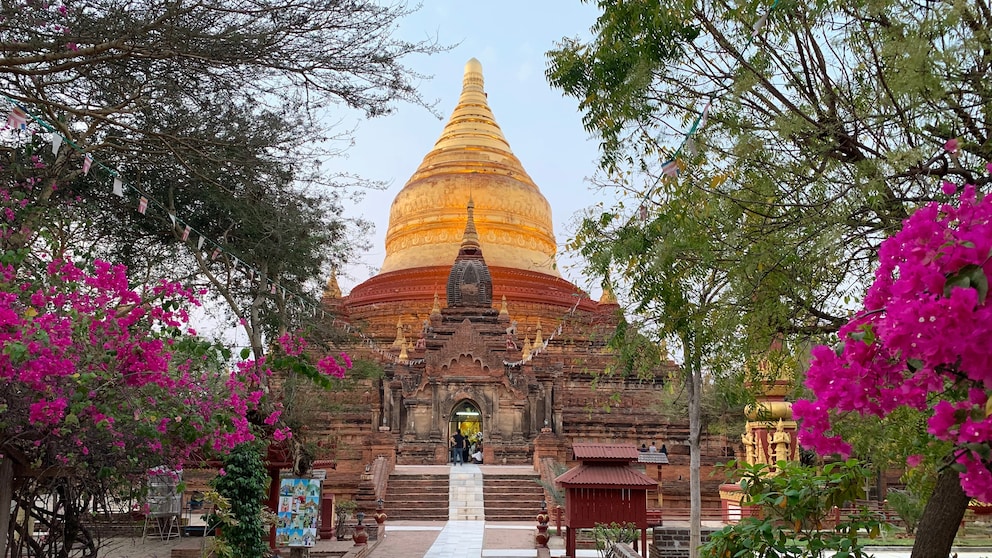
It’s 5:30 a.m. Time to get out of bed because the hunt for the perfect sunrise is about to begin. Visitors to Bagan, Myanmar’s open-air museum with its 2,000 temples, pagodas, and stupas, want to capture a postcard-worthy image to take home–or post on Instagram. Here’s how it works: Leave your accommodation at least half an hour before sunrise, rent an electric scooter–available on every corner in Bagan–and zip to one of the countless viewpoints in an eco-friendly way. Get tips from your hotel, hostel, or the internet. After a few days, you’ll want to find your own secret hotspot.

Hot Air Balloons and Temples – the Perfect Instagram Shot
Once there, find the optimal spot for a photo and wait in anticipation. First, the tourist hot air balloons rise (the short-lived fun costs 250 to 300 euros per person), and after a few minutes, the sun shines over the temples. This blend creates the perfect Instagram shot. However, the quality of the pictures depends on the time of year.

Between March and April, Myanmar (and other Southeast Asian countries) experiences the so-called Burning Season. Locals not only burn their waste everywhere but also set controlled fires on fields and in forests to clear the land of overgrown remnants and prepare for the next planting season.
High Air Pollution During the Burning Season
The downside of the Burning Season: weeks of air pollution in the form of a haze that blankets the entire country. This also affects visibility, making photos only possible with diffuse landscapes in the background. Additionally, the dry period in the first third of the year results in parched air and temperatures up to 104 degrees Fahrenheit. During this hot season, people in Bagan are out and about in the morning until at most 11 a.m. and again in the afternoon from 4 p.m. During the day, most people relax in their air-conditioned accommodations or by the pool–a recommended amenity.
Bagan Requires Several Days
In the evening, the hunt for the perfect photo continues, this time with a sunset and without hot air balloons. It actually takes several days to fully appreciate the fascinating structures. They are a testament to the great era of the former royal city, which flourished between the 11th and 13th centuries AD. During this period, around 6,000 Buddhist pagodas (walkable) and stupas (not walkable) were built, a third of which are still preserved and partially restored. Since mid-2019, Bagan has been a UNESCO World Heritage Site.

Trekking Tour from Kalaw to Inle Lake
About six hours by car from Bagan is Kalaw. From here, a three-day trekking tour to Inle Lake introduces you to the Shan State. The journey takes you over mountains and valleys, past rivers and fields, to small villages where you stay with locals. The views and sunsets over the mountains are spectacular.

The tour also features excellent food. A specialty is Shan noodles. These rice noodles come in sticky or non-sticky varieties and can be served as a warm salad or soup. It takes days just to try the different flavors. Fortunately, they are offered nationwide, though they are particularly delicious here. Other delicacies include tea leaf salad made from fermented tea leaves, garlic, crispy roasted peas, and nuts, as well as avocado and tomato salad–both simple but incredibly well-seasoned.

The route to Inle Lake is manageable even for beginners, as long as you avoid the monsoon season. You don’t need to carry much luggage, as tour operators transport most of it from Kalaw to Inle Lake and then to your desired accommodation. A small backpack with essentials is sufficient.
Kalaw has countless trekking providers. The good ones usually offer alternative routes away from the popular path and can cater to smaller groups of fewer than eight people, such as the “Ever Smile Trekking Service.”
Also interesting: What is the difference between hiking and trekking?

Better Not Hike Without a Guide
The standard prices for a guided tour from Kalaw to Inle Lake with most providers are 30,000 kyat (about 20 euros) for two days and one night, including all meals (excluding drinks), and 40,000 kyat (about 26 euros) for three days and two nights, including all meals (excluding drinks). If you want a private tour for just two people, it costs 60,000 kyat (about 39 euros) per person for the exclusive service.
Although the route is not challenging for experienced hikers, it’s worth considering whether to go without a guide. Even the usually reliable offline map app “Maps.Me” doesn’t show many of the trails. Communication in the villages is difficult, as little English is spoken. Electricity is not always available. During the day, locals use solar panels to charge a large battery for use in the evening and at night. It’s advisable to carry a power bank to charge your smartphone.
Inle Lake – Floating Villages and One-Legged Fishermen
After three days of hiking, you finally reach the southern end of Inle Lake. It is Myanmar’s second-largest inland body of water and much more. Especially in the south, an impressive canal system with floating villages has been established. On the water, entire fields and gardens are cultivated as if it were the most natural thing. There are also craft businesses, accommodations, temples, and even a monastery. And in the middle of the lake, the iconic fishermen balance on their boats. They stand on one leg while using the other to steer, leaving both hands free for fishing. This is multitasking here.

Nyaung Shwe – Perfect Base for Day Trips
To conclude the hike, you cross the extraordinary body of water northward to Nyaung Shwe. Most accommodations are located here. Although the town itself is not the most beautiful, it serves as a base for further excursions. For example, to the pagoda complex Mwe Taw Kakku (located slightly outside, north of the lake) or to the Shwe Inn Dein Pagoda in the southern part. If you’re templed out by this point in your trip, you can instead enjoy a glass of wine and the view of the lake. This is best done at one of the region’s wineries, such as the Red Mountain Estate, which can be reached by rental bike from Nyaung Shwe in about half an hour. A relaxing massage at one of the many studios is also a treat after the hike.
Ngapali Beach – A Place to Linger
Myanmar is not only for cultural travelers and active vacationers but also for beach lovers. Ngapali Beach on the country’s west coast is particularly popular. The place is accessible by bus or plane and exudes an idyllic atmosphere without large hotel complexes, despite being tourist-oriented. The crystal-clear water and clean beaches are surprising. The hotel facilities are tasteful and spread along the coast. The affordable snorkeling trips to the nearby islands are a nice change, but there are no spectacular reefs to see.
It’s recommended to explore the coast northward by bicycle or moped. This is easy to do by simply following the main road. A highlight along the way is the small airport, whose runway begins just a few meters from the sea. If you’re lucky, you’ll experience a plane landing directly overhead.
Be sure to drive a little further north, as there are real beach gems hidden there. A secret tip is the small family restaurant Silver Wave. Since there is no sign on the road, you should mark it in your map app beforehand.
There, you not only get fantastic seafood at reasonable prices–for example, a freshly grilled whole red snapper for about five euros–but also a deserted dream beach. Many visitors end up staying in Ngapali longer than planned because the relaxed atmosphere, great food, and beach vibe are simply too tempting.

Yangon – A Good Start and End Point
The best way to reach Ngapali Beach is from Yangon, the official name for Rangoon. The former capital and metropolis is a good start and end point for a trip through Myanmar. Yangon itself has many special attractions to offer. The most important is certainly the Shwedagon Pagoda. It is a must-see, regardless of how many Buddhist temple complexes you have seen or will see. It is a fascinating dream world of tons of gold and marble that, despite its splendor and many visitors, exudes a contemplative calm and serenity.

In the evening, Yangon’s Chinatown comes to life. Especially on 19th Street, but also in the neighboring streets, life bustles under colorful lanterns. You should be bold and try the many street food stalls. The food in Myanmar is very diverse and spicy. Garlic, onions, and heat are almost always included. Sensitive stomachs should be cautious with meat dishes and perishable foods.

When Mount Fuji Is Visible–and When It’s Not

The 6 Best Attractions and Activities in Hanoi
The Circular Train of Yangon
Another highlight of Yangon is the so-called Circular Train. It leisurely circles the entire city in three hours, passing through numerous suburbs. During the ride, you witness a small spectacle put on by the many vendors in the carriages. They walk up and down the train, loudly advertising fruits, sweets, small snacks, and other goods they have in tow. The most impressive are the vendors who, under the amazed eyes of their customers, quickly whip up a fresh tofu salad from various ingredients.

Yangon’s Abandoned Amusement Park
Even fans of Lost Places will find something in Yangon: Right at the southern end of the city zoo lies an abandoned amusement park.

The visit is not entirely legal, but nearby residents are happy to earn a little extra by showing tourists the way through the fence for 1,000 kyat (about 70 cents). In return, you get to see a bizarre world that also serves as an excellent backdrop for a horror film–or an Instagram post.
Also interesting: Ramree Island – Myanmar’s Island of Horror
