

March 6, 2026, 4:19 pm | Read time: 6 minutes
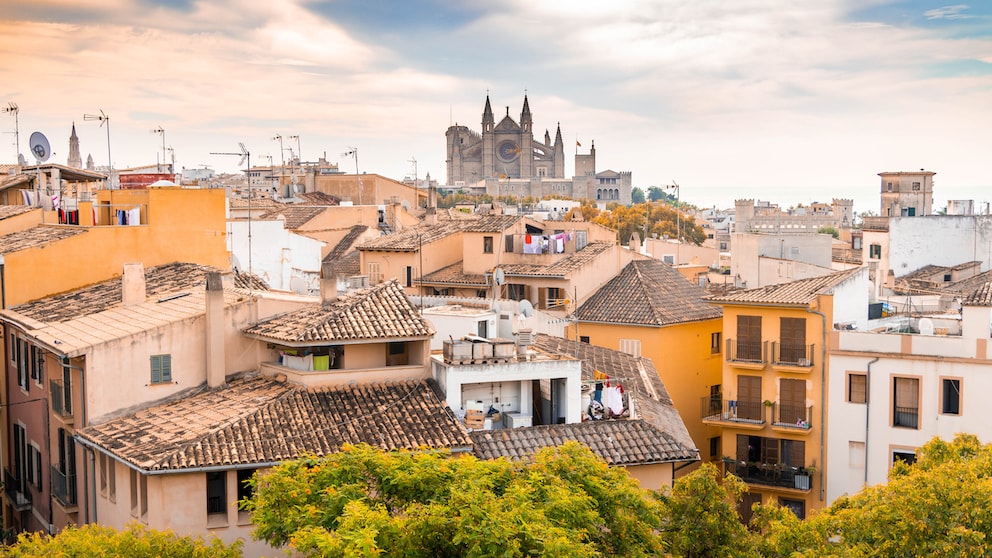
A shift in thinking seems to be taking place on the Balearic island of Mallorca, so popular with Germans. The Spanish island wants to move away from mass tourism and has also set an ambitious goal. Palma aims to become the European Capital of Culture. TRAVELBOOK gained fascinating insights at the ITB tourism fair in Berlin and also spoke with Palma’s tourism chief, Pedro Homar.
Sunburned bodies, both internally and externally soaked in alcohol, on beaches where towels are packed tightly together—this is what Mallorca’s hotspots look like in the summer. Especially in areas where partygoers enjoy (pardon the opinion) bad music, where Atzen, Megapark, and Schinkenstraße are common names at the center of the annual Mallorca vacation.
Of course, this is only a small part of Mallorca. Of course, mass is not just mass. And while the Balearic island is still frequently and eagerly visited each year and sometimes seems to burst at the seams, it’s not just Ballermann tourists who are drawn here. Many come for the beautiful beaches, the laid-back island life, the charming capital, and the culture of the picturesque Balearic island. And more of those visitors are desired, while fewer of the others are preferred. The island wants to focus on culture instead of mass tourism and make Palma the European Capital of Culture.
Germans Increasingly Travel to Mallorca in the Off-Season
The plans for more culture and sustainability and moving away from mass tourism were presented by the President of the Balearic Islands, Margarita Prohens Rigo, known as Marga Prohens, on Tuesday (February 3, 2026) at the International Tourism Exchange Berlin (ITB Berlin). The so-called “new” model aims to spread tourism more evenly. Culture offers the “transformation engine for the tourism model,” as Prohens explains. He suggests the project is already off to a good start, noting that 2025 already showed a turning point. Accordingly, the pressure on the island during the usually overcrowded summer months has somewhat decreased. At the same time, there has been much more interest in vacations to Mallorca during the intermediate and off-seasons.
Following President Prohens’ press conference, TRAVELBOOK also spoke personally with Pedro Homar, the head of the Fundación Turismo Palma 365. He explained: “We started with the new tourism strategy in 2012. The idea was already then to make Palma a year-round destination.” Currently, according to Homar, “70 percent of overnight stays occur in the high season” between May and September. The remaining 30 percent of overnight stays fall in the off-season—January to April and October to December. “Our goal is a 65:35 ratio. We hope to achieve this in the next three to five years,” Homar told TRAVELBOOK.
German tourists stand out in this context. According to Balearic President Prohens, between November 2024 and March 2025, 677,622 German tourists came to Mallorca alone. This is an increase of 13.3 percent compared to the previous year and even 33.5 percent more than two years earlier. At the same time, the number of German tourists overall has decreased. Pedro Homar tells TRAVELBOOK in an interview: “The German market has decreased by two percent in 2025 compared to 2024. However, we are 15 percent higher in spending.” He explains: “With fewer overnight stays, more tourists are spending more money than in 2024. This is essentially the model we are shaping for the city of Palma.”
This Demolition is Set to Fundamentally Change the Ballermann

Alternative accommodation is booming on Mallorca
Finding Balance Between Tourists and Locals
For the president, the numbers confirm the new Mallorca course. It remains the goal of her government to “balance tourist activity with the quality of life of residents and the protection of the territory,” as she explains at the ITB. Growth should be evenly distributed throughout the year.
“In 2023, we began to see some problems between the influx of tourists and the residents,” says Palma’s tourism chief, Homar, in an interview with TRAVELBOOK. One of the measures introduced to restore balance was to limit the number of beds. A second was maintaining the cap on cruise ships arriving daily: “A total of three. We hardly receive three cruise ships per day throughout the year.” Exceptions are only made in the high season. A third measure is creating an “agenda of activities that will take place throughout the year in hotels, restaurants, shops, and museums, exclusively for residents and free of charge.” The idea behind this is “for residents to rediscover spaces they traditionally associate only with tourists–so they see that it is positive for us as a city to have all these new developments open year-round.”
Capital of Culture 2031?
In the effort to spread out tourism and focus on sustainability, Mallorca’s focus is now on promoting cultural life on the island, especially in the capital, Palma. It aims to become the European Capital of Culture in 2031—and thus join a long list of cultural capitals such as Athens, Weimar, Florence, Dublin, Madrid, and Lisbon, to name a few. However, many probably chuckled when Chemnitz was chosen as the European Capital of Culture last year. Here, too, an image change was at work. So, how does Palma plan to strengthen the cultural focus and eventually become the Capital of Culture in 2031?
With its campaign “Balearic Islands—where culture pulses,” the island group wants to link tourism and culture more closely and establish Palma as a cultural destination outside the high season, as “Mallorca Magazin” writes. Various projects support this, such as the contemporary art fair “Art Cologne Palma Mallorca” taking place in April. Eighty-nine galleries from 20 countries are participating. The art fair will be held from April 9 to 12 at the Palau de Congressos Palma Bay. Further plans, according to Ballermann Radio, which cites Palma’s Mayor Martínez, include transforming Placa Major into an urban amphitheater and creating a public nature reserve on the Son Quint estate.
In addition to culture, Mallorca is increasingly focusing on digitization and environmental protection, according to Prohens. According to the president, 4.6 million euros have been invested in a project called “Digital Twin.” With the support of the platform, water resources and biodiversity can be better protected in the future. According to Tourism Minister Jaume Bauzá, the corresponding sensors are already installed on 150 beaches. An app for real-time analysis of seawater quality is also planned.
Decision in December
According to Inselradio Mallorca, Palma is presenting its bid to become the European Capital of Culture 2031 in Madrid today. Eight other cities from Spain are applying, including Las Palmas on Gran Canaria, Granada, and Toledo. The final decision on which cities will become the European Capitals of Culture in 2031 is expected in December this year.
Pedro Homar is relaxed about the nomination: “We want to be nominated as the European Capital of Culture 2031. But if we are not nominated, that’s not a problem,” he says in an interview with TRAVELBOOK, adding, “Our strategic plan will be implemented regardless. The nomination as the European Capital of Culture is the label.” The cultural course remains set: “In the next five to ten years, we want to be the cultural capital of the Mediterranean.”