

October 8, 2026, 9:28 am | Read time: 5 minutes
Southwest of Sicily lies the volcanic island of Pantelleria. It may not be well-known to many, but this Italian island has a lot to offer. With hot springs, rugged coastlines, and black volcanic rock, Pantelleria is a destination for those seeking more than just a beach vacation.
Pantelleria is located about 60 kilometers off the coast of Tunisia and roughly 100 kilometers from Sicily. Geologically, it is part of the African continent. This also explains its name: Pantelleria or Bint al-Riyah is Arabic and translates to “Daughter of the Winds.” This reveals a lot about the weather that usually prevails on the island, as strong winds often sweep over Pantelleria. This has shaped the landscape and the architecture of the residents to this day.
The Italian island is of volcanic origin and rose from the sea long ago. Hot springs and fumaroles, places where steam escapes, still bear witness to this today.
Hot Springs and Volcanic Rock
Anyone traveling to Pantelleria should definitely visit the Grotta di Benikulà. It is one of the volcanic features of the island. It is a cave in a rock crevice that acts like a sauna. Inside, the temperature is about 38 degrees Celsius, as water vapor escapes from the rock. There are hot springs all over the island that can be used for free.
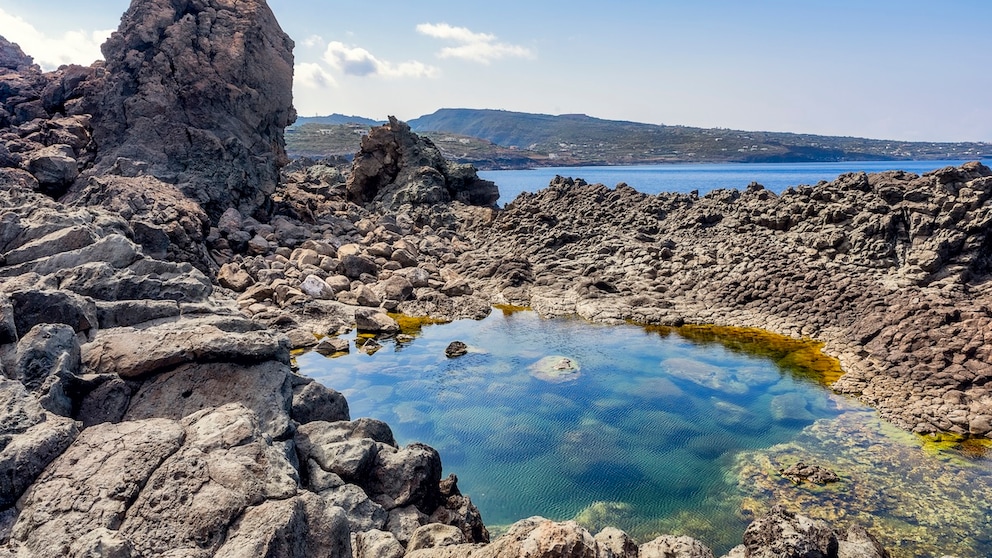
Thermal pools carved into the lava rock are often found right by the sea, with water temperatures ranging from 40 to 50 degrees Celsius. At Cala Gadir, a special algae grows on the pool walls, which is traditionally believed to help with colds.
Also interesting: In Sicily, ice cream is eaten for breakfast
The most famous is the Specchio di Venere, a turquoise crater lake in the north of the island. It is located in the middle of a nature reserve and is fed by rainwater and underground thermal springs, making the lake significantly warmer in some areas. On the shore, you can find mineral-rich mud, which is often used for skincare. Most of the Italian island has been a national park under protection since 2016.

No Classic Sandy Beaches
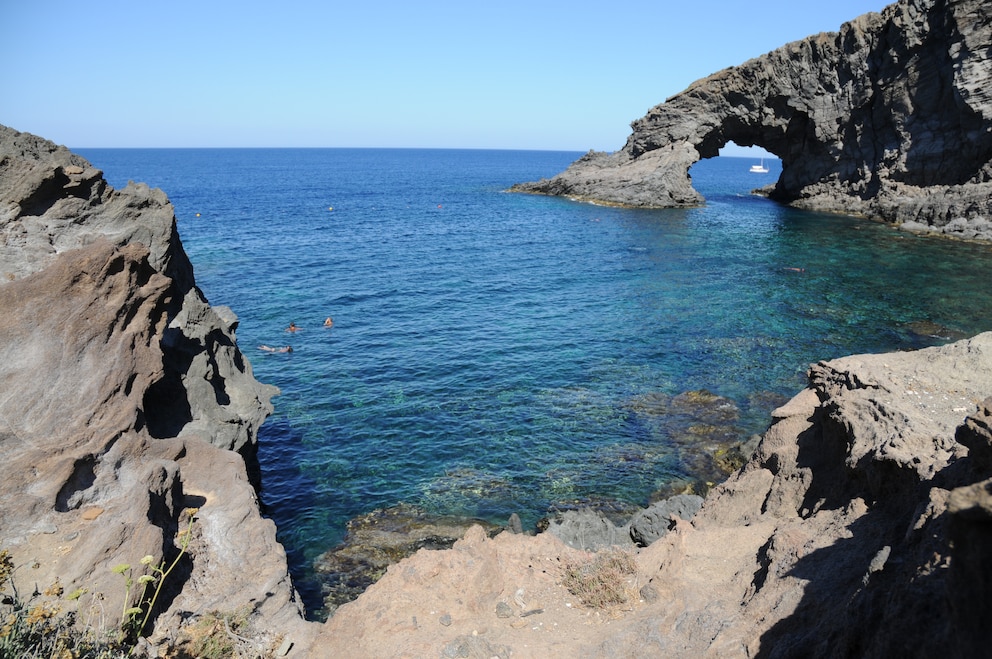
You won’t find real beaches on Pantelleria. Instead, the coast is characterized by black lava rocks, pebbles, or small, rocky coves. So, a traditional beach vacation isn’t possible there. However, you don’t have to miss out on swimming. Cala Levante is particularly suitable. There, you can swim, snorkel, and dive in crystal-clear water. Additionally, the island’s landmark is located there: the Arco dell’Elefante rock arch. The lava rock extends into the sea and resembles an elephant’s trunk.
Balata dei Turchi is also suitable for swimming. It is located in a very remote rocky bay in the south of the island. Instead of a sandy beach, there is a flat stone slab, hence the name Balata, derived from the Arabic and Sicilian term.
A real highlight is Cala Cinque Denti. Many tourists take a boat to this bay to swim in the crystal-clear water. Additionally, you can reach the Grotta della Pantofola di Cenerentola cave from there, but only by swimming. It is only accessible from the sea. Translated, it means “Cinderella’s Shoe,” referring to the cave’s opening, which is overarched by a bow-shaped rock resembling a shoe.
A Stay in a Dammuso
The island’s residents have adapted to the unique landscape and conditions over the years. That’s why the Dammusi still exist today. These cube-shaped houses made of dark lava stone with domed roofs once served as homes for farming families. A Dammuso is perfect for Pantelleria’s weather: Thick stone walls keep the heat out, and the whitewashed domed roof collects rainwater.
If you’re vacationing on Pantelleria, you should spend at least one night in such a Dammuso. Today, many of these structures, often located in the midst of nature, have been restored specifically for tourists. While some have retained their simple character, there are also more luxurious versions with private pools.


11 of the Most Beautiful Beaches on Bali
Christopher Nolan’s Chosen Filming Locations for “The Odyssey”
Unique Wine Cultivation
The island is not only characterized by lava rock but also by wine cultivation. Due to the strong winds, a special method of cultivation has been chosen. The vines are planted as “vite ad alberello,” or very low bush vines. The plants are placed in depressions about 20 centimeters deep. This allows rainwater to collect, and the vine is also protected from the wind.
The cultivation method is so unique that UNESCO added it to the Representative List of the Intangible Cultural Heritage of Humanity in 2014.
On Pantelleria, the white Zibibbo grape is primarily grown. It is used to produce the amber-colored sweet wine Passito di Pantelleria. For the wine, the grapes are dried in the sun after harvest, enhancing the sugar and flavors.
Getting There
If you’re now eager to visit this special Italian island yourself, you have several options. There are no direct flights from Germany to Pantelleria. However, you can fly to Palermo, Milan, or Rome and then continue to the island from there.
Alternatively, you can reach Pantelleria by ferry from Sicily. The ships operate year-round, and depending on the provider, the journey takes between 2.5 and 7 hours.