

October 27, 2026, 2:40 pm | Read time: 5 minutes
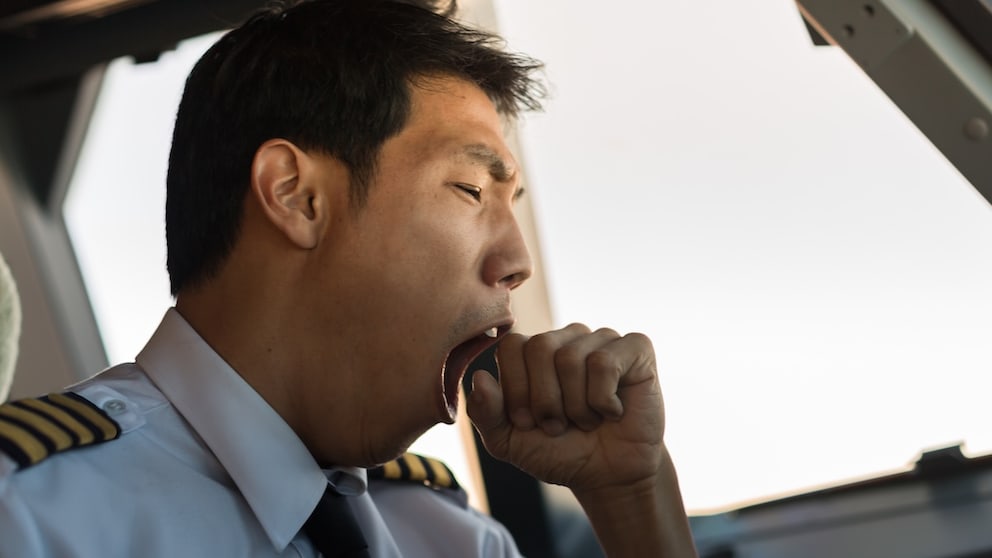
Almost everyone goes to work sometimes, even after a bad night or when they don’t feel fully rested. This is less of an issue with an office job than with a profession that involves responsibility for other people–and their lives. The results of a new survey are therefore all the more alarming. According to the survey, nearly one in four pilots gets into the cockpit even though they feel too tired. Similar results have been found in previous studies. TRAVELBOOK asked an expert–a professional pilot–for an assessment of the issue.
Microsleep Among Pilots Has Been Widespread for Years
TRAVELBOOK reported just a few months ago on a quick survey by the pilots’ union Vereinigung Cockpit (VC). It revealed that a remarkable 93 percent of respondents have fallen asleep on duty. The Indian aviation authority DGCA responded to this result by announcing mandatory anti-fatigue training.
Not much has changed since then. Quite the opposite. The Vereinigung Cockpit (VC) expressed “deep concern” in a statement. The widespread fatigue in the cockpit has been known since 2023, and the issues remain unchanged, as a new survey shows.
Survey Results in Detail
The VC refers to a recent study conducted on behalf of the European Cockpit Association (ECA) titled “A Fatigue Survey of European Pilots – 2026”. Seven thousand two hundred pilots participated, and the results are truly eye-opening:
- An alarming 78 percent of the pilots surveyed reported having experienced microsleep while on duty
- 38.8 percent reported insufficient rest periods, which could explain the fatigue in the cockpit
- Calling in unfit for duty due to fatigue? At least 24.2 percent of respondents said they would not do so. They fly even when they feel too exhausted, without reporting it. Because:
- 38.2 percent fear consequences if they do not show up for duty due to fatigue, such as disadvantages from management.
VC Demands Measurable Changes
The association describes the high participation in the survey as an “impressive signal” and sees pressure from airlines as a central problem. This pressure seems to have even increased: While in 2023, 65.8 percent of the pilots surveyed feared negative consequences if they refused to extend their flight duty time, the current survey shows it has risen to 69.1 percent.
To improve flight safety, the VC primarily calls for better rest periods. Additionally, effective fatigue management is needed to ensure pilots are sufficiently rested. An open reporting culture must also be established, where fatigue can be reported without fear of professional disadvantages. Airlines should not pressure pilots if they refuse to extend their flight duty time for safety reasons.
Finally, the association calls for stricter controls by national supervisory authorities and the European Union Aviation Safety Agency (EASA) to enforce existing safety regulations more consistently.
Expert Explains Whether Microsleep Among Pilots Is Dangerous
The issue of microsleep is well-known in car driving, as a sudden attack of fatigue can have serious consequences. If an accident occurs, it can be classified as grossly negligent or even criminal, leading to the revocation of the driver’s license or a prison sentence; more information can be found in the penalty catalog.
On the flight deck, however, microsleep does not lead to accidents. This is assured by Andreas Bertram, a professional pilot and managing director of Flugservice Bautzen (EDAB), in response to a TRAVELBOOK inquiry. Overall, he assesses the survey results much more soberly. Modern aviation is highly technical, with many tasks now handled by computers. “The computer flies much better,” says Bertram. Pilots are mainly there to monitor the technology and ensure all systems are functioning properly.
Especially on longer routes, this task can be extremely monotonous. The aircraft often flies straight for long distances while automated systems optimize altitude, energy consumption, and engine control. “When there’s nothing to do and all values are in order, it’s–to put it in German–boring,” Bertram describes the work in the cockpit. Pilots then look out the window–and might fall asleep.
Shocking! Survey Reveals Many Pilots Fall Asleep While Flying

Why Aviation English Sounds So “Wrong”
»Pilots Don’t Fall Asleep From Fatigue, but From Boredom
Bertram finds it quite plausible that pilots regularly nod off in the cockpit. However, in his assessment and experience, this is less due to overwork from too many flight hours and more due to the monotony of the job.
The situation is not immediately dangerous as long as the technology functions reliably. If a system fails or a value deviates from the norm, the aircraft systems respond with visual and acoustic warnings. And then it gets loud: “You can’t sleep so deeply as to miss that.”
Pilots must then assess the situation, work through the relevant checklists, and decide what actions are necessary. A monotonous monitoring task can thus become a highly demanding situation within seconds. Pilots must suddenly be able to perform at full capacity again. And certainly, after a long period of low demand, this can be challenging.
Regular Training for Emergencies
Bertram also points out that pilots are intensively prepared for such situations. Emergency training is part of their professional routine. Pilots are regularly tested and typically undergo semi-annual simulator training in their companies, where emergencies and unusual situations are practiced.
Despite increasing automation, their task remains demanding: They must always be ready to take control and make the right decisions.
But should something be done about the monotony? From Bertram’s perspective, the only option would be to allow pilots more manual flying time. However, how sensible this is remains questionable, as more manual flying is neither the safest nor the most economical solution.