

July 31, 2025, 3:26 pm | Read time: 4 minutes
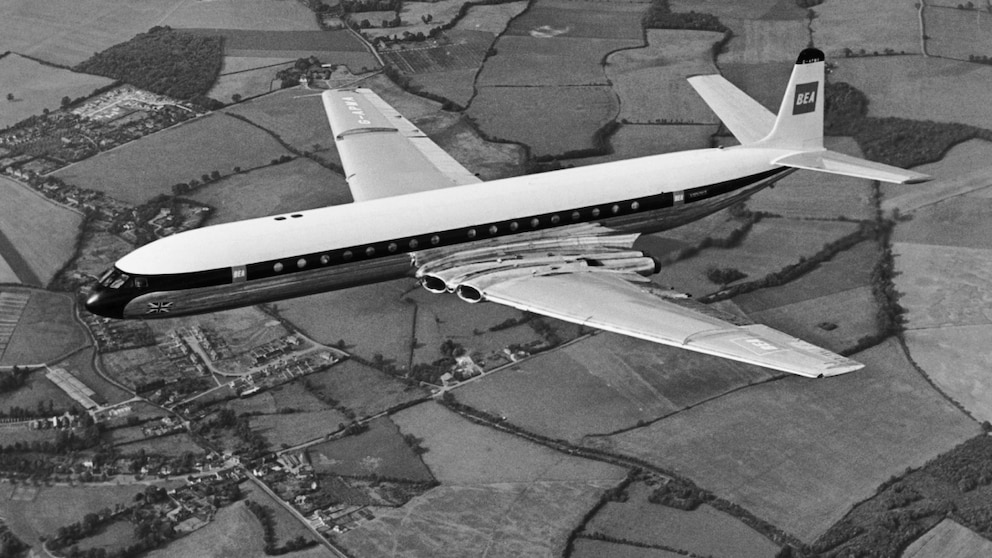
Flying to vacation destinations by plane is quite normal for many people today. However, it used to be something special. But what did planes look like back then? The first commercial jet-powered passenger plane took off in 1952 and has now been restored. It can be viewed in a museum near London.
The DH 106 1A Comet, made by the British manufacturer de Havilland, was the world’s first commercial jet-powered passenger plane. It replaced the previous propeller-driven aircraft and was significantly faster and more comfortable. The plane made its first flight for Air France in May 1952 from London to Johannesburg. Even though this aircraft type ushered in a new era–it could climb to 12,000 meters–there was still much room for improvement compared to today. The journey took about 23 hours because the maximum range was around 2,800 kilometers, requiring the trip to be completed in several stages. And that wasn’t the only problem the Comet faced.
Also interesting: The 10 oldest airlines in the world still flying today
First Jet-Powered Passenger Plane Stands Near London
The Comet was the first jet-powered passenger plane–today, only one example remains. It is located at the de Havilland Aircraft Museum north of London. As reported by CNN, the aircraft was handed over to the museum in 1985 in a terrible condition. It was more or less a bare metal tube, the remnants of the fuselage. However, over the years, volunteers have painstakingly restored the plane, so it can be visited today. Only the wings are missing, as they would take up too much space in the museum.
Entering the plane transports you to another time. The interior of the Comet is nothing like what we know today from a (normal) passenger or vacation plane.

No Comparison to Today’s Vacation Planes
Wide seats with blue upholstery and plenty of legroom, large square windows with short curtains–this was the standard class. There were also chrome drink holders and, as was customary at the time, ashtrays at every seat. Unlike today, there were no overhead compartments, just small buttons to call the flight attendants. These were painstakingly recreated using 3D printers.
There was also a first-class section back then. It was also equipped with wide, comfortable seats. Two pairs of seats faced each other with a large table in between, similar to what you might see in train compartments today.
According to CNN, this was the pinnacle of luxury travel. Advertising photos from the time showed passengers in stylish clothing with cocktails in hand and lavish meals. Travelers were likely very wealthy at the time.
According to Eddie Walsh, a volunteer museum worker leading the restoration, flying on the Comet was very expensive back then. In a CNN interview, he explained that one had to be quite wealthy to fly anywhere–especially on the Comet. A single ticket for the first connection to Johannesburg cost about 175 pounds, which today would be equivalent to more than 5,200 euros.

Former Private Jet Flight Attendant: “They Told Us the Plane Could Be Shot At”

Why Some Flight Attendants Sit on Their Hands During Takeoff and Landing
Tech Enthusiasts Also Get Their Money’s Worth
But not only was the interior completely recreated, but also the cockpit. Tech enthusiasts will find the de Havilland Aircraft Museum particularly rewarding. The reconstruction, with its countless analog dials, switches, and control panels, was almost an impossible task, according to Walsh.
The Comet had another unique feature. Behind the pilot and co-pilot seats were chairs for a flight engineer, who monitored fuel consumption, and a navigator, who planned routes with paper, pencil, and maps. This made the aircraft state-of-the-art in 1952.
Success Story Without a Happy Ending
Despite the promising start of the first jet-powered passenger plane, its story did not end well. This is also shown in the museum. One side of the aircraft is exposed, revealing the framework and highlighting the former flaws.
The cabin wall was one of the biggest problems of its time, showing massive design flaws. Less than a year after the first flight, the first fatal accident with a Comet occurred. Two months later, another crash claimed more lives.
In 1954, more accidents followed–a Comet broke apart mid-air on a flight to Italy. This led to a worldwide flight ban to uncover potential issues. After flights resumed, another fatal accident occurred, ultimately leading to the end of the Comet 1A.
Later tests on the aircraft’s fuselage revealed that the outer layer could not withstand repeated pressure build-up and release. This led to cracks and fractures.