

October 20, 2025, 9:39 am | Read time: 4 minutes
A massive new airport has opened just outside Mumbai, India’s metropolis, poised to become a new hub in Asia. All the details on the new Navi Mumbai International Airport.
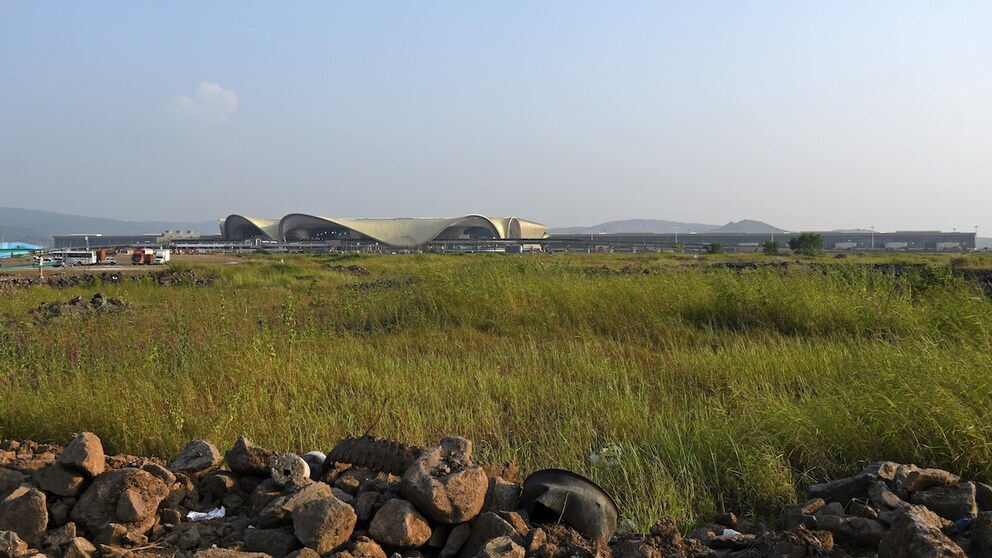
A huge champagne-colored lotus flower stretches out in the dense Indian smog: the gleaming Navi Mumbai International Airport, or NMIA, is finally open. Long planned and repeatedly delayed, operations at India’s new mega-airport are slowly ramping up, even though it’s not fully completed. For now, only passengers traveling within India can fly here, but starting mid-December, international destinations will also be served.
Overview
20 Million Passengers in the First Year
NMIA is launching in phases, with five phases in total. Initially, 20 million passengers per year are expected to be handled on one runway and in a single terminal. Additionally, 0.5 million tons of cargo will be processed. Mumbai’s low-cost airline Akasa Air is set to start with more than 100 weekly domestic flights—“and expand this number in the winter schedule to more than 300 domestic flights and over 50 international flights per week,” according to the airport. “No airline in India will have a larger share of its fleet and operations at NMIA than Akasa Air,” says its founder and CEO Vinay Dube.
The planned 20 million flight passengers at NMIA are likely to make a difference in India’s second-largest city. Until now, all of Mumbai’s flight passengers were handled at Chhatrapati Shivaji Maharaj International Airport (BOM). Too many. The result: long queues, delays, in short: chaos. The airport in India’s bustling metropolis is bursting at the seams. Or in the words of Arun Bansal, CEO of the operating company Adani Airport Holdings Limited: “The current airport has reached its capacity of 55 million passengers per year.” The new airport in neighboring Navi Mumbai, east of the city, is expected to alleviate this. An additional capacity of 20 million is urgently needed, Bansal explained according to the BBC. Accordingly, Navi Mumbai Airport will “significantly reduce” traffic congestion in India’s financial capital. But the plans for Navi Mumbai Airport don’t stop there.
Rather, the operators have set far higher goals than just relieving BOM: NMIA is to become India’s largest aviation center. A hub in Asia and a competitor to other already active hubs in the region, such as Dubai or Singapore.
Also interesting: The world’s largest airport is set to be built here

Airports Where You Can Expect Chaos Now

These Airports in Europe Offer Passengers the Best Departure Service
90 Million Passengers in the Future
In the long term, the 1,160-hectare Navi Mumbai Airport is expected to serve 90 million passengers annually and “expand to four runways, multiple terminals, and a cargo complex,” writes the responsible architectural firm Zaha Hadid Architects in a statement. If successful, it will nearly match Dubai’s DXB (about 92 million passengers per year) and even surpass airport giants like Singapore’s Changi (about 67 million), London’s Heathrow (about 84 million), or New York’s JFK (about 63 million).

Also interesting: The world’s largest airports by passenger volume
How to Get to Navi Mumbai Airport?
Until then, Navi Mumbai Airport still has a longer road ahead. Because besides the airport itself—with its various leveled hills, diverted rivers, and bridged streams, as well as several delays in its planned completion in 2032—there are also a few open construction sites outside. One of the most important: connections to the transportation network.
Navi Mumbai Airport is located about 40 kilometers from the city and business center in South Mumbai. Approximately 35 kilometers separate the new airport from Mumbai’s current main airport. In the city’s dense traffic, this means a travel time of at least one and a half hours. That doesn’t sound too bad at first, but given Mumbai’s traffic chaos, it’s only relative. More traffic to and from the airport would likely mean an extension of travel time—not to mention the increasing car emissions in smog-covered Mumbai.
Direct Connection Between Airports
The expansion of the existing public transportation system is expected to provide relief: “The planned multimodal connection of the airport—which links the Mumbai Trans Harbor Link, Navi Mumbai and Mumbai Metro, the suburban railway, and ferries—will significantly improve regional accessibility (and) reduce travel time,” the airport’s architects enthuse. Additionally, the transportation project will “promote economic development throughout West India.” Once the direct subway connection between the old and new airports is completed, it will run every 20 minutes. However, according to the BBC, this could take years. Until then, electric buses will shuttle transfer passengers back and forth. Apparently, a typical practice in India, according to an aviation consultant interviewed by the BBC. He explained that supporting infrastructure is often built afterward rather than concurrently.