

August 21, 2025, 10:26 am | Read time: 4 minutes
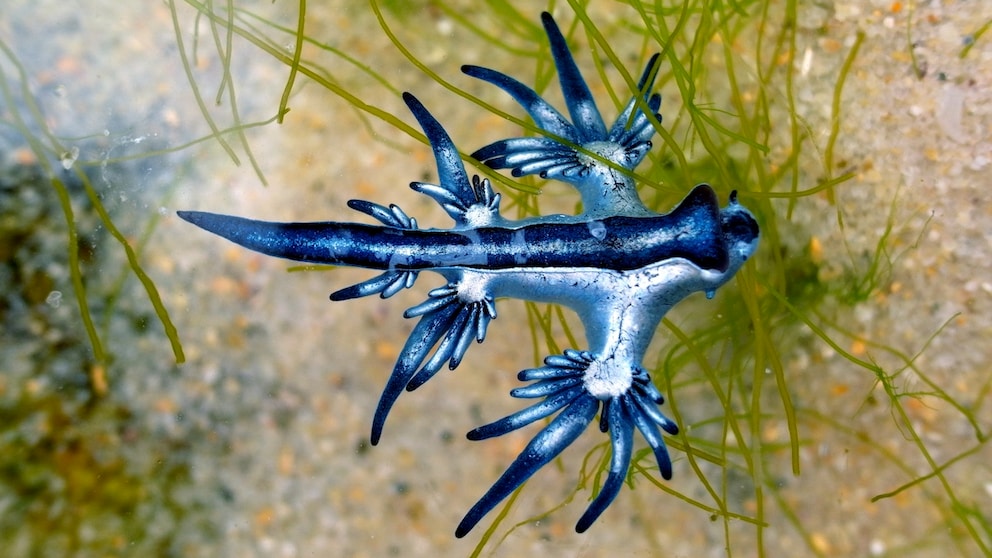
An eleven-kilometer stretch of beach on Spain’s Costa Blanca has now been closed. Tourists are not allowed in the water–the reason is the sighting of the rare sea slug Glaucus atlanticus. Due to its extraordinary, almost mythical appearance, it is also called the “Blue Dragon.” However fascinating the marine creature may seem, it should be observed from a safe distance. At TRAVELBOOK, you’ll find out why.
As reported by the “Daily Mail,” the so-called Blue Dragon has appeared on the beaches of the municipality of Guardamar del Segura, north of Torrevieja on the Costa Blanca. Consequently, the red flag was raised. Tourists are no longer allowed to swim. So far, two specimens have been discovered. Authorities warn against touching the creature, even with gloves, as contact can be unpleasant for humans.
In early July, a renowned marine biologist discovered the rare sea slug Glaucus atlanticus off the coast of Mallorca. There have been sightings in the past as well. Last year, the sea slug reportedly caused a stir on the beaches of Texas (TRAVELBOOK reported). Torrevieja on the Costa Blanca has also been affected before–the Blue Dragon was sighted in the area in 2021 and 2023.
Overview

Blue Dragons on Mallorca–why it’s spectacular
The Spanish marine biologist Gádor Muntaner claims to have discovered the extraordinary marine creature in July during a boat trip in the northwest of Mallorca, specifically near the Serra de Tramuntana mountain range. She reported this to the newspaper “Ultima Hora.” A sensation–since 1705, no sightings of the sea slug have been recorded on the Balearic island. It is a “very, very rare creature,” Muntaner told the paper.
Characteristics of the unique marine creature
The Blue Ocean Slug typically grows between 3 to 5 centimeters. According to “Ultima Hora,” Gádor Muntaner encountered a relatively large specimen. The appearance of the creature is truly unique. Its bright blue body is artfully patterned–the lateral appendages appear like shimmering wings. Normally, the Blue Dragon drifts on the high seas and in groups just below the water’s surface. Its striking coloration serves as camouflage, specifically as protection from predators both from the air and the water. The top side appears deep blue and blends with the sea, while the gray-white underside is barely distinguishable from the bright sky when viewed from below.

Occasionally, however, westerly winds can drive Blue Dragons from the Atlantic to coasts. This is demonstrated by Muntaner’s find and confirmed in a conversation with TRAVELBOOK by marine life expert Phillip Kanstinger from WWF. Despite their uniqueness, one should not approach or touch the colorful sea slugs.
These Sea Creatures Can Pose Be Dangerous on Vacation

Swimmer Injured as Poisonous Jellyfish Spread Off Tenerife
What makes the Blue Dragon dangerous
As Phillip Kanstinger explains, the so-called Blue Dragon is a nudibranch. It lives on the high seas, where it primarily encounters cnidarians such as corals and jellyfish. It also feeds on them. “It’s actually good for us humans that the slug eats Portuguese man o’ war, for example,” says the expert, “because they are dangerous.” TRAVELBOOK previously reported sightings of the venomous jellyfish in Mallorca.
Also interesting: These are the most venomous jellyfish in the world
According to Phillip Kanstinger, nudibranchs store the toxins they consume. “This makes them toxic themselves, so you shouldn’t touch them.” Unlike other slugs, they don’t have a hard shell, so the cnidarian toxin is transferred upon contact. The venom of a Portuguese man o’ war causes red, painful welts on the skin upon contact. In the worst case, it can lead to an allergic shock. However, there are no known cases where contact with the “Blue Sea Dragon” has had similar effects on humans. Panic is therefore unwarranted.
Nevertheless, tourists should not take any risks if they happen to discover one of the sea slugs on the beach. Leave the creature alone, do not touch it, and if possible, inform lifeguards on site.
Is climate change driving the Blue Dragon?
Various reports attribute the occasional sightings of Blue Dragons, as well as Portuguese man o’ war, to global warming. According to expert Kanstinger, this is still a hypothesis that cannot yet be substantiated. “The animals are only seen sporadically,” he explains, “due to influx events. There is no evidence yet that they are spreading due to climate change.”