

December 16, 2025, 2:50 pm | Read time: 3 minutes
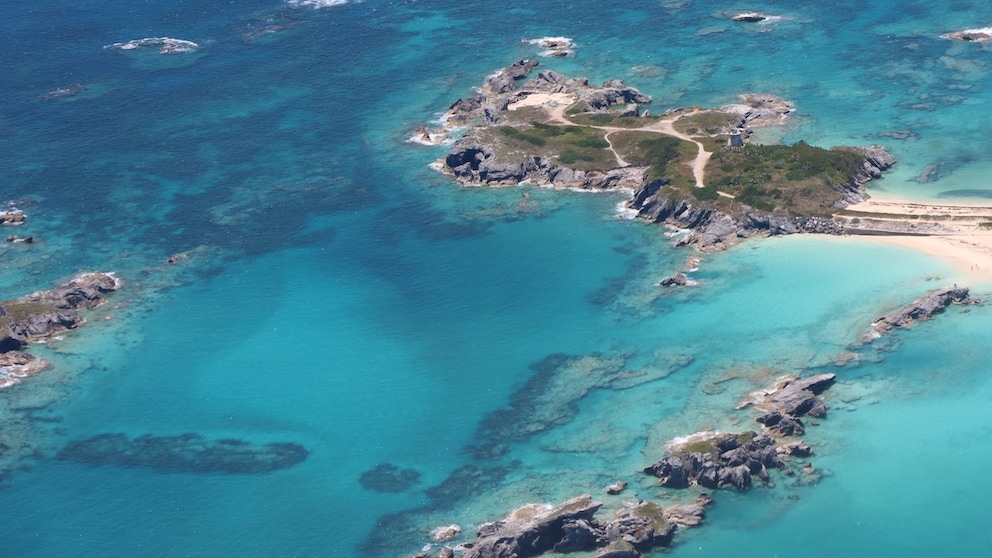
Since the 1950s, the so-called Bermuda Triangle has been considered mysterious. Numerous myths surround the question of why ships and planes are said to have disappeared in a specific region of the Atlantic. Yet, independent of this, Bermuda is of particular scientific interest from a geological perspective. Researchers have long been investigating why this island exists in the middle of the Atlantic. In this context, they have now made a remarkable discovery beneath Bermuda.
Massive Rock Layer Beneath Bermuda
The oceanic crust is the thin, dense layer of the Earth’s crust that forms the ocean floors. This is explained on “Planet Schule,” the recognized online knowledge platform of German educational television by SWR and WDR. This crust mainly consists of volcanic rock basalt, typically ranging from 5 to 8 kilometers thick. Bermuda presents a different case. Seismologists William Frazer and Jeffrey Park have discovered an anomaly, which they documented in a research paper. They identified an additional zone beneath the island territory in the North Atlantic that significantly differs in structure and composition from the surrounding rock. “This underplated layer is about 20 kilometers thick,” the authors write, “about twice as thick as observed in many other intraplate ocean islands.”
This massive rock layer should not exist at this location. Such structures typically arise from volcanism, processes associated with the ascent of magma from the Earth’s interior. Bermuda sits on a topographic uplift of the ocean floor and has shown no volcanic activity for more than 30 million years, as the researchers emphasize. The uplift should have long since subsided—and the recently discovered structure might explain why it hasn’t. It acts like a stabilizing foundation within the Earth’s plate—a kind of raft, so to speak—and keeps the area permanently elevated.
Researchers Solve Mystery of River That Flows ‘Uphill’

Researchers Discover Mysterious Underwater Wave in Lake Geneva
Explanations for the Mysterious Structure
Frazer and Park suspect that during the last volcanic phase, large amounts of molten rock did not reach the surface but remained trapped in the Earth’s crust. After cooling, the magma developed into this unusual, raft-like rock slab. Due to its relatively low density, the structure deflects seismic waves—ultimately leading to its discovery. As the researchers explain, they analyzed earthquake waves from a great distance. When these waves passed through Bermuda’s subsurface, they changed their behavior. This was interpreted as a clear indication of material with an unusual composition.
In 2019, a scientific study gained attention by geochemically analyzing rock beneath Bermuda. The responsible researchers noted the hypothesis that the formation of this structure might be related to the breakup of the supercontinent Pangaea around 300 million years ago. More specifically, it could be linked to the beginning of the opening of the Atlantic Ocean. The analyses showed an unusually low silicon content in the rock and distinctive chemical signatures. These suggest that the magma originated from a particularly deep or different area of the Earth’s mantle. Since then, research has considered Bermuda not a classic volcanic hotspot like Hawaii, but something special—possibly even unique on Earth.
Further Research to Understand the Bermuda Anomaly
However, it remains unclear whether Bermuda is truly a geological anomaly. As study author Frazer explained to the portal “Live Science,” similar structures might exist beneath other islands. To find out, further investigations are planned.
The enormous significance of this discovery is beyond question. Frazer emphasizes the importance of thoroughly studying extreme locations like Bermuda to understand those with less extreme conditions. “This gives us a sense of which processes on Earth are more normal and which are more extreme.”