

February 6, 2026, 1:59 pm | Read time: 4 minutes
Rivers typically avoid massive mountain ranges—and they flow downhill, as gravity pulls water downward. However, the Green River in the U.S. state of Utah seems, in some sections, to do the opposite: flow uphill. Over millions of years, it has carved deep into the landscape, forming canyons as it traverses the ancient Uinta Mountains–a range that has existed for over 50 million years. Normally, a river would be diverted around such a stable massif rather than cutting through it. A new study now provides an explanation for this geological puzzle.
Seemingly Uphill-Flowing River: Green River in Utah
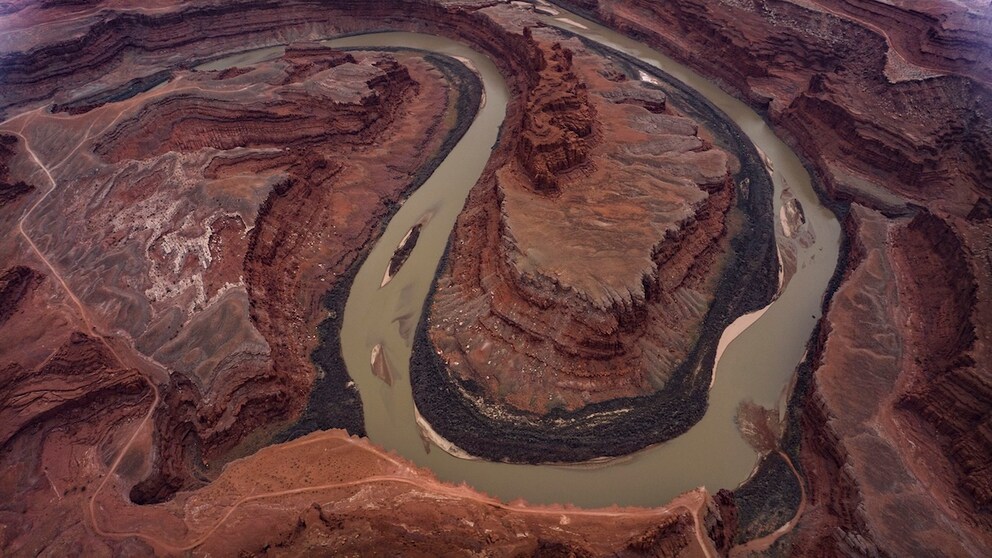
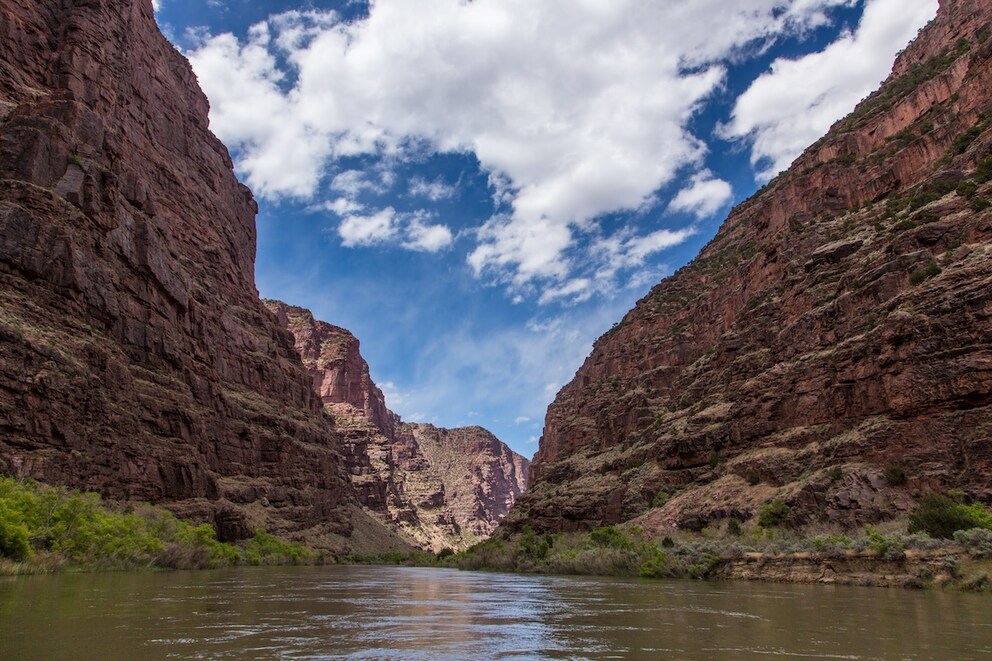
The Green River is the main tributary of the Colorado River. It flows through the U.S. state of Utah from the Flaming Gorge Reservoir in the northeast to its confluence with the Colorado River in Canyonlands National Park. On its southwest journey, it forms spectacular gorges such as Desolation Canyon and Gray Canyon. It passes the town of Green River, which is named after it, and flows through the remote Labyrinth Canyon. Travelers might encounter the river casually, perhaps on a road trip through Utah. Others seek it out specifically to experience the secluded canyons. In some sections, it appears as if the Green River is flowing against the natural gradient—essentially “uphill.”
Clearly, the Green River naturally flows downhill. The apparent contradiction is an optical illusion, not caused by the movement of the water, but by the arrangement of rock formations, canyons, and horizon lines that our brains misinterpret.
Another aspect of the river is less easily explained. It cuts through the Uinta Mountains, carving a gorge up to 700 meters deep—the Canyon of Lodore—before continuing south to join the Colorado River. The Uinta Mountains are over 50 million years old and have long been considered tectonically “quiet.” The present-day canyons formed much later. So how did the Green River manage to overcome the massive mountain range? This was precisely the subject of a recent study.

The 13 Most Beautiful Natural Wonders of France

Verdon–Europe’s Most Beautiful Gorge
Study Finds Explanation for Unusual River Course
When and how could the Green River flow through the Uinta Mountains—and why does it run so unusually there? An international research team investigated these questions. They examined the current landscape, river profiles, and elevation patterns of more than 40 catchment areas. A characteristic pattern emerged: Many rivers have old, flat sections in their upper reaches, while the lower reaches are young, steeply incised, and separated by distinct “knicks.” These deeply incised lower reaches indicate accelerated erosion.
Digital elevation models showed that the mountain range has changed “from within”: In the center of the Uinta Mountains, the terrain has been uplifted by up to 450 meters—far too much to be explained by erosion or river diversions alone.
The researchers conclude that the Green River has faced changing geological conditions over time. They cite a rare phenomenon as the cause: a lithospheric drip. A heavy piece of rock in the Earth’s crust detached and slowly sank into the deeper mantle, causing the mountains above to be uplifted. During their measurements, the team discovered a round, cold zone about 200 kilometers deep beneath the Uinta Mountains, with a diameter of 50 to 100 kilometers—a remnant of the detached crustal piece. This interplay of uplift and subsidence of the mountain landscape allowed the Green River to flow through the Uinta Mountains and carve deep gorges.
Significance of the Study
The responsible research team believes their investigation has solved a mystery that is about 150 years old. The Green River never flowed “uphill”—rather, the landscape beneath it moved more than previously thought. But the significance of the study goes beyond this single insight. It shows that even tectonically quiet mountain ranges can be significantly influenced by processes within the Earth. These are processes that can alter river courses and shift watersheds, which in turn have ecological consequences, such as the mixing of previously separated fish species.