

September 14, 2026, 5:22 am | Read time: 5 minutes
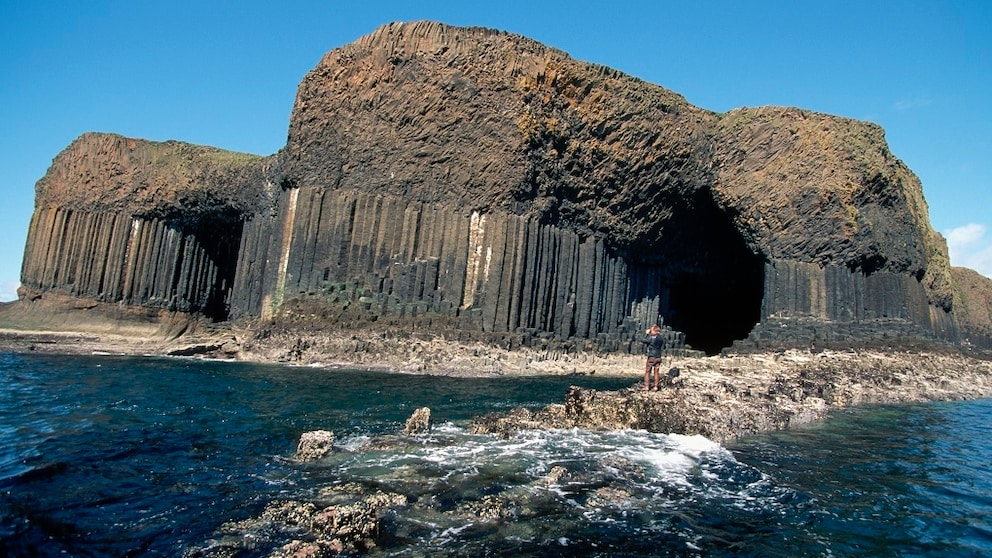
Already a cult site in Celtic times, Fingal’s Cave continues to captivate visitors with its hexagonal basalt stones. It has inspired numerous artists such as the German composer Mendelssohn and the British painter Turner and has been visited by figures like the writer Jules Verne and Queen Victoria. And then there’s the legend about the cave, which involves giants.
The Scottish island of Staffa, part of the Inner Hebrides, is essentially just a large rock jutting out of the stormy Atlantic off Scotland’s west coast. Yet it is home to one of the country’s most impressive natural wonders, which has inspired artists and writers for centuries: a mighty sea cave carved over millions of years by the tides into the soft basalt rock from which it is formed, with its miraculously hexagonal columns reminiscent of another natural wonder, the Giant’s Causeway in Ireland. Indeed, a legend involving giants also surrounds Fingal’s Cave, the name of the grotto.
A spokesperson for the official Scottish tourism agency Visit Scotland tells TRAVELBOOK that the massive sea cave was formed 50 to 60 million years ago by lava flows. These are the same flows that created the Irish Giant’s Causeway. That’s why both sites feature the unique hexagonal basalt columns that have always fascinated observers. “The power of the waves crashing against the rock formation shaped Fingal’s Cave over time.” From an originally small opening in the rock, the grotto we see today emerged over eons.

Inspiration for Artists and Writers
But it’s not just the bizarre rock formations that draw crowds of visitors; it’s also the unique acoustics in the cave. In Gaelic, Fingal’s Cave, which was likely an early Celtic cult site, was named “Cave of Melody.” The sound produced by the waves within the rock dome is described in various online sources as very impressive. It inspired artists long before the internet, such as the German composer Felix Mendelssohn Bartholdy. After visiting the natural wonder, he composed his “Hebrides Overture,” and he is far from the only one whose imagination was sparked by the cave.
Also interesting: St. Kilda – the island of bird people in the Atlantic
“Other famous visitors included Queen Victoria, Jules Verne, and Robert Louis Stevenson,” says the spokesperson. The writer Verne mentions Fingal’s Cave in several of his novels. Stevenson may have taken inspiration from his visit for his legendary pirate classic “Treasure Island.” Other famous poets and authors who visited the cave include Walter Scott (“Ivanhoe”) as well as William Wordsworth, John Keats, and Alfred Lord Tennyson. The most famous British painter, William Turner, immortalized his memories in the work “Staffa Fingal’s Cave.” The rock band Pink Floyd also mentions Fingal’s Cave in a never-released song for the film “Zabriskie Point.”
Bizarre Dispute Over This Uninhabited Rock in the Middle of the Sea
This Little-Known Adventure Travel Destination in Europe Is Now Award-Winning
Legend of Giants
This enduring fame is thanks to the British botanist Sir Joseph Banks, who visited Staffa in 1772 and subsequently promoted the beauty of the island and Fingal’s Cave. Perhaps the fascination with the cave also stems from the legend surrounding it. According to the website “Scotland Stories,” a mighty giant named Benandonner once lived in it. He was at odds with an Irish warrior named Fionn MacCumhaill, or Fingal for short. After challenging each other to a fight to the death, Fingal built a bridge from Ireland to the Scottish mainland: the Giant’s Causeway.
Also interesting: Massacre Cave – the Scottish cave of horrors
Benandonner then set out across it to destroy his enemy. When Fingal saw from afar how large his opponent was, he became frightened. He resorted to a trick to avoid the fight. His wife wrapped him in bed linens, and he lay in a giant cradle as if he were a baby. When Benandonner arrived and saw the supposed giant baby, he was struck with fear. If that was Fingal’s son, how large must the father be? So Benandonner returned to his cave in Scotland, which is ironically called Fingal’s Cave today. In doing so, he destroyed the Giant’s Causeway.
How to Visit Staffa
Those wishing to visit Staffa and the famous sea cave have several opportunities to do so. “The easiest way to reach the island is with one of the local tour operators such as Staffa Tours, Staffa Trips, and Turus Mara. The best season for this is from late March to September, when boats operate from Oban. However, the excursions are highly dependent on the weather conditions.” Staffa itself is uninhabited by humans but is home to a uniquely diverse wildlife. Puffins can be found here, as well as skuas and other species. In the waters around the island, seals, dolphins, whales, and sharks abound.
Also interesting: Ebenezer Place – the shortest street in the world in Scotland
“In the Inner Hebrides, visitors can expect picture-perfect villages and breathtaking beaches with crystal-clear water. Additionally, there are fascinating wildlife encounters and the freshest catch from the sea directly from the boat,” says the Visit Scotland spokesperson. The island group consists of a total of 35 inhabited and more than 40 uninhabited islets, including Staffa. Nevertheless, it is home to one of Scotland’s most unusual sites, Fingal’s Cave. Since 2001, the island has been specially protected as a nature reserve and is managed by the National Trust for Scotland. Currently, about 100,000 people visit Staffa each year.