

February 27, 2026, 10:05 am | Read time: 3 minutes
Standing in the middle of a lake—which sounds a bit like magic—is theoretically possible in southern Germany. Specifically, in Lake Constance. There you’ll find the so-called “Teufelstisch” (Devil’s Table). You can learn more about it at TRAVELBOOK.
Teufelstisch in Lake Constance
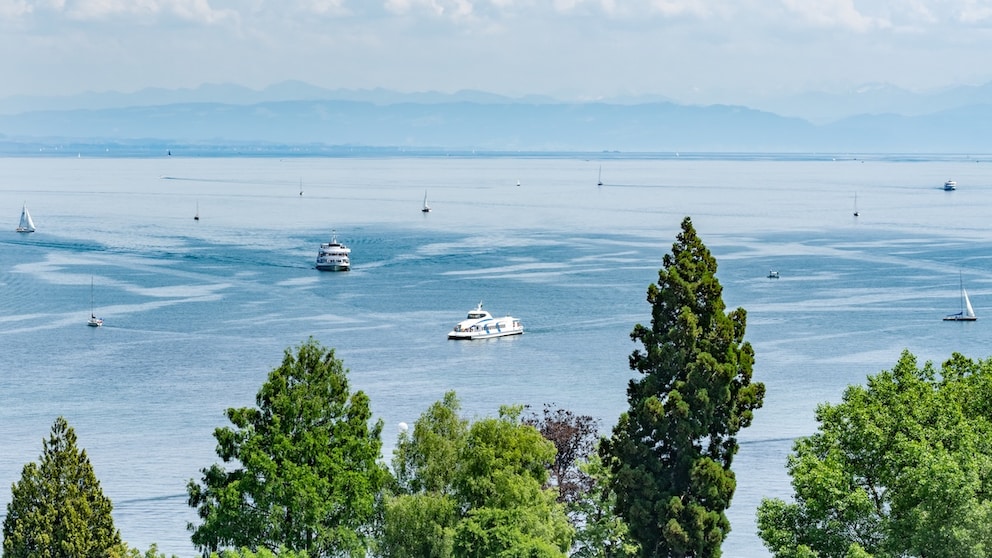
In Lake Constance, more precisely in Überlinger See, the northwestern part of the Upper Lake, lies the Teufelstisch. What initially sounds peculiar is nothing more than a rock formation in the water. However, it is special because it is a geological phenomenon that doesn’t occur very often.
The rock stands freely in the lake, about 50 meters from the shore, and has an area of about 160 square meters. The plateau visible from above is approximately 22 by 10 meters. Depending on the water level, it is about 1.5 meters below the surface, but during high water, it can be up to three meters—at low water, it may even rise above the water surface.
On the lake side, the wall of the column drops almost vertically to a depth of 90 meters. For Lake Constance, this is not an extraordinary number—as its deepest point measures 251 meters.


Researchers Discover Mysterious Underwater Wave in Lake Geneva
The 6 Most Spectacular Diving Spots in Germany
The Place Has Something “Devilish”
When you first hear about the Teufelstisch, you might wonder where the name comes from. Sandra Domogalla from the municipality of Bodman-Ludwigshafen explains to TRAVELBOOK that the name derives from its characteristic shape and the associated dangers. “The rock rises as an almost vertical needle about 90 meters from the lake bed and ends just below the water surface in a flat, table-like slab. At very low water levels, this slab shimmers greenish or even protrudes entirely from the water, resembling a table placed in the lake.”
The “devilish” aspect, on the other hand, is related to the dangers. “The place is notorious for its difficult visibility conditions. Among divers, it is considered one of the most dangerous spots in Lake Constance. The threatening atmosphere in dimmer light and the murky water convey the impression of a sinister, ‘devilish’ place,” Domogalla explains.
Diving is prohibited at the Teufelstisch. The reason is several fatal accidents in recent decades. The ban was imposed in 1994. However, an exception permit can be applied for if divers have sufficient qualifications and experience, according to the website of the Konstanz district.
Better to Observe Teufelstisch from Afar
While there is a ban for divers, this is not the case for swimmers. However, Sandra Domogalla warns: “Swimming there is extremely dangerous; there is no access from the land, and the hiking trail has not existed for years. The rock is only a few meters from the shore, but the terrain drops almost vertically both at the shore and at the rock itself.” There is no shallow entry or standing area.
She also warns that the spot is located in a narrow passage of the Überlinger See. Unpredictable currents often prevail there, according to Domogalla. Additionally, ships regularly pass by, which is life-threatening for swimmers.
“Even though there is no explicit ban for swimmers like there is for divers, this underscores the extreme danger of this place. There is no beach, no lifeguard, and no rescue possibility on site,” Domogalla points out the dangers.
Even though you often see photos from earlier times showing people standing on the rock at particularly low water levels, this is by no means recommended. Instead, the “spectacle” of the Teufelstisch, which is rarely observed throughout the year, should be viewed from a boat or the shore.