

July 4, 2026, 12:13 pm | Read time: 5 minutes
They stand for suffering, destruction, and immense human tragedies. Yet former battlefields and memorials worldwide are among the places that attract numerous visitors year after year. This phenomenon is called “Dark Tourism.” But what drives people to visit such places–and what value can engaging with their history have?
Why People Visit Places of Horror
“These places attract us because they evoke intense emotional reactions and provide a deeper understanding of human history,” says travel psychologist Christina Miro. Visiting such memorial sites can help develop compassion and mourning for the victims. “Especially concentration camp memorials remind us of the darkest chapters of human history and heighten awareness of the importance of peace and the protection of human rights.”
Even during a vacation, engaging with distressing topics, such as Dark Tourism, can be meaningful. However, it requires a conscious approach to one’s own limits. According to the psychologist, one can indeed face emotional challenges while traveling, “provided one is aware of it and knows one’s own resilience.” It is important to “maintain a balance between emotionally demanding experiences and personal well-being.”
Traces of War on the Beach of Dunkirk
On the northern French coast near Dunkirk, the ebb tide reveals an extraordinary relic on the beach of Zuydcoote. Rusty steel parts protrude from the sand–the remains of the British steamer “Crested Eagle.”
The ship was involved in “Operation Dynamo” at the end of May 1940, the large-scale evacuation of Allied troops during World War II. As the soldiers were encircled by the Wehrmacht, the only escape route was across the English Channel to England.
The “Crested Eagle” was bombed shortly after leaving Dunkirk and caught fire. More than 300 soldiers lost their lives. Today, the wreck is overgrown with mussels and green algae. At low tide, visitors can walk among the remains, while the sea completely covers them at high tide.
The shipwreck is a small open-air museum and serves as a reminder of one of the many war tragedies whose traces remain visible to this day.
Hiroshima–the Consequences of the Atomic Bomb
August 6, 1945, marks the deepest cut in Hiroshima’s history. On this day, the atomic bomb “Little Boy” detonated over the Japanese city. The ground temperature reached up to 4,000 degrees. Tens of thousands of people died immediately, with many more succumbing later to the effects of radiation.
The Hiroshima Peace Memorial Museum documents the events through photographs and personal belongings of the victims. Clothing, surgically removed glass shards, and other exhibits vividly convey the impact of the explosion. The quiet atmosphere in the exhibition rooms further enhances the impression.
Together with the nearby “Atomic Bomb Dome,” which remains preserved as a ruin and is now a UNESCO World Heritage site, the museum serves as a monument to peace.
A Destroyed City as a Warning
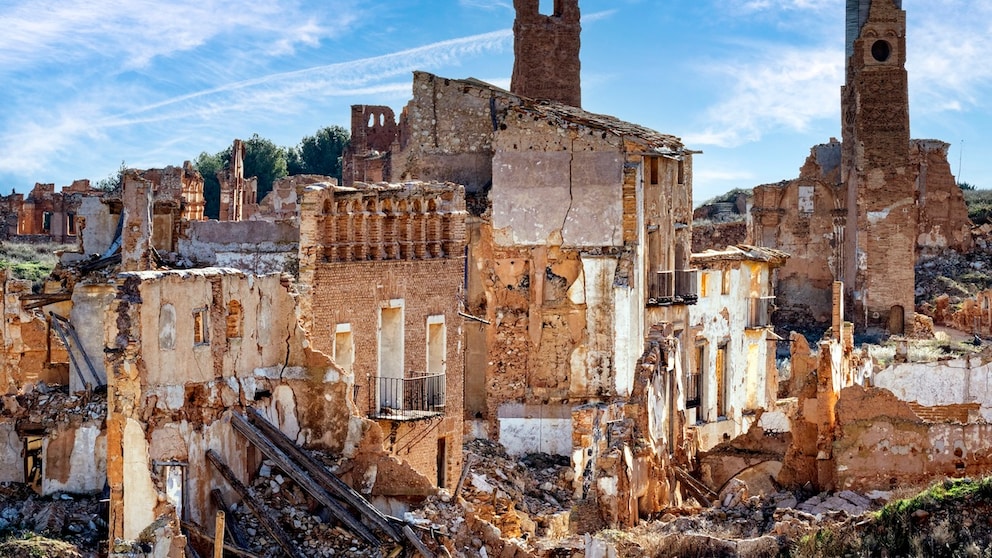
The Spanish town of Belchite in the Aragon region appears frozen in time. Decayed churches, destroyed houses, and collapsed walls recall the battles of the Spanish Civil War from 1936 to 1939.
During the Battle of Belchite in the summer of 1937, Republican troops attempted to halt the advance of the Nationalists and capture Zaragoza. The encircled Nationalist units offered fierce resistance for two weeks and held out despite bombardments.
The nearly completely destroyed town was deliberately not rebuilt. Today, visitors can participate in guided tours, and Belchite occasionally serves as a film set.
Also of interest: The 20 Most Impressive “Dark Tourism” Sites Worldwide
Memories of D-Day
On June 6, 1944, the Allied landings in Normandy marked one of the decisive military operations of World War II. German defensive installations, mined obstacles, and deep trenches turned the beaches into a deadly battlefield.
U.S. Lt. Gen. Omar Bradley later recalled: “All boats came under machine-gun crossfire. When the first men jumped off, they doubled up and fell into the water. Then everything went haywire. Some were hit and wounded in the water. Others drowned immediately.”
The landing sectors, with code names like Omaha Beach or Juno Beach, are still well-known today. Museums, monuments, and military cemeteries–including the German war cemetery at La Cambe–commemorate the events and their victims. Many of those buried there were barely 20 years old.

Why Cambodia Is Worth a Trip

A Walk to the Darkest Places in Estonia’s Beautiful Capital
The Legacy of the “Killing Fields”
Between 1975 and 1979, the Khmer Rouge under Pol Pot established a regime of terror in Cambodia. More than 300 sites became so-called “Killing Fields,” where mass murders were committed.
About 20 kilometers south of Phnom Penh lies Choeung Ek, the most well-known of these memorials. There, people were tortured, forced to confess, and then executed.
A Buddhist stupa with thousands of human skulls commemorates the victims. The Tuol Sleng Genocide Museum in Phnom Penh, located in a former school that was converted into a prison and torture center during the Khmer Rouge regime, complements the memorialization.
Srebrenica–Remembering the Genocide
During the Bosnian War from 1992 to 1995, the worst massacre in Europe since the end of World War II occurred in Srebrenica.
The Federal Agency for Civic Education describes the events as follows: “On July 11, 1995, Bosnian Serb units, led by military chief Ratko Mladić, captured the town of Srebrenica and killed over 8,000 Muslim Bosnians, men and boys, in the following days.”
The Srebrenica Memorial Center commemorates the victims with personal items from mass graves, giving them names and faces. Especially around the anniversary on July 11, the number of visitors increases significantly.
For travel psychologist Christina Miro, engaging with such places remains of great importance: “To learn from it and not repeat it.”
With material from dpa