

October 21, 2026, 8:11 am | Read time: 9 minutes
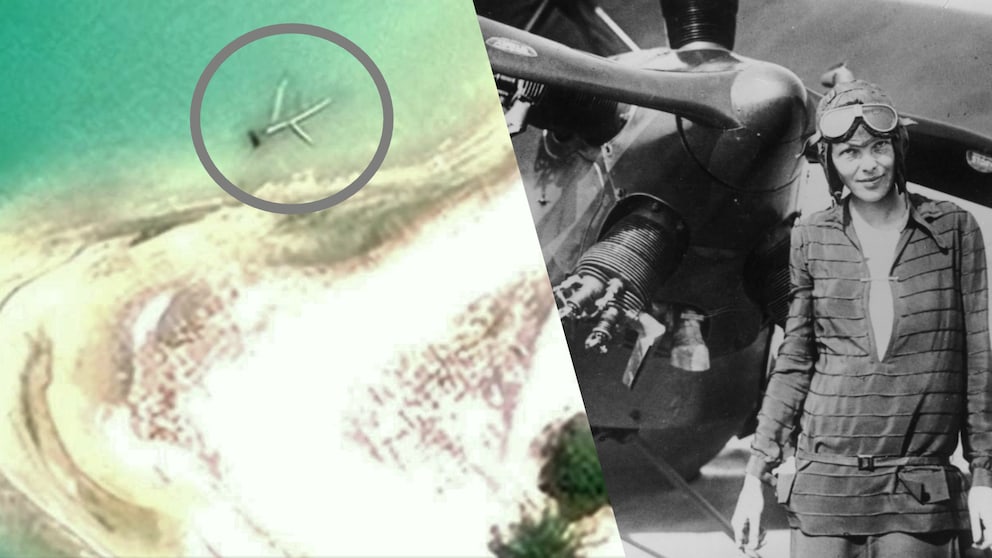
Eighty-nine years ago, the legendary American pilot Amelia Earhart disappeared over the Pacific and was declared dead. Some say she died when her plane crashed into the ocean, while others believe she was captured by Japanese soldiers. Hope for answers resurfaced this month: A research team set out for a remote atoll in the South Pacific, where a satellite image was thought to show Earhart’s plane and solve the mystery of her disappearance. However, it has now been confirmed that the once-promising discovery was merely driftwood.
Amelia Earhart was the first woman to fly across the Atlantic and was already a role model for American women during her lifetime. In 1937, at just 39 years old, she aimed to become the first woman to fly around the world at the equator. But during this endeavor, she mysteriously vanished. For the searchers, this is the second setback in a short time: In 2024, a sonar image of the supposed plane of the pioneer turned out to be a rock.
Overview
Six Years of Hope–and in the End Just Driftwood
The new expedition was triggered by a satellite image from 2020. It showed a long, metallic outline in the lagoon of the uninhabited atoll Nikumaroro in the island nation of Kiribati. According to BILD, it was about 12 to 13 meters long, almost as large as the fuselage and tail of Earhart’s Lockheed Electra 10-E. The “Taraia Object” was named after the peninsula where it was discovered.

The expedition was backed by Purdue University in Indiana. Earhart once worked there, and a university foundation had financed her “flying laboratory.” After the world circumnavigation, the plane was supposed to return to the university.
The search expedition was initially planned for November 2025. However, it was postponed due to a lack of permission from Kiribati and the onset of cyclone season. According to the “Times of India,” the costs were around $900,000. Compared to the $11 million for the sonar search in 2023 (which we report on below), it’s almost a bargain.
The Purdue University reports: In early October, the 17-member team set out from Tarawa, covering about 1,500 kilometers over sometimes rough seas. On Nikumaroro Island, they had to cut their way to the lagoon with machetes and chainsaws. Then, bad weather kept the researchers away from the shore for three days. After seven days on site, the result was clear: The object was nothing more than driftwood. All that remained was a Y-shaped piece that resembled a branch more than an aircraft tail. The shine apparently came from hardened coral sand. Nevertheless, the team does not want to give up.
Ric Gillespie was likely not surprised. The co-founder of the organization TIGHAR has been searching for Earhart on Nikumaroro for decades and had already searched the site twice with metal detectors. According to the “Guardian,” he suspected it was a tree even before the departure.
A Lot of Findings on Nikumaroro
Gillespie believes the island itself holds the key to the mystery. Earhart’s intended destination for her penultimate leg was Howland Island, a tiny island in the middle of the Pacific where she planned to refuel. However, she never arrived there. Gillespie’s theory: Amelia Earhart did not crash into the ocean but managed to make an emergency landing on Nikumaroro, about 650 kilometers southeast of Howland. The atoll is just barely above sea level, only 6 kilometers long and 2 kilometers wide. The small island is completely surrounded by a coral reef. According to Gillespie’s theory, Earhart landed on this reef, managed to get ashore, and survived there for a few days.

Several pieces of evidence support this: A week after Earhart’s disappearance, Navy pilots found signs that someone had recently set up camp on the coast. A year after Earhart’s disappearance, a small group of Britons settled on the previously uninhabited island. In 1940, these settlers found parts of a woman’s shoe, an empty sextant box (navigation devices also used in aircraft), and a bottle of a French liqueur brand that Earhart reportedly enjoyed. The shoe was later identified as a brand Earhart wore.
In the same year, a human skull and skeleton were also found on the island. A doctor in Fiji examined the bones and believed they belonged to a man, but they were later lost. In 2018, U.S. anthropologist Richard Jantz re-evaluated the old measurements using modern methods and concluded that the bones could very well be Earhart’s. However, the study was also criticized, as old photos cannot be considered sufficient evidence.
The Purdue team did not return empty-handed either: In the lagoon, they found a steel tube about 76 centimeters long, which is now being examined. Others are searching for the plane where Earhart was supposed to land: on the seabed off Howland Island.
Setback Already in 2024 During Expensive Sonar Search
Hobby researcher Tony Romeo is also involved. For a short time, it even seemed as if he had succeeded in his search for Earhart’s unmistakable plane. He returned from a roughly 100-day sea voyage in December 2023 with a sonar image that he believed showed the missing plane in the depths of the ocean. In an interview with “Business Insider,” the former U.S. Air Force intelligence officer revealed that he had always been fascinated by Amelia Earhart’s story.
Romeo’s expedition began in September 2023 in Tarawa, another atoll in the Pacific Ocean. The 16-member research crew used a $9 million unmanned high-tech diving drone to survey an area of the seabed of more than 13,000 square kilometers. About a month after the journey began, the diving drone recorded a sonar image of an airplane-shaped object–about 160 kilometers off Howland Island. However, the team only discovered the image on the 90th day of the journey, making a return for closer inspection impractical.
On November 1, 2024, Tony Romeo confirmed to the “New York Post” that the supposed breakthrough, after taking new sonar images, turned out to be a rock formation shaped like an airplane. Romeo, who had sold all his commercial properties to finance the search, remains optimistic despite the setback. “The worldwide response to our initial discovery was truly inspiring, a testament to Amelia and the allure of her incredible story.”

This German Was the First Person to Drive Around the World

In the “Nevada Triangle,” 2,000 airplanes have already disappeared.
The Last Hours Before the Disappearance
Earhart’s route was supposed to take her from Miami over Puerto Rico, Venezuela, and Brazil across the Atlantic to Senegal. It was then to continue over Sudan, Ethiopia, India, Myanmar, and Papua New Guinea, always along the equator. The last leg on the way to her final destination, Hawaii, was to be the most dangerous, as the route led entirely over the Pacific Ocean. On the way over the vast waters, Earhart planned to stop only once, on Howland Island, which was then a U.S. territory near present-day Kiribati. But the pilot never reached her destination.

Her last radio transmissions were desperate: She and her navigator Noonan could not find the island’s coordinates, fuel was running out, and radio contact was lost. When no ship in the vicinity managed to re-establish contact, a massive fleet was immediately dispatched to search for Earhart. At the time, it was the most expensive and extensive rescue operation in U.S. Navy history, with dozens of warships and aircraft involved. But it was in vain. A few weeks later, Earhart was declared dead by her husband. The most likely cause of death: The plane crashed into the Pacific, and the two pilots died on impact or by drowning. Some adventurous theories suggest that Earhart and Noonan were captured by Japanese soldiers (the Pacific War was already underway in 1937). However, there is no evidence for this. The third theory remains: the emergency landing on Nikumaroro.
Gillespie believes that Earhart managed to save herself from the reef to the land and survived there for a few days. At night, when the tide came in, she is said to have swum to the plane and tried to send distress signals for several days.
Earhart’s Calls for Help on the Radio
These transmissions are not Gillespie’s speculation but were reportedly received at several U.S. military stations and, according to dozens of reports, also heard on U.S. radio. Several women reported hearing Earhart’s calls for help in the middle of a radio broadcast at home in their living rooms. At the time, more than 120 such reports were received by authorities from private households and official search teams, more than half of which were considered credible and consistent in content. There are careful, written transcriptions of all the transmissions heard. Several military stations at the time believed the transmissions originated from Nikumaroro–then known as Gardner Island. Gillespie has collected and meticulously analyzed all the transmissions over the years. He has made the report on his findings freely accessible online.
The transmissions paint a picture of Earhart’s desperate situation: In one transmission, she reports how the water around the plane is rising and that she cannot hold out much longer. In another, she states that her companion is severely injured and in urgent need of medical help. In yet another transmission, Earhart allegedly even gave her coordinates. The listener who accidentally overheard this reportedly lost the note.
Gillespie organizes the transmissions in his report and concludes that the pattern of intervals in which Earhart remained silent and those in which she transmitted suggests that Earhart only turned on the plane’s engines during low tide to be able to transmit. Additionally, the transmissions from the first few days described the plane as “surrounded by water,” while the subsequent transmissions were distress calls in which Earhart reported that the plane was half on land, half underwater. In the last recorded transmissions, it was testified that the plane was almost completely submerged in the ocean.