

June 30, 2026, 5:08 am | Read time: 5 minutes
Almost arrested, and in Latin America no less? TRAVELBOOK author Julia Mähl traveled through Colombia and nearly got arrested. She reveals what happened and how dangerous she really thinks the country is.
How dangerous is a trip through Colombia really? If someone were to ask me that today, after six weeks of backpacking through the country, I wouldn’t have to think long: In my opinion, anyone who follows certain dos and don’ts won’t have any trouble in Colombia. With one small caveat. Because something happened to me and my travel companion in the first week of our trip that somewhat contradicts this.
Welcome to Colombia’s Coffee Zone
It was our second stop on the trip. We had just taken the bus from Bogotá to Salento, spent the first night there, and were enchanted by the small town in the middle of Colombia’s coffee zone. Colorful facades, small restaurants, shops, and the best coffee: A real oasis of calm after the bustling capital. At least briefly. Because we arrived in the middle of “Semana Santa,” the Spanish Holy Week, which is one of the biggest holidays of the year in Colombia. And while everything goes its normal course at the beginning of the week, the celebrations reach their peak on Good Friday, Holy Saturday, and Easter Sunday.
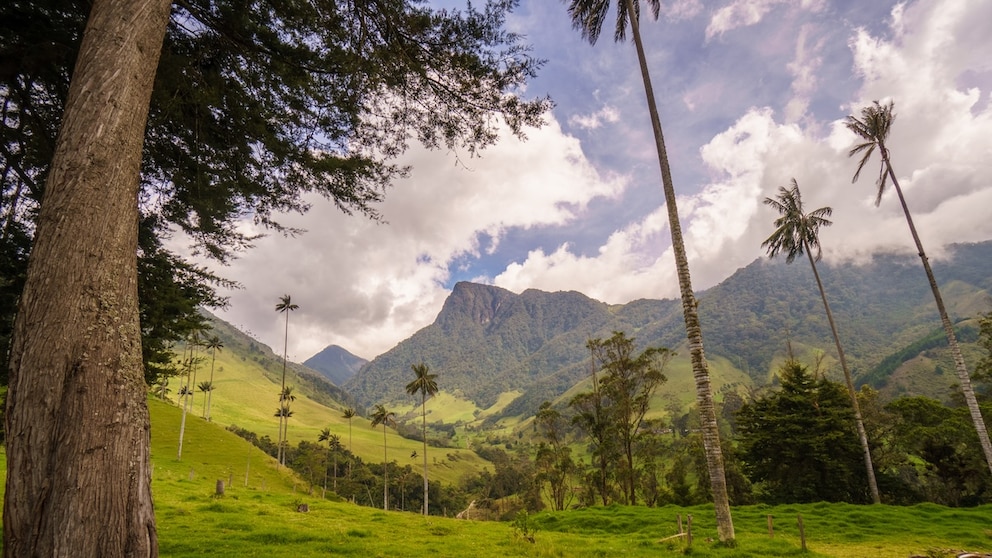
One of the main attractions around Salento is the famous “Valle de Cocora” with its tall palm trees that grow up to 60 meters high. Definitely a point on our Colombia bucket list, which is why we decided to visit the valley the next day. To avoid the tourist crowds, the hotel owner recommended we start hiking early in the morning and suggested a route that was less frequented than the rest of the region. With one note: Due to “Semana Santa,” some paths in the nature reserve were closed. If that were the case, we would have to turn back.

The Ideal Travel Route Through Colombia

5 Places in Colombia You Shouldn’t Miss
Border Checks and Communication Problems
So far, so good. The next morning we set off, took the jeeps to “Valle de Cocora,” started at the right spot, followed the path, and passed all the stops our hotel owner had told us about. Eventually, we reached a checkpoint where a small fee was required to continue. We paid, passed, and continued hiking. Until finally, about two hours later, nearly at the end of our loop and just before the famous palms, we arrived at a second checkpoint that also required a fee. We had heard about this in advance. But just as we were about to pay, two armed police officers stopped us. They asked us in Spanish if we had a permit for the direction we had come from. Of course, we didn’t.
What followed was nearly an hour of communication problems as we tried to figure out what we had done wrong and what to do next. During this time, the officers took our personal information, told us about a kind of “lesson” we needed to learn, and said we wouldn’t be allowed to leave Colombia until the matter was resolved. They also made it clear that we had likely walked on the closed path the hotel owner had mentioned. This meant we had broken a law and committed an offense.
In the six weeks in Colombia, I never worried—except at that moment. And the fact that it wasn’t a dark street corner or a nighttime walk home, but rather a hiking trail in broad daylight, where it happened, wasn’t on my bingo card.
Would a Bribe Have Been Appropriate Here?
In hindsight, I’m almost sure we could have solved the problem quickly with some cash. It’s a real cliché: the image of corrupt police officers in Latin America who can be persuaded to impose a milder penalty with the right amount of money. But I kept hearing during our subsequent travels that it did work. Only at that moment, in the middle of Valle de Cocora, we were too perplexed and overwhelmed to even think of it.
After the two officers detained us for a while longer, noted our personal information, took fingerprints, and instructed us to come to the town hall the following Monday after “Semana Santa” for further instructions, we were finally allowed to leave.
The problem: At the time of our hike, it was only Thursday, so we had to endure an entire weekend without being able to travel further and without shaking off the fear of possibly being arrested at the next airport or passport control.
In the end, we were fortunately able to resolve the whole thing. Although, “resolve” is actually saying too much. Because when we appeared at the town hall on Monday, none of the employees had ever heard of this incident. We also didn’t appear in the crime database. The police probably wanted to make an example of us and scare us, they speculated—and sent us home.
The whole incident was something we wouldn’t forget quickly—but fortunately, it didn’t prevent us from leaving the country. We were lucky.